
Non-FictionStartup GuideWaitlist Strategy
Pre Launch Waitlist Workbook eBook
Build an engaged email waitlist of 1000 potential
Build an engaged email waitlist of 1000 potential users before writing code using landing pages, content upgrades, and referral incentive systems.
Formats
Free sample
Chapter 1: The 42% Lie--Most founders are building the wrong thing.Not because their idea is bad. Not because they lack skill. Not because they don't work hard enough. They are building the wrong thing because they are building anything at all before they have proven that someone—anyone—will pay for it.Let me show you the number that should terrify you.CB Insights, after analyzing over one thousand startup failures, published a breakdown of why promising companies die. The number one cause?
Not running out of money. Not getting outcompeted. Not team drama. Forty-two percent of failed startups cited one reason above all others: no market need. They built something that nobody wanted.Read that again.
Forty-two percent.That means for every ten founders who pour their nights, weekends, savings, and sanity into building a product, four of them will discover—after months or years of work—that the silence they heard during development was not a temporary condition. It was the market's final answer.Code did not save them. Features did not save them. A beautiful logo, a pitch deck, a patent, a celebrity advisor—none of it saved them. Because you cannot fix a lack of customers with better engineering.This book exists to make sure you are not one of those forty-two percent.But here is what makes this different from every other "validate your idea" book you have seen.
I am not going to tell you to "talk to customers" (though you should). I am not going to tell you to "run a survey" (though that helps). I am going to give you a specific, repeatable, no-code system to build a waitlist of one thousand engaged, eager potential users before you write a single line of production code.Not passive subscribers who forget they signed up. Not social media followers who double-tap and scroll past. Engaged humans who have given you their email address, opened your updates, referred their friends, and—in many cases—paid a refundable deposit to hold their spot in line.And here is the promise of this book: if you cannot build that waitlist, you should not build the product.That sounds harsh.
Let me explain why it is actually the most compassionate thing anyone will tell you about your idea.The Trap That Catches Smart Founders There is a belief embedded so deeply in startup culture that most founders never question it. You have heard it a thousand times. It sounds like wisdom. It sounds like grit. It sounds like every motivational speaker who never actually built a company."If you build it, they will come."Field of Dreams was a movie about a farmer who hears a ghost and plows under his corn to build a baseball diamond.
It was a beautiful film. It is a catastrophic business strategy.Here is what actually happens when you build first and ask questions later.You get excited about an idea. The idea feels brilliant at 2 AM. You start designing. Then you start coding.
Then you start telling friends, who say "that sounds cool" because they are nice and do not want to hurt your feelings. You interpret their politeness as validation. You build faster. You add features. You polish the UI.
You file for an LLC. You buy the domain. You design a logo. You obsess over gradient colors and button shadows.Months pass. Thousands of dollars disappear.
Hundreds of hours vanish.And finally, nervously, you launch.You post on Product Hunt. You tweet the link. You email your friends. You wait.A trickle of visitors. A few signups.
Then nothing.You check analytics obsessively. You refresh the page. You convince yourself that the problem is marketing, not the product. You buy ads. You hire an agency.
You double down.The numbers do not move.Eventually, quietly, you admit what you knew three months earlier but could not face: nobody wants this. Or at least, not enough people want it enough to pay for it.That is the 42% lie. Not that the statistic is wrong—it is devastatingly accurate. The lie is that you have to experience it yourself to learn the lesson.You do not. You can learn it from this chapter, right now, and save yourself a year of your life.The Inversion That Changes Everything What if you did the opposite?What if you refused to build anything until you had one thousand humans on a waitlist, actively telling you they want what you plan to make?What if you treated "I will build it" not as the first step but as the last step—the reward you give yourself after proving demand?This is not theory.
This is not motivational fluff. This is how Superhuman built a waitlist of over two hundred thousand people before launching their email client. This is how Robinhood accumulated one million people on a waitlist before they allowed a single trade. This is how Clubhouse (before its decline) used invite-only exclusivity to manufacture demand that outpaced their server capacity.These companies did not guess. They did not hope.
They built a machine that produced proof before they produced code.And you can build the same machine. Not in a year. Not in six months. In ninety days, following the chapters of this book, you can go from an idea to a waitlist of one thousand engaged potential users.But first, we need to be clear about what "engaged" actually means. Because most founders celebrate the wrong metrics, and that celebration leads directly to the 42% graveyard.The 1,000 True Fans Reality Check Kevin Kelly, the founding editor of Wired magazine, wrote an essay in 2008 that has become scripture for independent creators.
His argument was simple: you do not need millions of customers. You need one thousand true fans. A true fan is someone who will buy anything you make. They will drive to your show. They will buy the deluxe edition.
They will tell their friends.Kelly's essay was about artists, musicians, and writers. But the principle applies brutally well to pre-launch founders.One thousand engaged beta users who open your emails, respond to your surveys, refer their colleagues, and eventually convert to paying customers are worth more than ten thousand passive subscribers who forgot they signed up thirty seconds after entering their email address.Let me prove this with math.Ten thousand passive subscribers, at a typical 2% conversion rate, become two hundred customers.One thousand engaged users, at a typical 15% conversion rate (because engagement predicts purchase intent), become one hundred and fifty customers.The passive list is larger by fifty customers. But look at the effort required. The passive list required you to collect ten thousand emails—through ads, giveaways, or low-friction forms that attracted tire-kickers. The engaged list required you to collect one thousand emails from people who actually care.
The engaged list will give you better feedback, lower churn, higher lifetime value, and more referrals.Quality over quantity is not a cliché. It is a mathematical advantage.But here is where most resources get it wrong. They tell you to chase subscribers. They tell you to optimize for volume. They sell you courses on "how to grow your email list to 100,000 fast."That advice…
This is the end of the free sample. Get the eBook to keep going. Buy now
About this book
Details
- Author
- Gerber Jerrica
- Publisher
- SamEnrico
- Language
- English
- Genre
- Non-Fiction, Startup Guide, Waitlist Strategy
- Released
- 2026-05-29
- Pages (approx.)
- 138
- Available as
- eBook, Audiobook

Read better in the ZLOADR app
Your eBooks on your phone or tablet. Sign in with your SamEnrico account and start reading.
More by Gerber Jerrica
 Menopause Palpitations GuideGerber Jerrica$11.99
 Workaholism In Healthcare WorkersGerber Jerrica$11.99
 The Internal Trigger MapGerber Jerrica$11.99
 Loyalty Program PricingGerber Jerrica$12.99
 Pistol Annies Hell on Heels GuideGerber Jerrica$11.99
 Diverse Teams Creative Edge GuideGerber Jerrica$11.99
 The Jade Serpent's Curse: A Dragon's Vengeance in the Forbidden CityGerber Jerrica$11.99
 The Silent Codebreakers: How a Group of Women Cracked the Nazi's Secret MessagesGerber Jerrica$11.99
 Understanding Frontonasal Dysplasia Phocomelic Upper LimbsGerber Jerrica$17.99Loyalty Program PricingGerber Jerrica$12.99
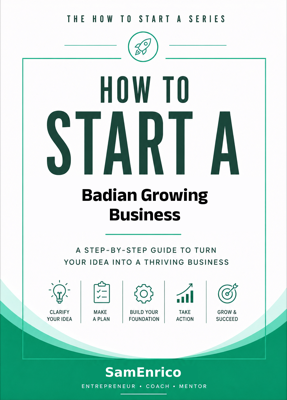 How to Start a Badian Growing Business (Beginners Guide)Gerber Jerrica$11.99
 Applied Generative AI for Business SolutionsGerber Jerrica$11.99
You may also like
 Hong Kong Handover 1997Dunn Johnnie$11.99
 Zumba For Postnatal Recovery CourseNeal Christian$11.99
 Zumba for BeginnersLadner Nikia$11.99
 YouTube Comment Mining GuideHumes Pandora$12.99
 Worry Box MeditationCarlin Rudy$11.99
 Workplace Stress MeditationNguyen Lynn$11.99
 Workplace Stress and Sleep RepairHawley Ivory$11.99
 Workplace Perfectionism CureDelaney Jeffry$11.99
 Workplace Injustice Anger GuideWallen Isabelle$11.99
 Work Addiction and Burnout LinkGreenwood Ester$11.99
 Women in Yoga and WellnessBeattie Galina$11.99
 Women in Stand Up ComedyChun Evangeline$11.99