
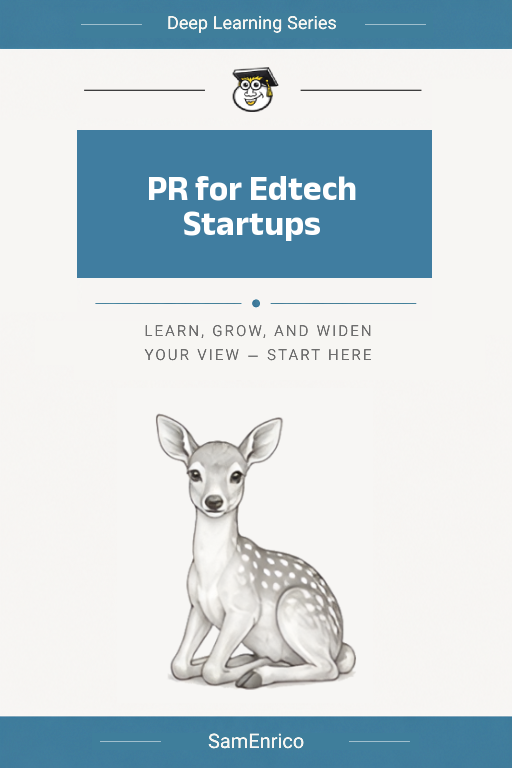
Non-FictionStartup GuideMedia Outreach
PR for Edtech Startups eBook
Get edtech media coverage on zero budget. Educatio
Get edtech media coverage on zero budget. Education and learning publication pitching.
Formats
Free sample
Chapter 1: The Trust Threshold--–- The email arrived at 6:42 AM on a Tuesday. Sarah, a reporter for a mid-sized education publication, had been awake since 5:30, grading papers from her side job as a substitute teacher. She opened her inbox to find 147 new messages. One hundred and thirty-two of them were pitches from companies she had never heard of. Most began with some variation of "I hope this email finds you well." Most were deleted without being read.
Three made it past her first pass. One—from a first-time founder with no PR budget and no agency—actually made her smile. That founder had done something the other 131 had not. That founder had read the room.This chapter is about becoming that founder.The Education Journalism Paradox Here is something most PR books will not tell you: education journalism is fundamentally different from every other beat. A tech reporter at Tech Crunch is rewarded for speed and novelty.
A business reporter at the Wall Street Journal is rewarded for exclusives and financial impact. But an education reporter? They are rewarded for something far messier, far harder to fake, and far more aligned with your zero-budget reality: credibility.Education journalists are, in large part, former educators. According to the Education Writers Association, nearly 40 percent of education reporters have worked in a classroom. Many maintain teaching credentials.
Almost all of them have deep, personal relationships with the teachers, administrators, and parents who read their work. This means they do not think like generalist reporters. They think like people who have stood in front of thirty restless fourth-graders on a Friday afternoon. They know what works in theory. They have seen what fails in practice.This creates a paradox that frustrates most edtech founders.
The very thing that makes education journalism difficult to crack is the same thing that makes zero-budget PR possible. Because journalists are skeptical of paid influence, your lack of a marketing budget is not a disadvantage. It is a signal. It tells the reporter that you are not backed by venture capital trying to manufacture hype. It suggests, rightly or wrongly, that you are operating on the same shoestring as the teachers you claim to serve.Consider the difference between two hypothetical pitches.
The first comes from a well-funded startup with a PR agency. It includes a polished press release, a link to a glossy media kit, and a quote from the CEO that uses words like "revolutionize" and "paradigm shift." The second comes from a solo founder with no budget. It includes a plain-text email, a link to a Google Drive folder with three i Phone photos, and a quote from a teacher who used the product to help a student learn to read. Which one do you think the former teacher turned reporter is more likely to open?The answer is obvious, and yet most edtech founders get it wrong. They assume that more money leads to better coverage.
They assume that a professional press release is superior to an authentic email. They assume that journalists are impressed by big names and bigger budgets. Every single one of these assumptions is false in education journalism.What 600+ Journalists Actually Said Over the past several years, multiple organizations have surveyed education journalists about their preferences, pet peeves, and priorities. The Muck Rack State of Journalism report, the Cision Global State of the Media report, and the Education Writers Association's internal surveys have produced remarkably consistent findings. While the exact numbers vary by year, the trends are unmistakable.First, education journalists receive an average of 50 to 100 pitches per week.
During back-to-school season, that number can triple. The vast majority of these pitches are deleted within five seconds. The most common reasons for deletion are: irrelevant subject lines (73 percent), obvious copy-paste errors (68 percent), and a complete lack of personalization (81 percent). If you send a pitch that begins "Dear Journalist" or fails to reference any of the reporter's previous work, you have already lost.Second, education journalists overwhelmingly prefer pitches that include original data, even if that data comes from a small sample size. According to a 2023 survey by the Education Writers Association, 87 percent of education reporters said they were more likely to cover a story that included original research or pilot study results.
Only 12 percent said the same about product announcements. This is a critical insight for zero-budget founders. You do not need a randomized controlled trial with thousands of students. You need a before-and-after comparison from a single classroom. You need a teacher who tracked progress for four weeks.
You need a parent who documented their child's struggle and breakthrough. That is original data. That is gold.Third, education journalists actively avoid stories that feel like paid placements. When asked to identify their biggest frustration with PR professionals, the top response (cited by 64 percent of respondents) was "pitches that are clearly just repurposed press releases." The second most common response (58 percent) was "exaggerated claims that cannot be verified." This is where your zero-budget status becomes a strategic asset. Because you cannot afford to manufacture hype, you are forced to lead with truth.
And truth, in education journalism, is the only currency that matters.Fourth, and most encouragingly for founders with no budget, education journalists are far more likely to respond to a pitch that comes directly from a founder or educator than one that comes from an agency. According to Muck Rack's 2024 report, 71 percent of journalists said they preferred direct contact from sources over agency-filtered pitches. The reasons cited included faster response times, more authentic voices, and fewer layers of approval. You do not need a PR firm. You need a story and an email address.The Trust Threshold: A Working Definition Let me introduce a concept that will appear throughout this book: the Trust Threshold.
The Trust Threshold is the invisible line every pitch must cross before a journalist will invest time in your story. Below the threshold, you are spam. Above the threshold, you are a potential source. Crossing the threshold has nothing to do with your budget, your logo, or your investor list. It has everything to do with three factors: relevance, evidence, and voice.Relevance means your story connects directly to something the journalist has already covered or something their audience is currently asking about.
If a reporter has spent the last six months writing about the teacher shortage, your pitch about a tool that reduces burnout is relevant. Your pitch about a gamified math app is not. Relevance is not about your product. It is about the reporter's beat.Evidence means you can point to something real. Not a promise.
Not a roadmap. Not a testimonial from your mother. Real evidence looks like: a spreadsheet of pre- and post-test scores from a pilot with 15 students, a two-minute video of a teacher explaining how your tool saved them four hours a week, a permission slip from a parent allowing you to share their child's progress. Evidence does not need to be perfect. It needs to be authentic.Voice means you sound like a human being who has actually been inside a classroom or spoken to someone who has.
Journalists can spot corporate boilerplate from fifty paces. They have seen "leveraging synergistic solutions" a thousand times. They have never…
This is the end of the free sample. Get the eBook to keep going. Buy now
About this book
Details
- Author
- Ashmore Lashandra
- Publisher
- SamEnrico
- Language
- English
- Genre
- Non-Fiction, Startup Guide, Media Outreach
- Released
- 2026-05-28
- Pages (approx.)
- 148
- Available as
- eBook, Audiobook

Read better in the ZLOADR app
Your eBooks on your phone or tablet. Sign in with your SamEnrico account and start reading.
More by Ashmore Lashandra
 Validation For DisabilityAshmore Lashandra$11.99
 The Parent Anger Support GroupAshmore Lashandra$11.99
 ED Assessment GuideAshmore Lashandra$11.99
 Underearners Anonymous Step GuideAshmore Lashandra$11.99
 The MO Learning Curve GuideAshmore Lashandra$11.99
 The Beast of Gévaudan: France's Unstoppable WolfAshmore Lashandra$11.99
 MillinerAshmore Lashandra$11.99
 Register .eu Domain GuideAshmore Lashandra$12.99
 The Breeder's Guide to Orpington ChickensAshmore Lashandra$11.99
 How to Become a Outsole SchedulerAshmore Lashandra$11.99
You may also like
 Hong Kong Handover 1997Dunn Johnnie$11.99
 Zumba For Postnatal Recovery CourseNeal Christian$11.99
 Zumba for BeginnersLadner Nikia$11.99
 YouTube Comment Mining GuideHumes Pandora$12.99
 Worry Box MeditationCarlin Rudy$11.99
 Workplace Stress MeditationNguyen Lynn$11.99
 Workplace Stress and Sleep RepairHawley Ivory$11.99
 Workplace Perfectionism CureDelaney Jeffry$11.99
 Workplace Injustice Anger GuideWallen Isabelle$11.99
 Work Addiction and Burnout LinkGreenwood Ester$11.99
 Women in Yoga and WellnessBeattie Galina$11.99
 Women in Stand Up ComedyChun Evangeline$11.99