
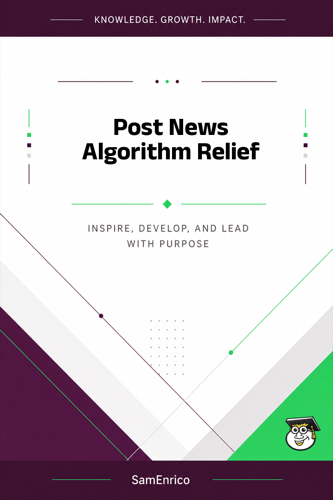
Post News Algorithm Relief eBook
Examines news-focused social without comparison.
by Guy Danelle
Examines news-focused social without comparison.
Formats
Free sample
Chapter 1: The Morning Ritual--It is 6:47 AM. The alarm on your phone has not yet gone off, but you are already awake. Not because you slept well—you didn't—but because your hand, operating on a neural pathway so deeply grooved it feels involuntary, has reached for the device on your nightstand. You tell yourself you are just checking the time. But the time is not what your thumb is hunting for.The screen lights up.
Before your eyes have fully adjusted to focus, before the fog of sleep has lifted from your frontal cortex, you see them: three notifications. A breaking news alert about a political crisis in a capital city you have never visited. A push notification from a social media app telling you that someone has replied to a comment you made twelve hours ago. A headline from a news aggregator with a phrasing designed to imply that something terrible is happening and you are only just now learning about it.Your heart rate increases. Not dramatically—not like a sprint or a shock.
But measurably. A clinician with a heart rate monitor would see the spike: from fifty-eight beats per minute to seventy-three in the span of two seconds. Your body does not know the difference between a notification about a war and a tiger in the room. Cortisol, the stress hormone, begins to diffuse into your bloodstream. You are not afraid.
But your body is.You scroll.And in that scroll—in those first ninety seconds of wakefulness—you have already lost the first battle of the day. Not because you are weak. Not because you lack discipline. But because you are a human being with a normally functioning brain, and you are up against a machine that was designed by some of the brightest engineers in the world to do exactly this: to capture your attention before you have even decided to give it.This is the Morning Ritual. And it is killing you slowly.Welcome to the Social Scoreboard Let us name what is happening in that 6:47 AM scroll, because naming is the first step toward liberation.
You are checking your position on the Social Scoreboard—an invisible but painfully felt ranking system that measures, quantifies, and displays your standing relative to every other person in your digital orbit. The Scoreboard has many columns: Who knew the news first? Who had the most righteous take? Who shared the most compelling article? Who commented with the wittiest indignation?
Who was silent when they should have spoken? Who spoke when they should have been silent?The Scoreboard did not always exist. There was a time—not so long ago, historically speaking—when the news arrived at predictable intervals. The morning newspaper on the doorstep. The evening broadcast at six-thirty.
The radio update on the hour. You consumed the news, and then you went about your day. You might discuss it with a coworker or a spouse. You might write a letter to the editor, which would be published days later, if at all. But you did not perform your relationship to the news in real time, and you certainly did not compare your performance to anyone else's.That world is gone.
It was replaced by something that looks like connection but functions like a competitive sport.The transformation happened in stages. First came the blogosphere in the early 2000s, where anyone could publish their thoughts. Then came social media platforms—Facebook (2004), Twitter (2006), Reddit (2005), Tumblr (2007), Instagram (2010), Tik Tok (2016)—each one adding new layers of quantification. The "Like" button appeared in 2009, a seemingly innocuous feature that turned out to be one of the most consequential UI decisions in human history. Suddenly, your thoughts had a score.
Your photo had a score. Your joke had a score. Your outrage had a score.But the real turning point was the shift from the "Like" to the "Share." A Like is passive. It says I noticed this. A Share is active.
It says I endorse this, and by endorsing it, I am telling you something about who I am. The Share turned news consumption into identity performance. When you share a story about climate change, you are not just distributing information. You are announcing: I am the kind of person who cares about the planet. When you share a story about political corruption, you are announcing: I am the kind of person who cannot be bought.
When you do not share a story about a humanitarian crisis, you are implicitly announcing—at least to the anxious committee in your head—I am the kind of person who looked away.This is the mechanism of the Social Scoreboard. It is not a literal leaderboard posted on a wall. It is a felt sense, an ambient awareness, a low-hum anxiety that lives in your chest and whispers: Everyone else is doing better than you. Everyone else is more informed. Everyone else is more virtuous.
Everyone else is faster, smarter, angrier in the right ways, calmer in the right ways, and definitely more articulate than you would be if you tried to post right now.The voice is lying. But the voice is persistent.Defining Newsfluence We need a word for this specific kind of anxiety, because general terms like "stress" or "FOMO" do not capture its texture. Let us introduce that word now: Newsfluence.Newsfluence is the anxiety that arises when you compare your raw, confused, incomplete, behind-the-scenes processing of current events to the curated, confident, performative understanding displayed by others online. It is the feeling of seeing a friend post a perfectly structured thread about a complex geopolitical crisis and thinking: How do they already have an opinion? How do they already know the names of the key players?
How do they already know which side to be on? What is wrong with me?Newsfluence has three distinct components, each of which we will explore throughout this book.The first component is information inferiority—the belief that everyone else knows more than you do. This belief persists even when you are objectively well-informed. It is not about actual knowledge; it is about perceived knowledge. The problem is that you see the highlights of everyone else's information consumption (the polished post, the shared article, the insightful comment) while you see the full, messy reality of your own (the confusion, the ignorance, the half-remembered fact from a podcast you only half-listened to).
This asymmetry is not your fault. It is a structural feature of how information is displayed online. But it feels like a personal failure.The second component is virtue anxiety—the fear that you are not responding correctly to the moral demands of the moment. A disaster occurs. A politician does something terrible.
A social injustice is exposed. The algorithm surfaces these events immediately, often before the facts are fully known. And in that gap between event and understanding, there is immense pressure to perform the right emotion. To be angry enough. To be sad enough.
To be outraged in the proper direction, with the proper intensity, for the proper duration. Virtue anxiety is the fear that your emotional performance will be judged insufficient.The third component is temporal panic—the fear that you…
This is the end of the free sample. Get the eBook to keep going. Buy now
About this book
Details
- Author
- Guy Danelle
- Publisher
- SamEnrico
- Language
- English
- Genre
- Non-Fiction, Self-Help
- Released
- 2026-06-06
- Pages (approx.)
- 152
- Available as
- eBook, Audiobook

Read better in the ZLOADR app
Your eBooks on your phone or tablet. Sign in with your SamEnrico account and start reading.
More by Guy Danelle
 Depression Peer Specialist GuideGuy Danelle$11.99
 Visceral Fat Insulin ResistanceGuy Danelle$11.99
 The International Aid Fraud GuideGuy Danelle$11.99
 Financial Due Diligence GuideGuy Danelle$12.99
 The Four Days' Fury: How the Dutch Outwitted the English Fleet (1666)Guy Danelle$11.99
 Cloud Automation EngineerGuy Danelle$11.99
 How to Become a Pot BuilderGuy Danelle$11.99Financial Due Diligence GuideGuy Danelle$12.99
 Learn to Play the KavalGuy Danelle$11.99
You may also like
 Hong Kong Handover 1997Dunn Johnnie$11.99
 Zumba For Postnatal Recovery CourseNeal Christian$11.99
 Zumba for BeginnersLadner Nikia$11.99
 YouTube Comment Mining GuideHumes Pandora$12.99
 Worry Box MeditationCarlin Rudy$11.99
 Workplace Stress MeditationNguyen Lynn$11.99
 Workplace Stress and Sleep RepairHawley Ivory$11.99
 Workplace Perfectionism CureDelaney Jeffry$11.99
 Workplace Injustice Anger GuideWallen Isabelle$11.99
 Work Addiction and Burnout LinkGreenwood Ester$11.99
 Women in Yoga and WellnessBeattie Galina$11.99
 Women in Stand Up ComedyChun Evangeline$11.99