
Non-FictionBusiness BriefEurope Tech
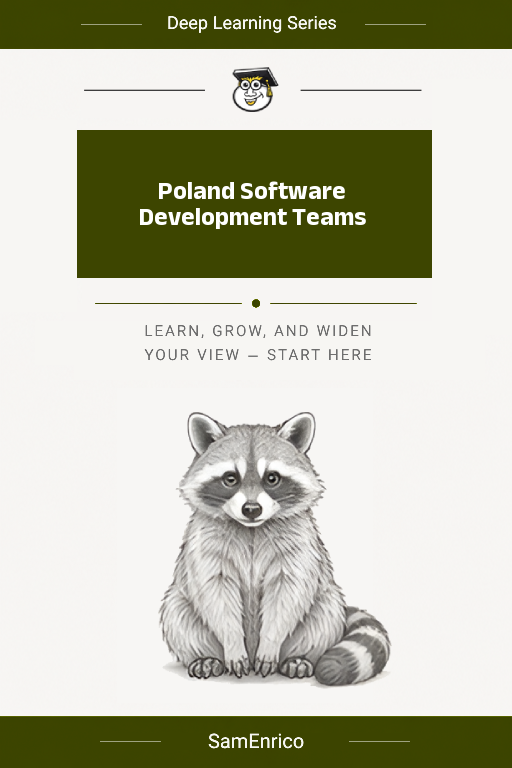
Poland Software Development Teams eBook
Hire Eastern European developers with EU time zone
by Whited David
Hire Eastern European developers with EU time zone alignment and strong English technical skills.
Formats
Free sample
Chapter 1: The Warsaw Awakening--The first sign that something had changed was the coffee.Not the coffee itself—Poland had always had good coffee, a legacy of Viennese influence and a stubborn refusal to settle for instant. It was the conversation around the coffee that signaled a transformation. In 2015, if you sat in a Warsaw coworking space, you heard English spoken with Indian accents, American accents, sometimes German. Developers talked about "tickets" and "sprints" and "the client in Chicago." By 2022, the conversations had shifted. Engineers talked about "architectural reviews" and "technical debt" and "our product roadmap." Not the client's product.
Our product.That linguistic shift—from client-vendor language to product-owner language—is the quiet revolution that this chapter documents. Poland did not simply become a cheaper place to hire developers. Poland became a place where developers stopped acting like vendors and started acting like builders.The $3 Million Mistake In early 2019, a fintech startup based in Austin, Texas—let's call them Pay Forward—raised a 12million Series A.Theyneededtoscaleengineeringfast.The CTOhadpreviousexperienceoutsourcingto Bangaloreandfeltconfidentrepeatingthatplaybook.Hehiredarespected Indianoutsourcingfirm,negotiatedarateof12 million Series A. They needed to scale engineering fast. The CTO had previous experience outsourcing to Bangalore and felt confident repeating that playbook.
He hired a respected Indian outsourcing firm, negotiated a rate of 12million Series A.Theyneededtoscaleengineeringfast.The CTOhadpreviousexperienceoutsourcingto Bangaloreandfeltconfidentrepeatingthatplaybook.Hehiredarespected Indianoutsourcingfirm,negotiatedarateof38 per hour for a team of 15 senior developers, and settled into what he assumed would be 12 months of smooth scaling.Nine months later, Pay Forward had spent $2.1 million on development and had shipped exactly two minor features. The core payment reconciliation engine—the heart of their product—was still not production-ready. The Indian team had built exactly what was requested: a pixel-perfect implementation of the technical specification document written by the Austin architects. The problem was that the specification was wrong. The architects had never run a payment reconciliation system at scale.
The Indian engineers, brilliant and hardworking, had never been empowered to question the specification. They were paid to code, not to think.The CTO flew to Bangalore for what he called a "rescue mission." He spent two weeks pair-programming with the lead architect, rewriting the core logic. But by then, the damage was done. The company had missed its launch window. A competitor had captured the market.
Pay Forward raised a down-round six months later, and the CTO was replaced.The post-mortem was brutal. The company had not lost to a better product. They had lost to a bad outsourcing model. They had optimized for rate per hour instead of value per hour. And that mistake cost them 3millionindirectspendplusanestimated3 million in direct spend plus an estimated 3millionindirectspendplusanestimated8 million in opportunity cost.This story is not unique.
It plays out every week in boardrooms across America and Western Europe. And it is the single best argument for why Poland matters.The Numbers That Changed Everything Let us ground the narrative in data. By 2026, Poland's technology sector had reached a critical mass that was difficult for any serious engineering leader to ignore.The country now hosts approximately 1.2 million IT professionals across all disciplines. This figure includes software developers, QA engineers, Dev Ops specialists, security analysts, data scientists, and technical project managers. Of these, roughly 400,000 are active software developers—the addressable market for companies seeking to hire coding talent.To understand why this matters, consider the regional context.
Poland's developer population is larger than the combined totals of the Czech Republic, Hungary, and Slovakia. It is three times larger than Romania's. It is larger than the entire tech workforce of Portugal and Greece combined. Within a five-hour flight of London, Berlin, or Paris, there is no larger concentration of engineering talent outside of the country itself.But size alone is not the story. Quality is the story.On Hacker Rank's global rankings, which measure algorithmic problem-solving and coding proficiency, Poland consistently ranks third in the world, trailing only China and Russia while surpassing the United States, Germany, and the United Kingdom.
The platform has tested millions of developers, and Polish engineers routinely outperform their Western counterparts on raw technical challenges.This is not an accident. Poland's education system, particularly its emphasis on mathematics and logic, produces a steady stream of graduates who approach programming as a formal discipline rather than a trade. The International Mathematical Olympiad (IMO) has seen Polish teams finish in the top fifteen globally for twenty consecutive years. The country produces more ICPC (International Collegiate Programming Contest) finalists per capita than any other European nation.What does this mean in practice? A Polish senior developer with five years of experience has often solved more complex algorithmic problems in university than an American developer with ten years of experience has encountered in the workplace.
They are trained to think in edge cases, to optimize for constraints, to find the elegant solution rather than the first working solution.The Big Tech Validation The market has noticed. By 2026, every major technology company had established a significant presence in Poland.Google opened its Warsaw engineering hub in 2019 with 200 engineers. By 2026, that number had grown to over 1,500, making it one of Google's largest R&D centers in Europe outside of London and Zurich. The Warsaw office leads development for several core Google Cloud products and has become a center of excellence for machine learning infrastructure.Amazon chose Krakow for its largest European development center outside of Dublin. The campus, which opened in 2021, now houses over 2,000 engineers working on Alexa, AWS, and Amazon's logistics algorithms.
The decision was deliberate: Amazon had acquired several Polish startups and discovered that the local talent pool rivaled anything in Western Europe at 60% of the cost.Microsoft established its largest East European development center in Wroclaw, focusing on Azure and enterprise security. The company has partnered with local universities to create a dedicated computer science curriculum, effectively pipeline-training the next generation of Polish engineers.The Big Tech Paradox This concentration of Western giants creates what this book calls the Big Tech Paradox. The presence of Google, Amazon, and Microsoft in Poland is simultaneously the best validation of the market and the greatest threat to your hiring efforts.The validation is straightforward. These companies do not locate engineering centers in countries with weak talent pools or unreliable legal systems. Their due diligence processes are exhaustive.
When Google opens an office in Warsaw, it is because their internal data shows that Polish engineers are as productive as engineers in Mountain View—at a fraction of the total cost.The threat is equally real. Google Warsaw pays senior engineers total compensation packages exceeding $120,000 per year when including salary, bonus, and equity. Amazon Krakow offers similar numbers for principal-level talent. For a mid-sized startup or mid-market company, competing on cash compensation alone is impossible.But here is the insight that changes the calculation: most Polish engineers do not want to work for Google.This sounds counterintuitive until you understand the Polish tech psyche. The engineers who excel in Poland's math-and-logic education system are not motivated primarily by money.
They are motivated by interesting problems and autonomy. Google offers excellent compensation but often assigns engineers to tiny slices of massive systems—the "cog in a machine" phenomenon. Polish engineers, trained to solve whole problems, frequently find this unsatisfying.A…
This is the end of the free sample. Get the eBook to keep going. Buy now
About this book
Details
- Author
- Whited David
- Publisher
- SamEnrico
- Language
- English
- Genre
- Non-Fiction, Business Brief, Europe Tech
- Released
- 2026-05-30
- Pages (approx.)
- 138
- Available as
- eBook, Audiobook

Read better in the ZLOADR app
Your eBooks on your phone or tablet. Sign in with your SamEnrico account and start reading.
More by Whited David
 Alcohol Recovery Exercise PlanWhited David$11.99
 Post Hypnotic Suggestion for GratitudeWhited David$11.99
 Washing Machine ResiduesWhited David$11.99
 Technology FrustrationWhited David$11.99
 The Bloodhound and the Billionaire: How a K9 Detective Uncovered Europe's Largest Tax FraudWhited David$11.99
 How to Produce a CleanerWhited David$11.99
 Space Superiority InstructorWhited David$11.99
You may also like
 Hong Kong Handover 1997Dunn Johnnie$11.99
 Zumba For Postnatal Recovery CourseNeal Christian$11.99
 Zumba for BeginnersLadner Nikia$11.99
 YouTube Comment Mining GuideHumes Pandora$12.99
 Worry Box MeditationCarlin Rudy$11.99
 Workplace Stress MeditationNguyen Lynn$11.99
 Workplace Stress and Sleep RepairHawley Ivory$11.99
 Workplace Perfectionism CureDelaney Jeffry$11.99
 Workplace Injustice Anger GuideWallen Isabelle$11.99
 Work Addiction and Burnout LinkGreenwood Ester$11.99
 Women in Yoga and WellnessBeattie Galina$11.99
 Women in Stand Up ComedyChun Evangeline$11.99