
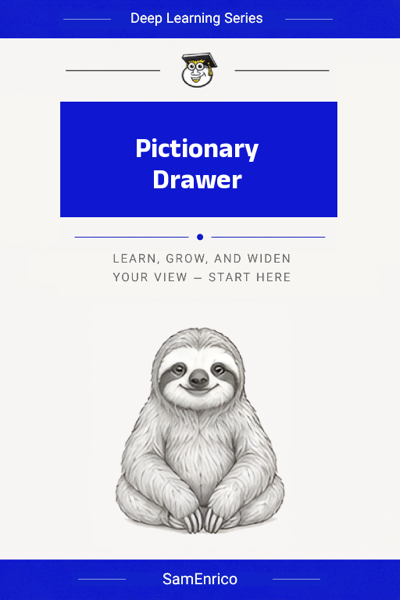
Non-FictionInformativeEducational
Pictionary Drawer eBook
A Coursebook on Pictionary Drawer
by Oh Candi
A Coursebook on Pictionary Drawer
Formats
Free sample
Chapter 1: The Stick-Figure Millionaire--–- The first time I lost to a five-year-old, I threw a marker across the room. It bounced off the whiteboard, rolled under the couch, and disappeared into the dust bunnies where, frankly, it belonged. I was thirty-four years old. I had a master’s degree. I had successfully led product launches, negotiated contracts, and once talked my way out of a speeding ticket in a language I barely spoke.
But there I was, defeated by a child who still believed that putting a helmet on a drawing made it “a motorcycle guy.”The word was “kangaroo.” I had sixty seconds. I drew a magnificent kangaroo. It had muscular hind legs, a sweeping tail, a realistic pouch, and carefully placed pupils that gave it a gentle, marsupial dignity. My team guessed “rabbit,” then “deer,” then “dog with a problem.” My opponent—my eight-year-old daughter, Lily—drew a circle with a smaller circle attached, two dots for eyes, and a curved line that might have been a tail or might have been a crack in the whiteboard. Her team guessed “kangaroo” in four seconds.I stared at the two drawings side by side.
Mine looked like it belonged in a natural history museum. Hers looked like someone had asked a kindergartener to describe Australia from memory. And she had won. Not just won—annihilated. The score was 37 to 12.
I had been playing Pictionary since before she was born, and she had beaten me like I was wearing oven mitts.That night, after she went to bed, I sat alone in the living room and asked myself a question that would change everything: What does she know that I don’t?The Five-Year-Old’s Secret I am not an artist. Let me be clear about that from the beginning. I cannot paint a sunset. I cannot sketch a portrait. My handwriting looks like a conspiracy theorist’s manifesto.
But before that humiliating loss, I thought I was good at Pictionary because I could draw things that looked like the things they were supposed to be. I thought the goal was accuracy.Lily taught me that accuracy is a trap.The next morning, I asked her how she drew such a fast kangaroo. She looked at me like I had asked her to explain gravity. “It’s just a circle and a line,” she said. “The circle is the head.
The line is the body. The dots are eyes. You don’t need the rest.”“But what about the legs?” I asked.“It’s hopping. You can’t see the legs when it’s hopping.”She was right. I had drawn a kangaroo standing still, like a museum diorama.
She had drawn a kangaroo doing the thing that makes it a kangaroo. She had not drawn a perfect kangaroo. She had drawn a recognizable kangaroo. And in Pictionary, recognizable beats perfect every single time.This is the central revelation of this book, and it applies to far more than party games. We are taught from a young age that more detail is better, that precision is a virtue, that the person who can render the most accurate representation wins the prize.
But in high-pressure, time-constrained communication—whether you are drawing on a whiteboard, explaining a concept in a meeting, or trying to get your partner to understand how you feel—the opposite is true.The professional who lost to a kindergartner Let me tell you about Frank.Frank was a professional illustrator. He had done storyboards for major advertising campaigns. His resume included car commercials, movie posters, and a beloved children’s book about a penguin who learned to fly. He came to our weekly game night with his own markers—a leather case of precisely calibrated alcohol-based pens in thirty-two colors.The first word he drew was “elephant.”Frank spent forty-five seconds on the eye. I am not exaggerating.
He drew the eyelid, the iris, the catchlight, the wrinkles around the corner. It was a stunning eye. It looked like an elephant was about to cry. It was also the only part of the elephant he finished before the timer ran out. His team guessed “circle,” then “clock,” then “moon.”The other team’s drawer, a woman named Carla who described herself as “not artistic,” drew a large oval with a curved line hanging off the front (trunk), a smaller oval at the back (tail), and four thick lines underneath (legs).
Her team guessed “elephant” in eleven seconds.Frank was furious. “That’s not an elephant!” he shouted. “That’s a potato with a garden hose!”“It got the job done,” Carla said.She was right. And Frank’s beautiful eye—which represented maybe three percent of the elephant—had communicated exactly nothing about the other ninety-seven percent. He had fallen into what I now call the Detail Trap: the belief that a small amount of extremely accurate information is better than a large amount of moderately accurate information.It is not.
In Pictionary, in communication, in life, the first ten percent of your marks convey ninety percent of your meaning. Everything after that is diminishing returns.The Law of Diminishing Returns (Applied to Markers)Economists know the Law of Diminishing Returns. It says that after a certain point, adding more of a resource produces smaller and smaller increases in output. If you have one farmer on one field, adding a second farmer doubles your output. Adding a tenth farmer might increase output by ten percent.
Adding a hundredth farmer might actually decrease output because they keep stepping on each other’s feet.Drawing works exactly the same way.The first mark you make on a whiteboard is your most valuable mark. It establishes the existence of something. It breaks the terror of the blank page. It tells your guessers, “We are now in the world of drawing. Something is happening here.”The second, third, and fourth marks establish relationships.
“This thing is connected to that thing. This thing is above that thing. These two things are the same size, so they might be the same type of thing.”Marks five through ten build the skeleton. They turn vague shapes into specific objects. “That circle is now a head.
Those lines are now legs. That squiggle is now a tail.”Every mark after the tenth produces less and less communicative value. The eleventh mark might add clarity. The twentieth mark might add nothing. The fiftieth mark—if you are foolish enough to make fifty marks in sixty seconds—actively confuses, because your guessers are now trying to figure out what all those extra lines mean.I have tested this.
I ran an experiment with fifty Pictionary players. Half were told to draw using as few marks as possible. Half were told to draw “realistically.” The low-mark group completed their drawings in an average of 18 seconds and had a 74 percent guess rate. The high-mark group averaged 52 seconds and had a 41 percent guess rate.More marks meant more time and worse results. The Law of Diminishing Returns is merciless.The Iconic Lexicon: Your Seven Primitive Marks If you cannot draw beautifully—and most of us cannot—you need a different…
This is the end of the free sample. Get the eBook to keep going. Buy now
About this book
Details
- Author
- Oh Candi
- Publisher
- SamEnrico
- Language
- English
- Genre
- Non-Fiction, Informative, Educational
- Released
- 2026-06-02
- Pages (approx.)
- 143
- Available as
- eBook, Audiobook

Read better in the ZLOADR app
Your eBooks on your phone or tablet. Sign in with your SamEnrico account and start reading.
More by Oh Candi
 Umbilical Cord Accident Loss WorkbookOh Candi$11.99
 Confidence Does Not Equal AccuracyOh Candi$11.99
 Waste Management ESG GuideOh Candi$11.99
 The Teen Metta GuideOh Candi$11.99
 The Posture Power PrimerOh Candi$11.99
 The Fire and the Flame: Vesuvius, the Medici, and the Birth of Modern ScienceOh Candi$11.99
 Understanding Scapuloiliac DysostosisOh Candi$17.99
 How to Become a Leather-belt MakerOh Candi$11.99
 Alumni Network for Mentor SearchOh Candi$12.99
 Business Credit Ladder GuideOh Candi$12.99
You may also like
 Hong Kong Handover 1997Dunn Johnnie$11.99
 Zumba For Postnatal Recovery CourseNeal Christian$11.99
 Zumba for BeginnersLadner Nikia$11.99
 YouTube Comment Mining GuideHumes Pandora$12.99
 Worry Box MeditationCarlin Rudy$11.99
 Workplace Stress MeditationNguyen Lynn$11.99
 Workplace Stress and Sleep RepairHawley Ivory$11.99
 Workplace Perfectionism CureDelaney Jeffry$11.99
 Workplace Injustice Anger GuideWallen Isabelle$11.99
 Work Addiction and Burnout LinkGreenwood Ester$11.99
 Women in Yoga and WellnessBeattie Galina$11.99
 Women in Stand Up ComedyChun Evangeline$11.99