
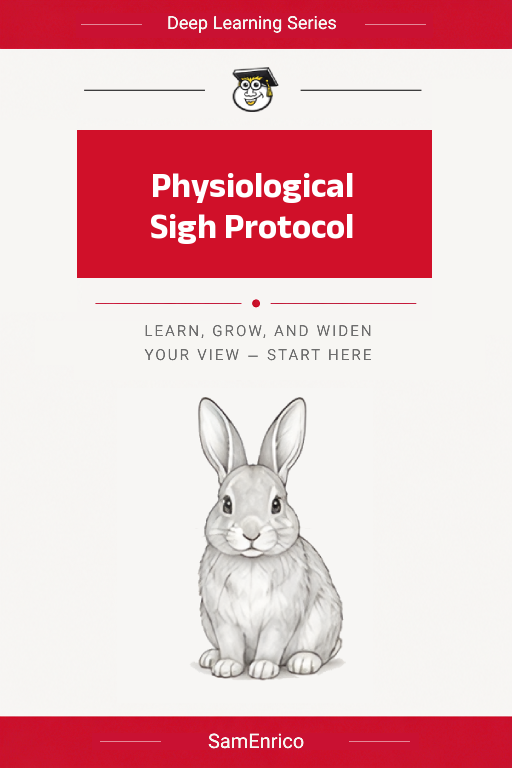
Physiological Sigh Protocol eBook
Use double inhale and extended exhale to rapidly l
Use double inhale and extended exhale to rapidly lower heart rate and calm the amygdala.
Formats
Free sample
Chapter 1: The Parachute Failure--–- The airplane bathroom was not designed for panic attacks. I learned this at thirty-seven thousand feet, somewhere over the Rocky Mountains, with my forehead pressed against a plastic wall and my heart slamming against my ribs like a fist on a locked door.The first sign of trouble was nothing. That was the problem. No turbulence, no engine noise, no announcement from the captain. Just a quiet, creeping sensation that the air had thickened, that my lungs were suddenly working twice as hard to move half as much oxygen.
I told myself it was nothing. I told myself I was fine. And then my body, which has never once listened to my self-talk, decided to prove me wrong.The wave hit like a cold crash. My vision narrowed to a tunnel. My hands, gripping the edges of the sink, were pale and trembling.
The worst part—the part I still remember with perfect, humiliating clarity—was the certainty that I was about to die. Not a vague philosophical awareness of mortality, but a screaming, primal conviction that this was it. Heart attack. Stroke. Something catastrophic.
I was thirty-four years old, reasonably fit, and absolutely convinced that my heart was in its final minutes.I tried to breathe. Of course I tried to breathe. Every self-help book, every yoga class, every well-meaning friend had offered the same advice: when you're stressed, just take a deep breath. So I did. I filled my lungs as slowly and deeply as I could manage.
I held it for a count of four. I exhaled with deliberate control.And my heart rate spiked higher.I tried again. Slower this time. A longer inhale. A softer exhale.
The panic intensified. My chest tightened. The tunnel vision narrowed further. Somewhere outside the bathroom door, I could hear the flight attendant's voice, calm and professional, asking if I was okay. I couldn't answer.
I was too busy trying to breathe my way back to safety—and failing so completely that I was now certain I would collapse right there, on the cold floor of an airplane bathroom, while my fellow passengers scrolled through their seatback entertainment.The flight attendant knocked again. I opened the door, not because I was ready, but because I was too exhausted to keep holding it shut. She took one look at me—sweating, pale, pupils blown wide—and didn't ask what was wrong. She didn't offer me water. She didn't call for a doctor.She said, "Sigh for me.
Twice in a row. Then let it all the way out."I thought she was insane. But I was also out of options. So I sighed. A real, pathetic, shuddering sigh.
Then another, a little deeper this time. And then, because she was still watching me with that calm, expectant look, I exhaled slowly, emptying my lungs completely.Something shifted. Not dramatically. Not like a switch flipping. But somewhere deep in my chest, I felt a release—a small, quiet sensation that the pressure had dropped from red-alert to orange-alert.
My heart was still racing, but it was no longer accelerating. My hands were still shaking, but the tremor had softened."Again," she said. "Three more times."I did. And by the third sigh, something remarkable happened: I realized I was no longer certain I was dying. By the fifth, I was just a tired, embarrassed man leaning against an airplane wall.
The tunnel vision had receded. The cold wave of terror had pulled back.I asked her how she knew that would work. She smiled and said she didn't know the science, but that her grandmother had taught her: when someone is falling apart, tell them to sigh twice and let it go slow. She'd used it on screaming babies, panicking passengers, and once on a groom who was about to faint at the altar.I spent the rest of that flight not sleeping, not relaxing, but thinking. Because I had just experienced something that contradicted everything I thought I knew about breathing and stress.
I had done exactly what I was supposed to do—slow, deep, mindful breathing—and it had made everything worse. Then a flight attendant had given me a thirty-second hack that actually worked.That was the beginning. Not of a solution, but of an obsession. Over the next several years, I would go on to interview neuroscientists, pulmonologists, psychiatrists, and elite performance coaches. I would read hundreds of peer-reviewed studies, some dating back to the 1930s, others published just months ago.
I would test protocol after protocol on myself, my family, my friends, and eventually thousands of readers and workshop participants.And I would discover something shocking: the flight attendant's grandmother's trick—the double inhale and extended exhale—is not folk wisdom. It is not a placebo. It is a precise, elegant, and brutally effective neurological hack that takes advantage of one of the body's most ancient and overlooked reflexes. It is called the physiological sigh, and it is very likely the single fastest way to lower your heart rate, calm your amygdala, and shut down a stress response in real time.But before we get to the how, we need to talk about why everything else you've been told about breathing and stress is not just incomplete, but sometimes actively harmful.The Great Breathing Misconception Let me ask you a question. If you wanted to calm down—really calm down, the way you might need to before a job interview, a difficult conversation, or a sleepless 3 AM spiral—what would you do?If you're like most people, you'd take a slow, deep breath.
You might even hold it for a moment before exhaling. This is so deeply ingrained in our cultural wisdom that it feels like common sense. Of course deep breathing is calming. It's relaxing. It's what every meditation teacher, yoga instructor, and wellness influencer has told us to do.Here's the problem: common sense is wrong.Not entirely wrong.
Deep breathing can be calming, under the right conditions. But the conditions matter enormously, and the generic advice to "just breathe deeply" ignores the single most important variable: the pattern of your breath. Specifically, the relationship between your inhale and your exhale.The human respiratory system is not a simple on-off switch. It is a sophisticated, bidirectional signaling system that can either activate the fight-or-flight response or trigger the relaxation response, depending on how you use it. And the difference comes down to one thing: whether your exhale is longer than your inhale.Let me say that again, because it is the most important sentence in this chapter.
A longer exhale than inhale is calming. A longer inhale than exhale is activating. And when your inhale and exhale are roughly equal? You stay right where you are, neither calming nor activating.This is not philosophy. This is physiology.
And it explains why my slow, careful, "calming" breaths on that airplane made my panic worse. Without knowing it, I had been taking slow, deep inhales and then releasing them quickly—or holding my breath entirely. I had accidentally activated my sympathetic nervous system while trying desperately to calm it down.The Autonomic Seesaw To…
This is the end of the free sample. Get the eBook to keep going. Buy now
About this book
Details
- Author
- Goldman Gerry
- Publisher
- SamEnrico
- Language
- English
- Genre
- Non-Fiction, Mental Wealth
- Released
- 2026-05-29
- Pages (approx.)
- 157
- Available as
- eBook, Audiobook

Read better in the ZLOADR app
Your eBooks on your phone or tablet. Sign in with your SamEnrico account and start reading.
More by Goldman Gerry
 Anger De escalation with TeensGoldman Gerry$11.99
 Relationship Building for Remote TeamsGoldman Gerry$11.99
 Plant Based Meal PrepGoldman Gerry$11.99
 Light Stream HealingGoldman Gerry$11.99
 Workplace Lunch Break RevivalGoldman Gerry$11.99
 Team Creative MomentumGoldman Gerry$11.99
 SAD Support Group GuideGoldman Gerry$11.99
 Truck Purchase GenerationsGoldman Gerry$11.99
 Orpheus Ascending: A Lyre’s Descent into the UnderworldGoldman Gerry$11.99
 The 35W Bridge Catastrophe: A Collapse of TrustGoldman Gerry$11.99
 A Collector's Handbook to the Mazda R100Goldman Gerry$11.99
 How to Become a Rug Inspector IiGoldman Gerry$11.99
You may also like
 Hong Kong Handover 1997Dunn Johnnie$11.99
 Zumba For Postnatal Recovery CourseNeal Christian$11.99
 Zumba for BeginnersLadner Nikia$11.99
 YouTube Comment Mining GuideHumes Pandora$12.99
 Worry Box MeditationCarlin Rudy$11.99
 Workplace Stress MeditationNguyen Lynn$11.99
 Workplace Stress and Sleep RepairHawley Ivory$11.99
 Workplace Perfectionism CureDelaney Jeffry$11.99
 Workplace Injustice Anger GuideWallen Isabelle$11.99
 Work Addiction and Burnout LinkGreenwood Ester$11.99
 Women in Yoga and WellnessBeattie Galina$11.99
 Women in Stand Up ComedyChun Evangeline$11.99