
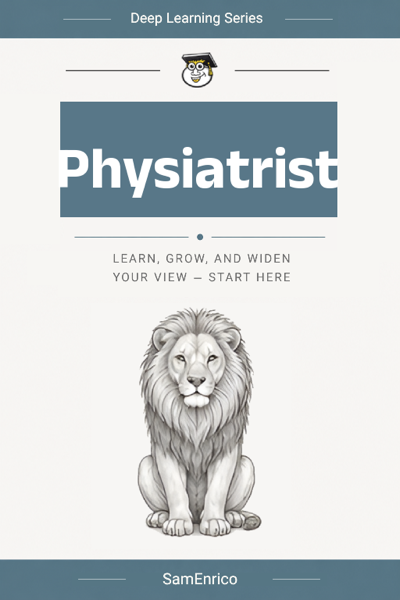
Non-FictionInformativeEducational
Physiatrist eBook
A Coursebook on Physiatrist
by Sams Takisha
A Coursebook on Physiatrist
Formats
Free sample
Chapter 1: The Question Most Doctors Never Ask...--The physiatrist watches the patient walk from the waiting room.Not the casual glance most physicians offer, but a slow, deliberate dissection of every moving part. The way the left foot slaps the ground instead of rolling smoothly—that is peroneal weakness, possibly an L5 radiculopathy. The slight pelvic drop on the right during left stance—that is a positive Trendelenburg sign, hip abductor failure. The way the patient grips the doorframe with one hand while pretending not to need it—that is compensation masking impairment, and it tells the physiatrist more than any MRI ever could.By the time the patient sits down, the physiatrist already has a working diagnosis. Not of a disease, but of a person in trouble.This is the art and science of Physical Medicine and Rehabilitation, and the person practicing it is called a physiatrist (fizz-ee-AT-rist).
Few medical specialties are as misunderstood, as poorly named, or as critically important to the modern healthcare system. The physiatrist is not a psychiatrist who forgot how to spell. The physiatrist is not a physical therapist with a medical degree. The physiatrist is a fully trained physician who specializes in the nonsurgical management of musculoskeletal and neurological conditions with one overriding goal: restoring function and maximizing quality of life.But to understand what a physiatrist does, one must first understand what most of medicine does not.The Pathology Trap For the last century, medical education has been built on a deceptively simple question: What is the disease?The neurologist asks this and localizes a lesion to the corticospinal tract. The rheumatologist asks this and measures an elevated anti-CCP antibody.
The orthopedic surgeon asks this and identifies a torn meniscus on MRI. These are all valid, important questions. They save lives. They diagnose conditions. They identify targets for surgery, for biologics, for life-saving interventions.But they are incomplete.A patient can have a perfect diagnosis and a perfect treatment and still be unable to walk, unable to work, unable to live independently.
The pathology-centered model asks what is wrong but rarely asks so what—so what can this person still do, and what can we do about what they cannot?Consider the case of James, a 62-year-old retired construction worker who appears in physiatry clinics across the country every single day. James has spinal stenosis—the MRI shows beautiful images of narrowed canals and compressed nerves. He saw a neurosurgeon who offered a laminectomy. He saw a pain anesthesiologist who offered epidural steroids. He saw his primary care doctor who prescribed opioids.
Each specialist answered the pathology question correctly. Each offered a reasonable intervention for the disease.But no one asked James what he wanted.When the physiatrist finally asks, James says: "I just want to walk to the mailbox without stopping. I want to take a shower without my wife helping me. I want to go fishing with my grandson one more time."The neurosurgeon saw a surgical candidate. The pain doctor saw a pain generator.
The physiatrist saw a grandfather who had lost the ability to participate in his own life.This is the fundamental philosophical shift that defines physiatry: moving from pathology to function, from diagnosis to disability, from what is the disease? to what can this person still do, and how can we maximize that?The Birth of the Quality of Life Profession To understand why physiatry exists, one must understand the grim mathematics of World War II.Before the war, battlefield medicine was largely about triage and survival. A soldier with a spinal cord injury was expected to die—not immediately, but within months from infection, kidney failure, or pressure ulcers. A soldier with an amputation was fitted with a wooden peg and told to make the best of it. Traumatic brain injury was a death sentence by another name.The war changed everything.
Advances in antibiotics, surgical techniques, and evacuation systems meant that soldiers were surviving injuries that would have been fatal a decade earlier. By 1944, military hospitals were filled with thousands of young men who had been saved from death but left with profound disabilities. The medical system had become extraordinarily good at saving lives. It had no idea what to do with the lives it saved.Enter Dr. Howard Rusk, a young Air Force physician who would become the father of modern physiatry.
Rusk noticed something that his colleagues missed: survival without rehabilitation was not victory. A soldier who lived but could not walk, could not work, could not return to his family—was that really success?Rusk established the first comprehensive rehabilitation programs at military hospitals, bringing together physical therapists, occupational therapists, speech-language pathologists, psychologists, and social workers under the leadership of a physician. He called this new physician a "physiatrist"—from the Greek physis (nature or function) and iatreia (healing). The healing of function.At the same time, Dr. Frank Krusen at the Mayo Clinic was developing the physical medicine side of the specialty, using heat, cold, electricity, and therapeutic exercise to treat musculoskeletal conditions.
Krusen's work established the non-surgical, non-pharmacological toolkit that remains central to physiatry today.The two threads—Rusk's comprehensive rehabilitation and Krusen's physical medicine—were woven together after the war. In 1947, the American Board of Physical Medicine and Rehabilitation was established. The physiatrist was officially born.In the decades since, physiatry has expanded far beyond its wartime origins. Modern physiatrists treat stroke survivors learning to walk again, athletes recovering from concussions, children with cerebral palsy learning to use communication devices, construction workers with chronic low back pain returning to their jobs, cancer patients managing post-chemotherapy fatigue, and COVID long-haulers struggling with brain fog and post-exertional malaise.The common thread is not a specific organ system or a specific disease. The common thread is function—and the fundamental belief that function can be restored, improved, or compensated for even when the underlying disease cannot be cured.The ICF: A New Language for Medicine How does a physiatrist measure function?
Not with a ruler or a blood test, but with a framework called the International Classification of Functioning, Disability and Health—the ICF.Developed by the World Health Organization, the ICF represents a paradigm shift in how we think about health and illness. Traditional medical classification systems (like ICD-10) categorize diseases. The ICF categorizes functioning. It asks not "what disease does this person have?" but "how does this person's health condition affect their life?"The ICF organizes health into three interconnected domains:Body Functions and Structures refers to the physiological and anatomical components of the body. Muscle strength.
Nerve conduction velocity. Range of motion. Joint integrity. Pain intensity. These are the things that traditional medical exams measure.
A physiatrist cares deeply about body functions—but not as an endpoint. Body functions matter only insofar as they enable activities.Activities refers to the execution of tasks and actions by an individual. Walking. Dressing. Eating.
Toileting. Bathing. Transferring from bed to chair. Writing. Driving.
These are the concrete, observable things that people do every day. When a patient says "I can't live like this," they are almost always describing an activity limitation, not a body function impairment. No one wakes up and…
This is the end of the free sample. Get the eBook to keep going. Buy now
About this book
Details
- Author
- Sams Takisha
- Publisher
- SamEnrico
- Language
- English
- Genre
- Non-Fiction, Informative, Educational
- Released
- 2026-06-03
- Pages (approx.)
- 159
- Available as
- eBook, Audiobook

Read better in the ZLOADR app
Your eBooks on your phone or tablet. Sign in with your SamEnrico account and start reading.
More by Sams Takisha
 Religious And Spiritual Grief After Loss WorkbookSams Takisha$11.99
 Metta for Chronic IllnessSams Takisha$11.99
 Cross Race Identification FailuresSams Takisha$11.99
 Luxury Goods ESG BenchmarkSams Takisha$11.99
 The Letting Go of Regret GuideSams Takisha$11.99
 The Phantom of Austerlitz: Napoleon's Ghostly TacticsSams Takisha$11.99
 Understanding Say–carpenter–syndromeSams Takisha$17.99
 Business Address Credit ImpactSams Takisha$12.99
 First 30 Days LinkedIn Mentor GuideSams Takisha$12.99
 How to Become a Dry-kiln OperatorSams Takisha$11.99
You may also like
 Hong Kong Handover 1997Dunn Johnnie$11.99
 Zumba For Postnatal Recovery CourseNeal Christian$11.99
 Zumba for BeginnersLadner Nikia$11.99
 YouTube Comment Mining GuideHumes Pandora$12.99
 Worry Box MeditationCarlin Rudy$11.99
 Workplace Stress MeditationNguyen Lynn$11.99
 Workplace Stress and Sleep RepairHawley Ivory$11.99
 Workplace Perfectionism CureDelaney Jeffry$11.99
 Workplace Injustice Anger GuideWallen Isabelle$11.99
 Work Addiction and Burnout LinkGreenwood Ester$11.99
 Women in Yoga and WellnessBeattie Galina$11.99
 Women in Stand Up ComedyChun Evangeline$11.99