
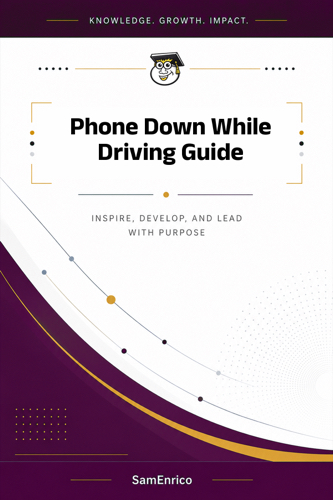
Phone Down While Driving Guide eBook
Teaches reducing phone-related frustration and dis
Teaches reducing phone-related frustration and distraction-induced anger.
Formats
Free sample
Chapter 1: The 43-Second Prisoner--–- The vibration buzzes against your thigh. You glance down—just for a second—to see who texted. When you look back up, the brake lights in front of you have turned from yellow to red to urgent. You stomp the pedal. The tires chirp.
You stop six inches from the bumper ahead. Your heart races. That was close, you think. I’ll be more careful next time.But there will be a next time. And another after that.
Because the problem is not your intention. The problem is not that you are a bad driver or a careless person. The problem is that you are driving a two-ton machine at highway speeds while your brain is operating inside a 43-second prison.The Statistic That Should Terrify You In 2019, a team of researchers at the University of California, Irvine, published a landmark study on human attention in the workplace. They found that the average knowledge worker switches tasks every forty-three seconds. Not every few minutes.
Not every minute. Every forty-three seconds. A typical office worker checks email, glances at Slack, answers a chat, returns to a report, picks up their phone, checks the news, and then—forty-three seconds after the last switch—does it all over again.This statistic is bad for productivity. It is terrible for mental health. But when you transfer that same fractured, frantic pattern of attention from a desk to a driver’s seat, it becomes something else entirely.It becomes lethal.Here is the math that matters: at 60 miles per hour, your car travels 88 feet per second.
The average “quick check” of a phone—looking down to read a text, see a notification, or change a song—takes approximately five seconds. In those five seconds, your car travels the length of a football field. Four hundred and forty feet. With your eyes off the road.No driver would voluntarily close their eyes for one hundred yards. Yet millions of drivers do exactly that every single day.
They call it a “quick check.” They tell themselves they are being careful. They believe that because they are not swerving or speeding, they are safe.They are wrong.The Myth of the Multitasking Driver For decades, car manufacturers, safety advocates, and even some state governments have promoted the idea that “hands-free” devices are a solution. The logic seems reasonable: if your hands are on the wheel and your eyes are on the road, what’s the harm in a quick conversation?The harm is that the brain does not multitask. It task-switches.When you talk on the phone—even with both hands on the wheel—your brain allocates cognitive resources to the conversation. It builds a mental model of the person on the other end of the line.
It processes their tone, their words, their pauses. It plans your responses. All of this happens in the same neural real estate that you need to monitor traffic, judge distances, anticipate brake lights, and spot a child running into the street.The result is not a 10% reduction in driving ability. It is a 50% reduction. Research from the National Highway Traffic Safety Administration (NHTSA) has repeatedly shown that talking on a phone while driving—even hands-free—impairs performance as much as driving with a blood alcohol concentration of 0.08%, the legal limit in most states.
You would never drink two beers and get behind the wheel. But you will take a call without thinking twice.And texting? Social media? Typing a destination into a map while rolling through a stop sign? Those activities are not 50% worse than drunk driving.
They are 600% worse. A driver who is texting is twenty-three times more likely to be in a crash than an attentive driver.Let that number sit with you for a moment. Twenty-three times.Why Silence Has Become Unbearable If the dangers are so clear—if the statistics are so stark—why does almost every driver still reach for their phone? Why do you reach for yours?The answer is not laziness. It is not a lack of caring.
It is neurological.In his landmark book The Shallows: What the Internet Is Doing to Our Brains, Nicholas Carr argues that the internet has physically rewired our neural pathways. Every time you click a link, scroll a feed, or check a notification, your brain releases a small amount of dopamine—not when you get the reward, but when you anticipate it. The ping of a notification is a promise. And the human brain is wired to treat promises as urgent.Over years of this training, your brain has learned to crave interruption. Silence no longer feels peaceful.
It feels uncomfortable. It feels like a withdrawal symptom. When you are sitting at a red light with nothing to do and no notification to check, your brain experiences that stillness as a problem to be solved. And the solution it has learned is simple: pick up the phone.This is not a character flaw. This is not a weakness unique to you.
This is the trained response of a brain that has been shaped by an attention economy that profits from your distraction. Technology companies employ thousands of engineers whose sole job is to make their apps more interruptive, more addictive, and harder to ignore. They have succeeded. You are not losing a battle against your own willpower. You are losing a battle against a multi-billion-dollar industry that has studied your psychology longer than you have.But here is the liberating truth: the enemy is not the phone.The Phone Is a Tool.
The Pathway Is the Enemy.This book will never tell you to throw away your smartphone, move to a cabin in the woods, and live like a Luddite. That approach fails for the same reason crash diets fail: abstinence without understanding collapses at the first moment of stress.The phone is a tool. It is no different from a hammer, a stove, or a steering wheel. A hammer can build a house or smash a finger. A stove can cook a meal or burn a hand.
A phone can navigate an unfamiliar city, call for help in an emergency, or play music that makes a long drive bearable. The problem is not the tool. The problem is the trained neural pathway that reaches for the phone the moment boredom appears.This book is about rewiring that pathway.Rewiring is not the same as resisting. Resisting requires willpower, and willpower is a finite resource that fails precisely when you are tired, stressed, or angry—which is exactly when you are most likely to be driving. Rewiring, by contrast, changes the underlying structure of the habit so that you no longer need to resist.
The urge simply does not arise, or when it does, it passes quickly without action.The chapters ahead will teach you how to do this. You will learn:Why red lights are the most dangerous moments of any drive (Chapter 2)How dopamine hijacks your attention and what to do about it (Chapter 3)The single most effective environmental change you can make today (Chapter 4)A simple phrase that dissolves road rage in seconds (Chapter 5)What to do when you slip—because you…
This is the end of the free sample. Get the eBook to keep going. Buy now
About this book
Details
- Author
- Hatcher Lincoln
- Publisher
- SamEnrico
- Language
- English
- Genre
- Non-Fiction, Self-Help, Focus
- Released
- 2026-06-10
- Pages (approx.)
- 130
- Available as
- eBook, Audiobook

Read better in the ZLOADR app
Your eBooks on your phone or tablet. Sign in with your SamEnrico account and start reading.
More by Hatcher Lincoln
 The Parent Death Anger GuideHatcher Lincoln$11.99
 The Recovery Ally System HandbookHatcher Lincoln$11.99
 Einstein First Wife MilevaHatcher Lincoln$11.99
 Resistance Band Stretching IntegrationHatcher Lincoln$11.99
 The Last Broadcast of the Lone WolfHatcher Lincoln$11.99
 The Blood Moon Conspiracy: The Secret History of the 18th-Century Vampire PanicHatcher Lincoln$11.99
 10 Ways to Use Chili Powder (Recipe Book)Hatcher Lincoln$11.99
 One Page Cart Abandonment RescueHatcher Lincoln$12.99
 Gen X Apparel Spending HandbookHatcher Lincoln$12.99
 Understanding Bardet–biedl Syndrome, Type 3Hatcher Lincoln$17.99
You may also like
 Hong Kong Handover 1997Dunn Johnnie$11.99
 Zumba For Postnatal Recovery CourseNeal Christian$11.99
 Zumba for BeginnersLadner Nikia$11.99
 YouTube Comment Mining GuideHumes Pandora$12.99
 Worry Box MeditationCarlin Rudy$11.99
 Workplace Stress MeditationNguyen Lynn$11.99
 Workplace Stress and Sleep RepairHawley Ivory$11.99
 Workplace Perfectionism CureDelaney Jeffry$11.99
 Workplace Injustice Anger GuideWallen Isabelle$11.99
 Work Addiction and Burnout LinkGreenwood Ester$11.99
 Women in Yoga and WellnessBeattie Galina$11.99
 Women in Stand Up ComedyChun Evangeline$11.99