
Non-FictionBusiness BriefCompliance
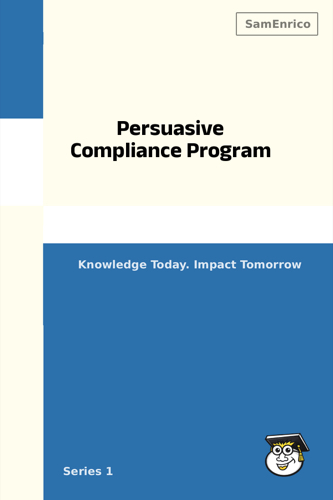
Persuasive Compliance Program eBook
Write regulatory proposals that frame legal requir
by Knoll Xuan
Write regulatory proposals that frame legal requirements as operational efficiency gains.
Formats
Free sample
Chapter 1: The Diagnostic Mirror--Every compliance officer has heard the same exhausted phrase whispered in windowless conference rooms: “This is just another cost of doing business.” The speaker—usually a weary operations director or a budget-focused CFO—leans back in their chair, arms crossed, having already decided that the new regulatory requirement landing on their desk is nothing more than a tax on productivity. They are not wrong about the feeling. But they are catastrophically wrong about the diagnosis.The belief that compliance is inherently a burden has become one of the most expensive cognitive errors in modern management. It creates self-fulfilling prophecies: when leaders expect waste, they find it. They ignore data, dismiss opportunities, and build adversarial relationships with regulators that cost millions in fines that could have been avoided.
Worse, they miss the single most valuable insight hidden inside every legal mandate: the law is trying to tell you where your operations are already broken.This book is built on a contrarian premise that will challenge everything you have been taught about regulatory work. That premise is simple: Compliance is not a cost center. It is free consulting.The goal of Persuasive Compliance Program is not to help you avoid fines—though you will avoid many. The goal is to transform you from a legal translator into an operational strategist. By the time you finish this chapter, you will never again look at a regulatory requirement as a burden.
Instead, you will see a diagnostic mirror reflecting the hidden weaknesses in your own organization’s processes. And once you see those weaknesses, you can fix them—not because the law demands it, but because fixing them makes your company run better, faster, and cheaper.The $47 Million Blind Spot Let us begin with a story that illustrates the cost of seeing compliance as a burden rather than a diagnosis.In 2016, a mid-sized logistics company operating across three states received a routine regulatory update from the Department of Transportation. The update required carriers to maintain detailed electronic logs of driver hours, rest breaks, and vehicle inspection schedules. Previously, paper logs had been acceptable. The new rule mandated real-time digital tracking.The compliance team groaned.
The operations team panicked. The CFO calculated the cost of new tablets, software licenses, and training at approximately $1.2 million. He called the requirement a “regulatory tax” and instructed his team to implement the cheapest possible solution—a basic app that drivers hated and frequently bypassed.For eighteen months, the company bled money. Drivers wasted an average of 22 minutes per shift fighting with the app. Dispatchers spent three hours daily reconciling paper backups with digital records.
The company’s on-time delivery rate dropped by 9 percent. The CFO blamed the regulation.Then a competitor did something different. Instead of treating the electronic logging mandate as a burden, their compliance officer asked a different question: “What operational flaw would require this rule?”She discovered that the DOT had implemented digital tracking because paper logs were too easy to falsify. But her company had a deeper problem: its dispatch system was entirely manual. Drivers called in their locations.
Dispatchers guessed at arrival times. Customers complained constantly about inaccurate delivery windows.She proposed a solution that looked nothing like compliance. She suggested integrating the required electronic logging software with the company’s customer-facing tracking portal. The same data that satisfied the regulator would also provide real-time delivery updates to customers. The same devices that tracked driver hours would automatically reroute trucks around traffic delays.The result was not just compliance.
It was a 22 percent reduction in stockouts, a 15 percent improvement in on-time delivery, and a 40 percent decrease in customer service calls asking “Where is my shipment?” The $1.2 million regulatory “burden” paid for itself in seven months.The first company spent $1.2 million to satisfy a rule. The second company spent $1.2 million to fix a broken process that happened to be required by a rule. Both were compliant. Only one was profitable.This is the difference between viewing compliance as a burden and viewing it as a diagnostic mirror.Command and Control Versus Outcome Orientation To understand why some regulations can be reframed as efficiency tools while others resist reframing, we need a fundamental distinction that will recur throughout this book. That distinction is between two types of regulation: Command and Control and Outcome-Oriented.Command and Control regulation tells you exactly how to do something.
It prescribes specific methods, technologies, or processes. For example: “All storage rooms must be equipped with a steel door rated for 90-minute fire resistance.” The regulator is specifying the means, not just the end.Outcome-Oriented regulation tells you what to achieve, leaving the method to you. For example: “All storage rooms must prevent the spread of fire for a sufficient duration to allow safe evacuation.” The regulator defines the goal, not the path.Here is what most compliance professionals miss: even Command and Control regulations contain diagnostic information. The fire door requirement exists because someone, somewhere, died in a fire that spread too quickly through a storage room. The specific 90-minute rating came from testing that determined how long it takes for typical warehouse fires to reach critical temperatures.
That information tells you something about your operation. If you have storage rooms, you have fire risk. The regulation is not an arbitrary tax. It is a warning label.The logistics company in our story succeeded because it faced an Outcome-Oriented regulation—electronic logging was required, but the method of integration was left open. The company that failed treated even that flexibility as a burden.Throughout this book, we will focus primarily on regulations that contain at least some outcome-oriented flexibility, because those are the ones where the reframing opportunity is largest.
However, even prescriptive Command and Control rules contain diagnostic value. The key is learning to ask the right question.The Reframe Exercise: A Systematic Method Every chapter in this book will give you a practical tool. Chapter 1’s tool is the Reframe Exercise, a systematic method for extracting operational value from any legal requirement.The exercise consists of four questions. Apply them to any regulation, compliance requirement, or legal mandate you face.Question One: What behavior is this rule trying to stop or encourage?Do not read the legal text. Read the intent.
Look for recitals, preambles, or explanatory notes. Regulations are rarely arbitrary. They are responses to specific failures. Find the failure.Example: A data breach notification law requires companies to notify customers within 72 hours of discovering a breach. The behavior being encouraged is rapid detection and transparent communication.
The behavior being stopped is hiding breaches.Question Two: In my organization, what would cause someone to engage in the prohibited behavior or fail to engage in the required behavior?This is the diagnostic question. If the rule requires audit trails, ask: why would someone in my company want to hide their access to sensitive data? If the rule requires safety inspections, ask: why would my team skip inspections? The answer is almost never “because they are evil.” It is usually “because the inspection process takes too long” or “because the data access system does not log automatically.”Question Three: Is that cause already creating operational waste or risk that we…
This is the end of the free sample. Get the eBook to keep going. Buy now
About this book
Details
- Author
- Knoll Xuan
- Publisher
- SamEnrico
- Language
- English
- Genre
- Non-Fiction, Business Brief, Compliance
- Released
- 2026-06-09
- Pages (approx.)
- 155
- Available as
- eBook, Audiobook

Read better in the ZLOADR app
Your eBooks on your phone or tablet. Sign in with your SamEnrico account and start reading.
More by Knoll Xuan
 Emotional Flooding Relationship GuideKnoll Xuan$11.99
 Eisenhower For Graduate StudentsKnoll Xuan$11.99
 The Angry Parent Cooling CornerKnoll Xuan$11.99
 Harvard Extension Technology PlatformKnoll Xuan$12.99
 Emotion Podcasts ListKnoll Xuan$11.99
 Assertiveness for Survivors of AbuseKnoll Xuan$11.99
 Gwalior Fort CaptureKnoll Xuan$11.99
 Compliment Filter RetrainingKnoll Xuan$11.99
 Ben Horowitz HardKnoll Xuan$11.99
 The Timbuktu Scholars: Guardians of the Mathematical UniverseKnoll Xuan$11.99
 The Philosopher Kings of Axum: Wisdom and Empire in Ancient AfricaKnoll Xuan$11.99
 Letters Across the Wire: The Secret Love Story of a WWII Codebreaker and a Nazi SpyKnoll Xuan$11.99
You may also like
 Hong Kong Handover 1997Dunn Johnnie$11.99
 Zumba For Postnatal Recovery CourseNeal Christian$11.99
 Zumba for BeginnersLadner Nikia$11.99
 YouTube Comment Mining GuideHumes Pandora$12.99
 Worry Box MeditationCarlin Rudy$11.99
 Workplace Stress MeditationNguyen Lynn$11.99
 Workplace Stress and Sleep RepairHawley Ivory$11.99
 Workplace Perfectionism CureDelaney Jeffry$11.99
 Workplace Injustice Anger GuideWallen Isabelle$11.99
 Work Addiction and Burnout LinkGreenwood Ester$11.99
 Women in Yoga and WellnessBeattie Galina$11.99
 Women in Stand Up ComedyChun Evangeline$11.99