
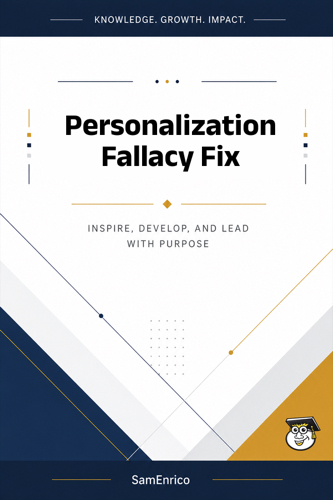
Non-FictionSelf-HelpCognitive Distortions
Personalization Fallacy Fix eBook
Stop assuming others' actions are targeted at you.
Stop assuming others' actions are targeted at you.
Formats
Free sample
Chapter 1: The Ancient Alarm...--–- The ping arrives at 11:47 on a Tuesday. Not a text, not a call—just a notification that someone has reacted to your comment with an emoji. A single eye roll. That’s it. No words.
No context. Just an ambiguous yellow face with its eyes rolled heavenward.By 11:48, your pulse has quickened. By 11:49, you have reread your original comment seven times, searching for the hidden offense. By 11:52, you have constructed an elaborate theory: the person who reacted is secretly allied with a coworker who dislikes you, and this emoji is the opening salvo in a coordinated campaign to humiliate you. By noon, you have drafted three furious replies, deleted all three, and decided that the entire platform is a nest of vipers designed specifically to torment you.Then, at 12:05, you realize something.
You have spent eighteen minutes of your life—eighteen minutes you will never get back—dissecting a piece of digital punctuation. And for what? Because your brain did what brains are designed to do: it assumed the worst, invented a target, and aimed your attention at a ghost.This is the Personalization Fallacy in its purest form. And it begins, as all things do, with an alarm system that was built for a world that no longer exists.The Machine That Was Built for the Savannah Your brain is not a truth-detector. Let that sink in for a moment because it contradicts almost everything you have been taught about human cognition.
We like to believe that we are rational creatures, that our minds are evolved to perceive reality accurately, that our emotions are reliable guides to the truth. None of this is accurate. Your brain is a survival machine. It was designed by millions of years of evolution for one purpose and one purpose only: to keep you alive long enough to reproduce. Truth is incidental.
Accuracy is secondary. Speed and safety are everything.Consider the famous evolutionary thought experiment. You are a hominid walking across the savannah 200,000 years ago. You hear a rustle in the tall grass. What do you do?
If you assume the rustle is a predator (say, a saber-toothed cat) and you are wrong—it was just the wind—you have wasted a few seconds of energy fleeing from nothing. No harm done. But if you assume the rustle is the wind and you are wrong—it is a predator—you are dead. Evolution therefore hardwired your ancestors to err on the side of caution. Better to see a threat that isn’t there than to miss a threat that is.This is called the false positive bias, and it is not a bug in your brain’s operating system.
It is a feature. It is why you jump at shadows, startle at sudden noises, and sometimes feel a chill run down your spine in a room that is perfectly safe. Your brain is constantly scanning the environment for danger, and it is heavily biased to report threats even when the evidence is ambiguous.Now fast-forward to the present. You are not on the savannah. There are no saber-toothed cats in your office, your living room, or your social media feed.
But your brain does not know that. It is running the same software it ran 200,000 years ago. The rustle in the grass has been replaced by a coworker’s sigh, a friend’s delayed text response, an ambiguous emoji, or a passive-aggressive Facebook post. Your brain processes these social stimuli through the same threat-detection circuitry that once kept you from being eaten. The result is catastrophic overkill.
You do not just notice a coworker’s sigh. You interpret it. You personalize it. You turn a random exhalation into a directed weapon.Cognitive Dissonance: The Engine of Personalization But threat-detection alone does not fully explain the Personalization Fallacy. There is a second, equally powerful mechanism at work: cognitive dissonance.
First identified by the psychologist Leon Festinger in the 1950s, cognitive dissonance is the psychological discomfort we experience when we hold two contradictory beliefs, or when reality does not match our expectations. The human mind abhors inconsistency. When something bad happens, we need to know why. Not knowing is intolerable. The discomfort is so acute that we will invent causes rather than tolerate ambiguity.Let me give you a concrete example.
You are walking down the street. A stranger catches your eye, frowns, and looks away. What just happened? There are at least a dozen possible explanations. The stranger has a headache.
The stranger is lost in thought and accidentally made eye contact. The stranger is nearsighted and was squinting at something behind you. The stranger just remembered an embarrassing moment from ten years ago. The stranger is having a bad day. The stranger did not see you at all.But your brain does not like this menu of possibilities.
It wants a single, coherent story. And because of the false positive bias we discussed earlier, it will almost always choose the most threatening story available: the stranger frowned because of you. You did something wrong. You look weird. You have spinach in your teeth.
You remind them of someone they hate. The story is unpleasant, but it resolves the dissonance. The world makes sense again. Something bad happened, and now you know why.This is the engine of the Personalization Fallacy. Cognitive dissonance creates the need for an explanation.
The false positive bias supplies the most threatening explanation available. And together, they produce a relentless stream of personalized interpretations for events that are almost certainly random.The Dissonance Spike: Your Biological Smoke Alarm If cognitive dissonance and threat-detection are the engine, the Dissonance Spike is the dashboard warning light. The Dissonance Spike is a physical-emotional signal that your brain has just leaped to a personalized conclusion. It is the moment before the story takes hold—the split second when your body knows something is wrong before your mind has decided what that something is.What does a Dissonance Spike feel like? It varies from person to person, but common descriptions include: a sudden increase in heart rate, a feeling of heat in the chest or face, a tightening of the jaw or shoulders, a flash of irritation or anger, a sinking sensation in the stomach, or a sudden urge to check your phone, refresh a page, or reread a message.
Some people describe it as a “ping” or a “jolt.” Others call it a “wave” or a “spike” (hence the name). Whatever form it takes, the Dissonance Spike is your earliest warning that you are about to commit the Personalization Fallacy.The crucial insight—and this is the foundation of everything that follows in this book—is that the Dissonance Spike is not a call to action. It is a call to observation. Most of us treat the Spike as if it were a fire alarm: we assume that if we feel it, there must be a real fire somewhere. We immediately search for the threat, identify a target, and react.
But the Spike is actually a smoke alarm. It goes off when there is smoke—but smoke can come from a real fire, a burning piece of toast…
This is the end of the free sample. Get the eBook to keep going. Buy now
About this book
Details
- Author
- Metzger Dovie
- Publisher
- SamEnrico
- Language
- English
- Genre
- Non-Fiction, Self-Help, Cognitive Distortions
- Released
- 2026-06-07
- Pages (approx.)
- 131
- Available as
- eBook, Audiobook

Read better in the ZLOADR app
Your eBooks on your phone or tablet. Sign in with your SamEnrico account and start reading.
More by Metzger Dovie
 NVC For Parents GuideMetzger Dovie$11.99
 Tenzing Everest DiplomatMetzger Dovie$11.99
 RLS And Mental Health Connection GuideMetzger Dovie$11.99
 The Interruption Energy DrainMetzger Dovie$11.99
 Emotional Intelligence for VolunteersMetzger Dovie$11.99
 Retainage Management GuideMetzger Dovie$11.99
 Twelve Step After RelapseMetzger Dovie$11.99
 Saadia Gaon Jewish PhilosophyMetzger Dovie$11.99
 The Quantum Whisperer: How a Teen Girl Cracked the Code of TimeMetzger Dovie$11.99
 The Icebound Plague: Viking Healers and the Arctic's First ImmunityMetzger Dovie$11.99
 The Oxford Renaissance: Scholars, Scribes, and the Birth of the Modern MindMetzger Dovie$11.99
 Sponsored Content Media BuyingMetzger Dovie$11.99
You may also like
 Hong Kong Handover 1997Dunn Johnnie$11.99
 Zumba For Postnatal Recovery CourseNeal Christian$11.99
 Zumba for BeginnersLadner Nikia$11.99
 YouTube Comment Mining GuideHumes Pandora$12.99
 Worry Box MeditationCarlin Rudy$11.99
 Workplace Stress MeditationNguyen Lynn$11.99
 Workplace Stress and Sleep RepairHawley Ivory$11.99
 Workplace Perfectionism CureDelaney Jeffry$11.99
 Workplace Injustice Anger GuideWallen Isabelle$11.99
 Work Addiction and Burnout LinkGreenwood Ester$11.99
 Women in Yoga and WellnessBeattie Galina$11.99
 Women in Stand Up ComedyChun Evangeline$11.99