
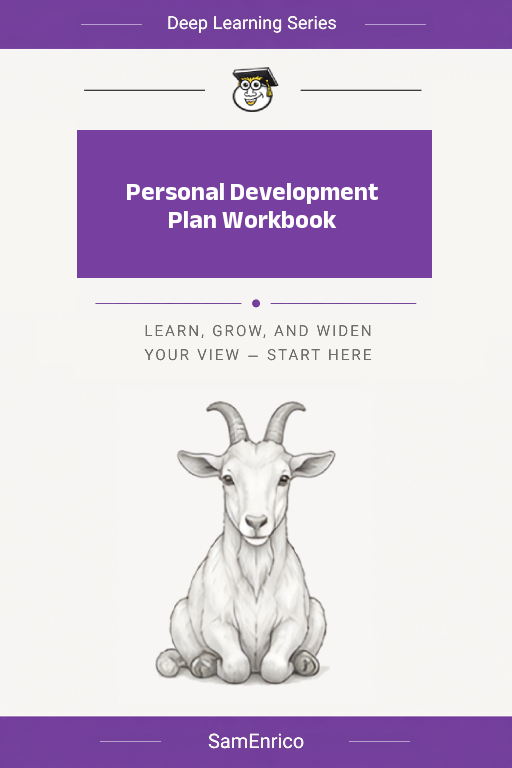
Personal Development Plan Workbook eBook
Create a personalized growth roadmap with goal set
Create a personalized growth roadmap with goal setting skill gap analysis and quarterly review templates included.
Formats
Free sample
Chapter 1: The Annual Autopsy--–- You are not lazy. You are not undisciplined. And you are certainly not broken. But if you have tried and failed to change your life more than once, there is something you are missing. Most people who pick up a book like this one have already attempted a New Year’s resolution, a quarterly goal, or a dramatic life overhaul.
They bought the planner. They downloaded the app. They told their friends they were going to change. And then, somewhere between week three and week eight, the momentum died. Not because they lacked ambition.
Not because they secretly didn’t care. But because they skipped the one step that separates successful change from perpetual cycling: the diagnostic phase.This chapter is called The Annual Autopsy because that is exactly what you are about to perform. An autopsy is not a judgment. It is not a eulogy. It is a forensic examination designed to answer one question: What actually happened?
When a medical examiner opens a body, they do not ask, “Was this person good or bad?” They ask, “What were the mechanisms of failure? Where did the system break down?” You are going to do the same thing with your last twelve months. Not to shame yourself. Not to catalog your shortcomings. But to gather data.
Clean, cold, usable data.Most personal development books begin with vision boards and positive affirmations. They ask you to dream bigger, think positive, and manifest your future. Those books have a place. But they also have a staggering failure rate. According to a longitudinal study conducted by the University of Scranton, roughly 92 percent of people who set New Year’s resolutions fail to achieve them.
The reason is not that people lack dreams. The reason is that they lack a post-mortem. They charge forward into a new future while dragging the corpse of the old one behind them, unaware that the same systemic failures will repeat themselves because they were never identified, never named, and never dismantled.You are going to do something different. Before you write a single goal for the next ninety days, you are going to look backward. You are going to open the wreckage of the last twelve months—not to wallow, but to salvage.
Every failed goal contains a gift. That gift is specificity. “I didn’t lose weight” is a vague regret. “I failed because I had no scheduled workout time and I kept my freezer stocked with ice cream” is a gift. It tells you exactly what to fix.
The autopsy transforms shame into engineering. And engineering, unlike willpower, actually works.The chapter opens with a confrontation. Not with your failures, but with your explanations for those failures. Most of us have a default story about why we didn’t achieve what we set out to achieve. That story usually sounds something like this: “I wasn’t motivated enough.” Or “I got busy.” Or “I’m just not that kind of person.” These are not explanations.
They are avoidance. They are fog machines designed to obscure the real, fixable, mechanical reasons that your plans derailed. The author calls these “emotional judgments” because they masquerade as self-awareness when they are actually self-protection. “I’m lazy” feels like an honest confession, but it is actually a magic trick. It turns a specific set of behaviors (skipping morning workouts, staying up too late, avoiding difficult tasks) into a permanent identity.
And once something is an identity, you are off the hook. You cannot change a lazy person. But you can change a person who has no scheduled workout time.This chapter will guide you through three distinct lists. Not one. Not two.
Three. Because the past twelve months contain three different kinds of material, and each requires a different kind of response. The first list is Wins. These are not brags. They are evidence.
Evidence that you are capable of change. Evidence that you have succeeded before, even if that success was small or short-lived. The second list is Lessons. These are the specific, mechanical failures. Not “I’m bad with money,” but “I didn’t automate my savings transfer.” Not “I hate exercise,” but “I tried to run at 6 AM when I am a night person.” The third list is Letting Go.
This is the hardest and most liberating list of all. It contains the goals that are dead but will not stop moving. The zombies. The goals you inherited from your parents, from society, from a version of yourself that no longer exists. You are going to bury those goals with a shovel and a prayer, and you are going to feel lighter the moment you do.By the end of this chapter, you will have a clean slate.
You will know what to keep, what to fix, what to bury, and what to park for later. You will also understand the single most important distinction in this entire book: the difference between a lapse and a collapse. A lapse is a temporary slip. You miss one workout. You eat one donut.
You skip one weekly review. Lapses are normal. They are not the problem. The problem is the collapse—a systemic failure so complete that no amount of willpower could have prevented it. If you have no scheduled workout time, missing a workout is not a lapse.
It is a collapse. If you have no automated savings, spending your bonus is not a lapse. It is a collapse. Lapses require self-compassion. Collapses require system redesign.
Most people confuse the two. They beat themselves up for a collapse as if it were a lapse, or they shrug off a lapse as if it were a collapse. You will not make that mistake again.The Root Cause Triangle Before you write a single word in your workbook, you need to understand why goals fail. Not the surface reasons. Not the stories you tell yourself.
The actual, evidence-based, research-backed categories of failure. Drawing from decades of behavioral psychology, organizational science, and coaching data, the author presents the Root Cause Triangle. This is not speculation. This is a synthesis of studies from institutions including the University of Scranton, the American Psychological Association, and the Journal of Applied Psychology.Here is the breakdown. Fifty percent of goal failure is caused by poor systems.
Not laziness. Not lack of talent. Systems. A system is any repeated process that produces a result without requiring conscious decision-making. Your morning routine is a system.
Your bill payment method is a system. Your approach to exercise scheduling is a system. When a system is poorly designed, no amount of willpower will save you. Willpower is a finite resource. It depletes over the course of a day.
It depletes faster when you are tired, hungry, or stressed. A well-designed system, by contrast, requires zero willpower. It is automatic. It is frictionless. It is the difference between having to decide every morning whether to exercise (willpower) and having your workout clothes laid out, your gym bag packed, and a calendar invitation that says “Exercise - Non-negotiable” (system).Thirty percent of goal failure is caused by limiting beliefs.
These are the stories you tell yourself about who you are and what you deserve. “I’m not a morning person.”…
This is the end of the free sample. Get the eBook to keep going. Buy now
About this book
Details
- Author
- Parish Erminia
- Publisher
- SamEnrico
- Language
- English
- Genre
- Non-Fiction, Professional's Cheat Sheet, Career Roadmap, Self Improvement
- Released
- 2026-05-30
- Pages (approx.)
- 137
- Available as
- eBook, Audiobook

Read better in the ZLOADR app
Your eBooks on your phone or tablet. Sign in with your SamEnrico account and start reading.
More by Parish Erminia
 US Federal Green Energy Credits GuideParish Erminia$11.99
 Stress Management for New ManagersParish Erminia$11.99
 Men's Carotid Artery Stenosis GuideParish Erminia$11.99
 TM Postpartum SupportParish Erminia$11.99
 Delegation for PodcastersParish Erminia$11.99
 The Queen’s Secret War: How Elizabeth II Outmaneuvered the PressParish Erminia$11.99
 The Last Bottle of Pompeii: A Wine That Outlived the VolcanoParish Erminia$11.99
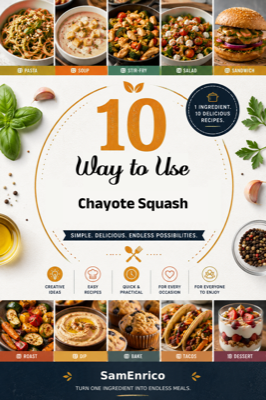 10 Ways to Use Chayote Squash (Recipe Book)Parish Erminia$11.99
 Language App Retention GuideParish Erminia$12.99
 Understanding Chromosome 15 RingParish Erminia$17.99
 Umber MiningParish Erminia$11.99