
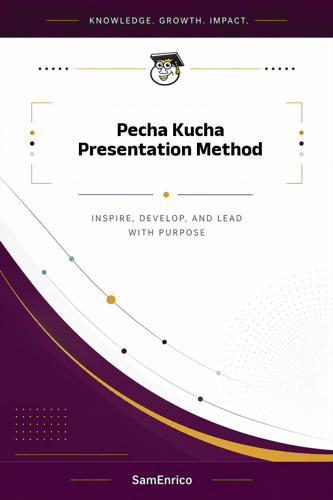
Non-FictionSelf-HelpAlternative Formats
Pecha Kucha Presentation Method eBook
Teaches the 20x20 format for fast paced, visually
by Slack Elmer
Teaches the 20x20 format for fast paced, visually driven presentations.
Formats
Free sample
Chapter 1: The Tokyo Constraint--–- Tokyo, 2003. A cramped basement lounge called Super Deluxe, tucked behind an electric toothbrush museum in the Roppongi district. The air smells of sake, sawdust, and the particular desperation of young architects who have been talking for forty-five minutes about a window detail. Their audience—other architects, mostly—has stopped pretending to listen. Phones glow under tables.
Eyes drift to the exit sign. One person is quietly folding a paper crane from a cocktail napkin.Astrid Klein and Mark Dytham, the Austrian-British duo who founded this small creative haunt, watch from the back of the room. They have seen this scene play out hundreds of times. A designer, brimming with passion for their work, stands before a screen and systematically murders that passion with bullet points, data-heavy slides, and a voice that becomes a monotone lullaby by minute twelve. The presenter believes they are being thorough.
The audience experiences slow suffocation.That night, after another rambling lecture finally limps to a close, Klein and Dytham stay late. They clear empty glasses from low tables and argue about what went wrong. The problem, they realize, is not the quality of the ideas. The problem is the container. Give a creative person an hour to speak, and they will fill that hour with everything they know.
They will add context, caveats, tangents, and backup slides. They will be thorough. And thoroughness, in live presentation, is indistinguishable from boredom.What if, they wondered, you forced the opposite? What if you gave someone a container so small that thoroughness became impossible? What if you demanded exactly twenty slides, each shown for exactly twenty seconds, and then the screen went dark—no exceptions, no extensions, no mercy?
They laughed at the cruelty of it. Then they stopped laughing. They named it Pecha Kucha, Japanese for the sound of conversation: "chit-chat."The first Pecha Kucha Night was held in that same basement lounge in February 2003. Twelve presenters. Six minutes and forty seconds each.
The rule was simple and absolute: twenty slides, twenty seconds per slide, auto-advance enabled. No remote control. No going back. No pausing for a sip of water or a nervous joke. When the timer clicked to slide twenty-one, your microphone dropped to zero, and the next presenter began.The architects who had been suffering through hour-long lectures now had only six minutes and forty seconds.
They could not explain every design decision. They could not walk through every floor plan. They had to choose. Twenty images. Twenty seconds of speech per image.
That was all.Something unexpected happened. The quality of presentations skyrocketed. Speakers who had previously been dry and meandering became sharp, emotional, even funny. Without time to explain, they had to imply. Without time to list data, they had to tell stories.
Without time to hide behind jargon, they had to be human. The audience, conditioned to expect boredom, found themselves leaning forward. The screen changed every twenty seconds—just often enough to prevent the brain from drifting, just slow enough to let one complete idea land.The night ended not with relieved applause but with genuine excitement. Presenters hugged. Audience members asked when the next night would be.
Someone said, "I have never been so nervous and so alive in the same six minutes."That was the beginning.The Global Spread of a Simple Idea Within twelve months, Pecha Kucha Nights had spread from that Tokyo basement to New York, London, Berlin, and Shanghai. The formula was viral by design: free to organize, easy to replicate, and powered by the universal human hatred of boring presentations. Anyone could host a night. The only requirement was the 20x20 rule. No licensing fees.
No corporate sponsorship. Just a timer, a projector, and twenty slides.By 2008, Pecha Kucha had reached over one hundred cities. By 2015, over one thousand. Architects remained the core audience—the format was born from their frustration—but the method leaked into every field that required public speaking. Educators used it to replace dreary student presentations.
Business leaders used it to enforce brevity in pitch meetings. Software developers used it to demo products without falling into feature-listing hell. A funeral director in Ohio used it to teach grieving families how to honor a life in six minutes. A veterinarian in Cape Town used it to explain emergency triage to pet owners.The format spread because it solved a problem that no one had realized was solvable. Before Pecha Kucha, the only known solutions to bad presentations were more preparation, more slides, or more charisma—all of which often made things worse.
The 20x20 rule offered something different: an external constraint that forced clarity. You did not need to be a naturally gifted speaker. You just needed to follow the rules. The rules would do the heavy lifting.Why Constraints Create Freedom This is the counterintuitive heart of the Pecha Kucha method, and it is the first principle you must internalize before reading another chapter. Constraints do not limit creativity.
They activate it.Most people believe the opposite. They think that more time, more slides, and more information will produce a better presentation. This is the "more is more" fallacy, and it is wrong. When you have unlimited time, you make unlimited poor decisions. You include the slide about the quarterly earnings report from 2017 because, well, it might be relevant.
You add the tangential anecdote about your summer internship because it humanizes you. You create a backup folder with forty-seven extra slides "just in case someone asks."All of that is fear dressed up as preparation. And the audience can smell it.The Pecha Kucha method replaces unlimited choice with radical constraint. Twenty slides. Twenty seconds.
No more. No less. This container is small enough that you cannot fill it with everything, which forces you to ask the only question that matters: What is essential?That question changes everything. When you ask what is essential, you stop adding and start cutting. You stop explaining and start implying.
You stop defending your expertise and start serving your audience. The constraint does not make your life harder—it makes your decisions clearer. You cannot include the 2017 earnings report because you only have twenty slides and slide four is already doing something more important. You cannot tell the internship anecdote because slide twelve needs those twenty seconds to land the emotional beat. The constraint becomes your editor, your ally, your excuse to be ruthless.This is why Pecha Kucha presentations often feel more emotional, more human, and more memorable than hour-long lectures.
The speaker is not fighting the format. They are riding it. The timer clicks forward like a heartbeat. Each slide arrives, delivers a single punch, and disappears before the audience has time to check their phone. The result is not a truncated lecture.
It is an entirely different genre of communication—one that respects time, attention, and the strange way human brains actually work.The Data Dump vs. The Emotional Journey To understand what Pecha Kucha achieves, you must first understand what it destroys. The enemy is the traditional presentation format that has dominated business, education, and conferences for decades. Call it the Data Dump.The Data Dump has recognizable symptoms.…
This is the end of the free sample. Get the eBook to keep going. Buy now
About this book
Details
- Author
- Slack Elmer
- Publisher
- SamEnrico
- Language
- English
- Genre
- Non-Fiction, Self-Help, Alternative Formats
- Released
- 2026-06-08
- Pages (approx.)
- 145
- Available as
- eBook, Audiobook

Read better in the ZLOADR app
Your eBooks on your phone or tablet. Sign in with your SamEnrico account and start reading.
More by Slack Elmer
 Body Language ConspiracySlack Elmer$11.99
 Outsourcing Data EntrySlack Elmer$11.99
 Fecal Calprotectin TrackingSlack Elmer$11.99
 Jan Pieterszoon Sweelinck: The Golden Voice of AmsterdamSlack Elmer$11.99
 MetallurgySlack Elmer$11.99
 How to Become a Corrugated-fastener DriverSlack Elmer$11.99
 Charity and Cause Pricing Without FearSlack Elmer$12.99
 How to Produce a Case SealerSlack Elmer$11.99
You may also like
 Hong Kong Handover 1997Dunn Johnnie$11.99
 Zumba For Postnatal Recovery CourseNeal Christian$11.99
 Zumba for BeginnersLadner Nikia$11.99
 YouTube Comment Mining GuideHumes Pandora$12.99
 Worry Box MeditationCarlin Rudy$11.99
 Workplace Stress MeditationNguyen Lynn$11.99
 Workplace Stress and Sleep RepairHawley Ivory$11.99
 Workplace Perfectionism CureDelaney Jeffry$11.99
 Workplace Injustice Anger GuideWallen Isabelle$11.99
 Work Addiction and Burnout LinkGreenwood Ester$11.99
 Women in Yoga and WellnessBeattie Galina$11.99
 Women in Stand Up ComedyChun Evangeline$11.99