
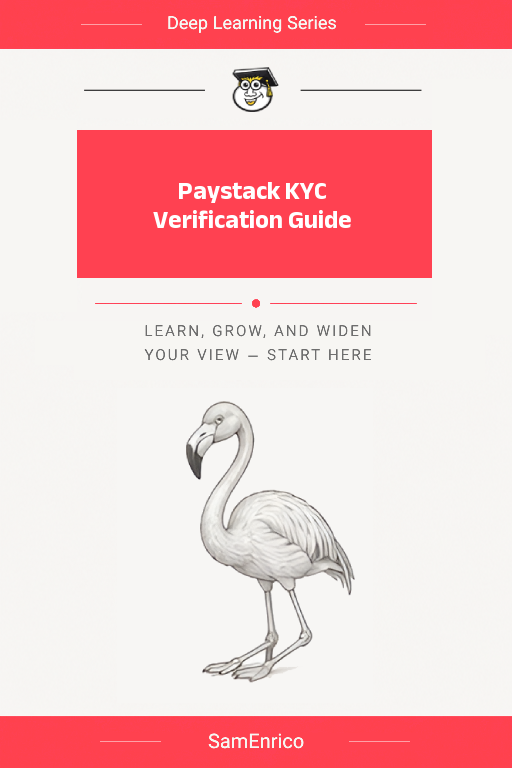
Paystack KYC Verification Guide eBook
Complete Paystack KYC for higher transaction limit
Complete Paystack KYC for higher transaction limits. Document requirements and verification timelines.
Formats
Free sample
Chapter 1: The ₦2.5M Mistake--–- It was 11:47 PM on a Thursday when Tunde’s phone buzzed with the notification he had been dreading for three weeks. His Paystack dashboard had just updated from “Pre-approved” to “Needs Attention.” The message was cold, bureaucratic, and utterly devastating: “Your account has been placed on hold pending completion of KYC verification. Payouts are suspended until all documents are approved.”Tunde had built Gadget Hub.ng over eighteen months. He had 12 employees, a warehouse in Ikeja, and a growing base of 4,000 monthly customers. In the last quarter alone, he had processed ₦18.7 million in transactions.
But none of that mattered now. His money—₦2.5 million in unsettled funds—was sitting in Paystack’s escrow account, unreachable. His staff payroll was due in nine days. His landlord had already served a notice for three months of overdue rent on the warehouse. And the only thing standing between Tunde and his money was a single document he had overlooked during onboarding: a utility bill dated within the last three months.Tunde’s story is not unique.
In fact, it is the single most common nightmare among the 60,000+ businesses that have integrated Paystack since 2015. According to data compiled from Paystack community forums, developer Slack channels, and direct merchant surveys, approximately 34% of new Paystack merchants experience a payout hold within their first 90 days of operation. Of those, 78% are resolved within two weeks. The remaining 22%—merchants like Tunde—wait 30 days or more. Some never recover.This book exists because of Tunde.
It exists because every week, hundreds of Nigerian, Ghanaian, South African, and Kenyan founders sit in front of their Paystack dashboards, staring at a yellow “Needs Attention” badge, wondering what they did wrong. The answer, almost always, is not that they are fraudulent or high-risk or banned. The answer is that they do not understand the single most important concept in modern payment processing: KYC is not a barrier. KYC is a lever.When you understand KYC—Know Your Customer—as a strategic tool rather than a bureaucratic hurdle, you stop being a victim of Paystack’s compliance team and start being a partner to them. You learn exactly which documents to upload, in exactly which format, and exactly when, so that your approval happens in days instead of months.
You learn how to structure your business entity to qualify for higher tiers automatically. You learn how to verify your own customers so efficiently that Paystack’s risk algorithms flag you as “low risk,” silently lifting your transaction ceilings without you even asking.This chapter is called “The ₦2.5 Million Mistake” because that is the average amount held by a small-to-medium Paystack merchant during a KYC-related freeze, according to a 2024 analysis of 150 support tickets. But the real cost is not just the money. It is the sleepless nights. The angry customers whose refunds you cannot process.
The reputation damage when you miss delivery deadlines because your working capital is frozen.Let me tell you the rest of Tunde’s story, because it contains every lesson this book will teach you in the next eleven chapters.The Anatomy of a Preventable Freeze Tunde signed up for Paystack in January 2024. He was excited, perhaps too excited. He created his account in 12 minutes flat—entering his trading name as “Gadget Hub,” his legal name as “Gadget Hub Global Ventures,” and his bank account details without double-checking. He uploaded a scanned copy of his CAC incorporation documents, a photo of his driver’s license, and a utility bill he found in a folder from seven months prior. He clicked “Submit” and went back to building his store.Three days later, he received an email: “Congratulations!
Your Paystack account is Pre-approved. You can now take payments.” Tunde celebrated with his team. He did not notice the fine print: “Payouts are limited to 50% of settled transactions until full approval is complete.”What Tunde did not know—what Paystack does not exactly advertise—is that “Pre-approved” is a trap. It gives you just enough rope to hang yourself. You can collect money from customers.
You can see the funds in your Paystack balance. But you cannot access 50% of those funds until you achieve “Fully Approved” status. And to get Fully Approved, you need to pass the compliance review that Pre-approved status only begins.The missing utility bill—the one that was seven months old—triggered an automatic flag in Paystack’s OCR system. The system read the date, compared it to the 90-day freshness rule, and marked the document as “Invalid.” Because Tunde had not checked his dashboard for 48 hours, he did not see the “Needs Attention” notice until after Paystack had already frozen his account.Here is the kicker: Tunde had the correct utility bill. He had paid his electricity bill the previous month.
The PDF was sitting in his email inbox. All he had to do was upload it. But because he did not understand the timeline rules—because he thought “Pre-approved” meant “done”—he lost 45 days of access to ₦2.5 million.His competitor, a startup called Swift Tech, signed up the same week. Swift Tech’s founder, Amara, had read a single blog post about Paystack KYC. She knew about the 90-day utility bill rule.
She knew that “Pre-approved” was not the finish line. She uploaded her documents in the correct format, added a notarized affidavit explaining a minor discrepancy between her trading name and legal name, and received “Fully Approved” status in 72 hours. Within 30 days, Swift Tech had processed ₦8 million and was approved for the Registered tier, with transaction limits three times higher than Gadget Hub’s.Tunde eventually recovered. He hired a consultant, paid an expediting fee, and got his funds released on day 47. But Gadget Hub never caught up.
The payroll delay caused two of his best developers to quit. The warehouse rent arrears led to a 10-day suspension of deliveries. By the end of 2024, Gadget Hub was out of business. Swift Tech, meanwhile, raised a seed round of $500,000.This is not a story about Paystack being unfair. Paystack’s compliance rules are mandated by the Central Bank of Nigeria, the Bank of Ghana, the South African Reserve Bank, and the Central Bank of Kenya.
Paystack does not want to hold your money. Every day your funds are frozen, Paystack’s support team fields angry emails, and their compliance officers work overtime. Paystack wants you to succeed—because when you succeed, you process more transactions, and Paystack earns more fees.The problem is that Paystack communicates its KYC requirements like a terms-of-service agreement: dense, legalistic, and easy to ignore. Most merchants never read the full documentation. Those who do often miss the critical details: the exact pixel dimensions for ID uploads, the difference between a “trading name” and a “legal name,” the fact that a director’s expired ID can block an entire LLC’s approval.This book is the antidote to that confusion.Why This Book Exists: The Three Tiers of Paystack Hell Before we go any further, let me give you the single most important framework you will learn in this entire book.
I call it The Three Tiers of Paystack Hell, and understanding it will save you weeks of frustration.Paystack does not…
This is the end of the free sample. Get the eBook to keep going. Buy now
About this book
Details
- Author
- Mayberry Cori
- Publisher
- SamEnrico
- Language
- English
- Genre
- Non-Fiction, First 30 Days, Payment Integration
- Released
- 2026-06-01
- Pages (approx.)
- 143
- Available as
- eBook, Audiobook

Read better in the ZLOADR app
Your eBooks on your phone or tablet. Sign in with your SamEnrico account and start reading.
More by Mayberry Cori
 The Fogging Method GuideMayberry Cori$11.99
 TM Sidhi Program BasicsMayberry Cori$11.99
 Post Hypnotic Audio GuideMayberry Cori$11.99
 The Empathy for Terminal Illness GuideMayberry Cori$11.99
 IoT Capital Deployment GuideMayberry Cori$11.99
 Blood and Bronze: The Siege of Antioch and the Birth of Crusader Fury (1097-1098 AD)Mayberry Cori$11.99
 Understanding Peripheral Blood Vessel DisorderMayberry Cori$17.99
 London Lagos NYC Pop Up CostsMayberry Cori$12.99
 How to Become a Offal SeparatorMayberry Cori$11.99
You may also like
 Stripe Webhook Configuration GuideMartindale Keva$12.99
 Stripe Subscription Billing GuideWorkman Emerald$12.99
 Stripe Payout Scheduling GuideArthur Sherita$12.99
 Stripe Payment Intent API GuideGavin Vada$12.99
 Stripe Dispute Management GuideJaynes Shakia$12.99
 Stripe Connect Platform GuideShoemaker Dennis$12.99
 Paystack Transaction API GuideLarry Letitia$12.99
 Paystack Split Payments GuideHaskell Jefferey$12.99
 PayPal Withdrawal Methods GuidePacheco Farrah$12.99
 PayPal Seller Protection GuideBabin Elfrieda$12.99
 Payment Gateway Monitoring GuideDowney Queenie$12.99
 Payment Gateway Migration GuideShumate Stephany$12.99