
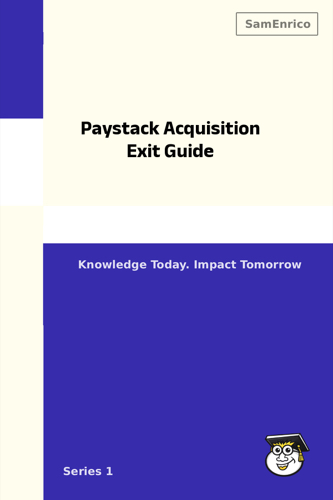
Paystack Acquisition Exit Guide Audiobook
Analyze the 200M Stripe purchase of Nigeria's fint
Analyze the 200M Stripe purchase of Nigeria's fintech leader as exit model.
Formats
Free sample
Chapter 1: The Trust Deficit--The first time Shola Akinlade watched a merchant refuse a working payment link, he almost laughed. Almost. The merchant had just spent fifteen minutes explaining how his last online payment gateway had “eaten” three weeks of revenue. The bank blamed the processor. The processor blamed the bank.
The customers blamed the merchant. And somewhere in that chain of broken promises, 1.2 million naira simply vanished. No refund. No explanation. No apology.
Just a ticket number that remained “under review” for six months before being closed without resolution.That merchant wasn't unusual. In Nigeria in 2015, he was the rule.“I will pay cash,” the merchant said, handing over crumpled bills. “At least when cash disappears, I know I was the one who lost it.”That line stuck with Akinlade. It revealed something deeper than a technical problem. It revealed a civilization of zero trust—a digital economy where every transaction carried the quiet suspicion of theft, where the default assumption was not “this will work” but “this will probably fail, and I will have no recourse.”This is the problem that Paystack solved.
Not the technology of payments—that existed already—but the psychology of trust. And understanding that distinction is the first and most important lesson of the Paystack acquisition exit guide. Because Stripe did not buy Paystack for its code. Stripe bought Paystack for its trust.The Nigeria Problem That Wasn't Technical To understand what Paystack built, you must first understand what already existed. In 2015, Nigeria had functional payment gateways.
Interswitch, founded in 2002, had built the backbone of the country's electronic payments. Paga, founded in 2009, had registered millions of users for mobile money. Numerous smaller gateways offered online payment processing for e-commerce merchants.From a purely technical perspective, a merchant in Lagos could accept a credit card online in 2015. The infrastructure existed. The banks were connected.
The settlement rails were mostly functional.And yet, less than 2 percent of Nigerian e-commerce transactions happened online. The other 98 percent defaulted to cash on delivery.Let that number sit for a moment. Ninety-eight percent. In an economy with over 180 million people, growing internet penetration, and a booming middle class, almost no one was willing to pay digitally for goods ordered online. Not because the technology failed, but because they trusted it about as far as they could throw their modem.The reasons were not abstract.
Online fraud was rampant—not necessarily in volume, but in the psychological damage of each incident. A customer who lost 50,000…
This is the end of the free sample. Get the Audiobook to keep going. Buy now
About this book
Details
- Author
- Shoemaker Dennis
- Publisher
- SamEnrico
- Language
- English
- Genre
- Non-Fiction, Business Brief, Fintech
- Released
- 2026-06-08
- Pages (approx.)
- 126
- Available as
- eBook, Audiobook

Listen in the VoxFlicks app
Audiobooks and audio dramas wherever you go. Sign in with your SamEnrico account and press play.
More by Shoemaker Dennis
 HRT For Cognitive Function Dementia GuideShoemaker Dennis$11.99
 Logistics Tech Investment PlanShoemaker Dennis$11.99
 Child Post Hypnotic GuideShoemaker Dennis$11.99
 The Empathy for Infertility GuideShoemaker Dennis$11.99
 The Maestro of Strings: Manuel Velázquez and the Birth of the Modern GuitarShoemaker Dennis$11.99
 Understanding Pericardial Defect Diaphragmatic HerniaShoemaker Dennis$17.99
 Stripe Connect Platform GuideShoemaker Dennis$12.99
 London Pop Up Permits and RegulationsShoemaker Dennis$12.99
 ScrapbookingShoemaker Dennis$11.99
 How to Start a Theme Parks BusinessShoemaker Dennis$11.99
You may also like
 Lagos Pop Up Payment SystemsWarden Laurinda$11.99
 Jamaican Financial Services SupportMccauley Layla$11.99
 Kopo Kopo Acquisition StoryMccallum Lu$11.99
 Mobile Banking for CooperativesPence Markita$11.99
 Franchising Your Local Brand Across Borders Payment ProcessingOverstreet Kaye$11.99
 Online Rent Payment SetupNewby Towanda$11.99
 Fintech Alternatives to SWIFTCoe Ciera$12.99
 Ghana Payment Gateway GuideFisher Aubrey$12.99
 Fintech Factoring Platforms GuideBarela Sunday$12.99
 Fintech Business Credit GuideBueno Meghann$12.99
 Bootstrapper Cash Flow Automation CourseHermann Alba$12.99
 AI Accounting Tools for Small BusinessBuckingham Shiloh$12.99