
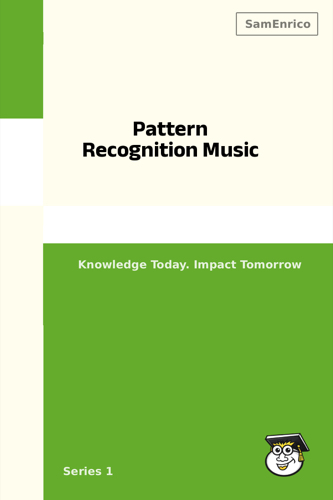
Free sample
Chapter 1: The Listening Paradox--–- The first time a machine heard music, it didn’t know what to do with the silence between the notes.In the winter of 1952, at Bell Laboratories in Murray Hill, New Jersey, a researcher named Harry Olson leaned close to a bulky contraption of vacuum tubes and copper wiring. The device, which he called the “Electronic Music Recognizer,” was the size of a refrigerator and capable of exactly one task: identifying a single musical note played on a single instrument. It could not recognize chords. It could not handle a change in tempo. It certainly could not tell you whether you were listening to Beethoven or the Beatles.
But when Olson played a pure, steady C4 on a flute into its crude microphone, the machine’s needles twitched, its relays clicked, and a small light labeled “C4” illuminated. The machine had heard. And in that moment, a quiet revolution began.Olson’s machine was not a failure. By the standards of its time, it was a miracle. But it was also a profound confession of ignorance.
The machine could recognize a note only because a human had already told it exactly what to listen for: the frequency of a C4 (approximately 261.63 Hertz), the expected duration, the lack of any competing sounds. Remove any of those conditions—play a chord, speed up the tempo, add room noise—and the recognizer collapsed into gibberish. Olson had built a machine that could recognize patterns only in a universe stripped of all the complexity that makes music worth listening to. The listening paradox was born: the easier a pattern is for a machine to recognize, the less it sounds like actual music.The Question That Refuses to Go Away This book is about that paradox and everything it has spawned in the seventy years since Olson’s refrigerator-sized triumph. It is about the quiet revolution that turned pattern recognition from a philosophical curiosity into the technology that powers Shazam, Spotify’s recommendation engine, and the AI that can listen to a thousand hours of garage band recordings and pick out the next hit single.
But this book is also about something deeper. It is about what happens when we ask a machine to do something that seems effortless for a human—listening to music—and discover that the effortlessness is an illusion.Consider what happens when you hear a song you love. Within milliseconds, your auditory cortex has decomposed the pressure wave into frequency components. Your brain has identified the beat, tracked the tempo, separated the vocal melody from the guitar accompaniment, recognized the singer’s voice, recalled the song’s structure (here comes the chorus), and triggered an emotional response—all before you have consciously registered that the song has begun. This is pattern recognition at its most astonishing: fast, parallel, unconscious, and deeply personal.Now ask a machine to do the same thing.
Suddenly, every step becomes a research problem. How do you find the beat when there is no percussion track? How do you separate overlapping notes when their frequencies interfere? How do you recognize a familiar melody when it is played in a different key, at a different tempo, on a different instrument? How do you know that a “wrong” note in a jazz solo is not an error but an expression?
These are not merely technical questions. They are philosophical ones. They ask: what is music? What is hearing? And what does it mean that a machine—with no ears, no emotions, no memories of its own—can now perform tasks that, not long ago, seemed uniquely human?This chapter begins the answer by tracing the origins of musical pattern recognition back to its roots: not in computer science, but in ancient philosophy, fundamental physics, and the strange wiring of the human brain.
The argument is simple but profound: pattern recognition is not something we impose on music. It is something music already is. The mathematical relationships that govern harmony, the physical laws that produce timbre, and the neural circuits that detect coincidence—these are not inventions. They are discoveries. The machine, for all its cold calculation, is merely formalizing what nature and evolution already built.The Pythagorean Discovery: Music as Number The story begins not in a laboratory but in ancient Greece, around 500 BCE, with a man named Pythagoras.
Most people remember Pythagoras for his theorem about right triangles, but he was also obsessed with a more mystical question: why do some combinations of sounds feel beautiful while others feel harsh? According to legend, Pythagoras was walking past a blacksmith’s shop when he noticed that the hammers produced different pitches depending on their weight. He rushed home, experimented with weighted strings, and discovered something remarkable.When two strings are plucked together, they produce a pleasant sound—a “consonant” interval—if the lengths of the strings are in simple whole-number ratios. A 2:1 ratio produces an octave. A 3:2 ratio produces a perfect fifth.
A 4:3 ratio produces a perfect fourth. These intervals sounded beautiful not because of culture or convention, Pythagoras argued, but because they reflected a deeper mathematical truth about the universe. He called this truth the “harmony of the spheres”—the idea that the planets, as they moved through the heavens, produced inaudible music governed by the same mathematical laws.This was the first recorded instance of what we now call the pattern recognition hypothesis: that musical structure is not arbitrary but mathematical, and that beauty arises when our ears detect these mathematical relationships. Pythagoras could not have known how prescient he was. Two thousand years later, when engineers began building automatic music transcription systems, they discovered that the same whole-number ratios were the key to pitch detection.
A note’s fundamental frequency (the pitch we hear) is always accompanied by overtones at integer multiples of that frequency. The recognizer that identifies a C4 is, in essence, listening for Pythagoras’s ratios.But Pythagoras left a problem unsolved. He could explain why an octave sounds consonant, but he could not explain why a major chord (with its ratios of 4:5:6) sounds “happy” while a minor chord (with ratios of 10:12:15) sounds “sad.” The ratios are still simple; the emotional valence is different. This gap—between mathematical pattern and emotional meaning—will haunt every chapter of this book. Machines can hear the ratios.
They cannot hear the sadness. That distinction, as we will see, is both the triumph and the tragedy of pattern recognition music.The Overtone Series: Physics’s Hidden Fingerprint Pythagoras’s ratios were the first clue that music is built on mathematical foundations. But the real breakthrough—the one that makes machine recognition possible—came from physics, specifically from the study of vibrating objects. When you pluck a guitar string, you do not hear a single frequency. You hear a fundamental pitch (say, 110 Hertz, which is an A2) plus a series of quieter, higher frequencies at integer multiples of the fundamental: 220 Hz, 330 Hz, 440 Hz, 550 Hz, and so on.
This is the overtone series.The overtone series is not an obscure fact for acousticians. It is the physical reason why a violin sounds different from a flute even when both play the same note. The…
This is the end of the free sample. Get the eBook to keep going. Buy now
About this book
Details
- Author
- Jean Malia
- Publisher
- SamEnrico
- Language
- English
- Genre
- Non-Fiction, Self-Help / Music
- Released
- 2026-06-07
- Pages (approx.)
- 150
- Available as
- eBook, Audiobook

Read better in the ZLOADR app
Your eBooks on your phone or tablet. Sign in with your SamEnrico account and start reading.
More by Jean Malia
 The Gacy Psychiatric EvaluationJean Malia$11.99
 Caffeine and Memory SleepJean Malia$11.99
 Opioid Overdose Reversal GuideJean Malia$11.99
 LTC Insurance Middle Income GuideJean Malia$11.99
 The Reformation in TransylvaniaJean Malia$11.99
 Sexual Addiction and ADHDJean Malia$11.99
 TM Teacher Training OverviewJean Malia$11.99
 The Fire Below: Katia and Maurice Krafft’s Volcanic OdysseyJean Malia$11.99
 Revolutionaries Master GuideJean Malia$11.99
 The Bloodied Snows of Quebec: Wolfe’s Last Stand at the Plains of Abraham (1759)Jean Malia$11.99
 The Mind of the Unabomber: Decoding a Lone Wolf’s DescentJean Malia$11.99
 Freemium Zero Rated Data GuideJean Malia$12.99
You may also like
 Hong Kong Handover 1997Dunn Johnnie$11.99
 Zumba For Postnatal Recovery CourseNeal Christian$11.99
 Zumba for BeginnersLadner Nikia$11.99
 YouTube Comment Mining GuideHumes Pandora$12.99
 Worry Box MeditationCarlin Rudy$11.99
 Workplace Stress MeditationNguyen Lynn$11.99
 Workplace Stress and Sleep RepairHawley Ivory$11.99
 Workplace Perfectionism CureDelaney Jeffry$11.99
 Workplace Injustice Anger GuideWallen Isabelle$11.99
 Work Addiction and Burnout LinkGreenwood Ester$11.99
 Women in Yoga and WellnessBeattie Galina$11.99
 Women in Stand Up ComedyChun Evangeline$11.99