
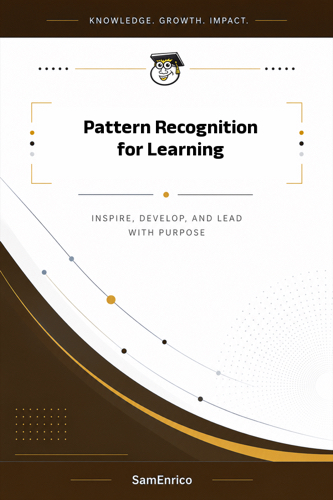
Pattern Recognition for Learning eBook
Accelerate subject mastery by identifying recurrin
Accelerate subject mastery by identifying recurring themes and structures.
Formats
Free sample
Chapter 1: The Highlighting Trap...--Sarah was a good student. At least, that’s what everyone told her. She showed up to every anatomy lecture, sat in the third row, and took meticulous notes. Her textbook was a work of art—each page swimming in a rainbow of highlighter colors. Pink for definitions.
Yellow for key processes. Blue for structures to memorize. Green for anything the professor repeated twice.She studied sixty hours a week. Sixty. That’s more than a full-time job.
Her friends had stopped asking her to go out. Her mother called and asked if she was eating properly. Sarah assured everyone she was fine. She was grinding. She was putting in the work.And she was failing.Not spectacularly—not the kind of failure that gets you a dramatic meeting with the dean.
The slow, demoralizing kind. Mid-seventies on exams. Then low seventies. Then, in the second midterm of her third semester, a sixty-two. She stared at the scantron as if it had personally betrayed her.
She had highlighted every page. She had read every chapter twice. She had made flashcards. She had done everything she was supposed to do.So why couldn’t she remember any of it?The Most Expensive Lie in Education Sarah is not real. But she is also everywhere.Every semester, millions of students sit down with textbooks, highlighters, and the sincere belief that if they just cover the material, they will learn it.
They re-read chapters. They review their notes. They cram before exams. And then, days or even hours later, the information evaporates like morning dew.This is not a moral failing. It is not a lack of effort.
It is not a problem of intelligence.It is a problem of method.For decades, cognitive psychologists have known that the most common study techniques—highlighting, re-reading, underlining, summarizing, cramming—are among the least effective. In a landmark 2009 study, researchers Jeffrey Karpicke and Henry Roediger III asked students to learn a set of foreign language vocabulary words. Some students studied the words repeatedly. Others practiced retrieving the words from memory. One week later, the students who had simply re-read the material forgot more than half of what they had learned.
The students who practiced retrieval forgot almost nothing.Here is the uncomfortable truth that no one tells you in school: your brain is not a hard drive. It does not store information like files on a computer. You cannot simply “write” data to your memory by reading it enough times. If that worked, you would remember every conversation you have ever had, every commercial you have ever seen, every street you have ever walked down. You do not.
Because repetition alone is not enough.So what is your brain? If it is not a hard drive, what is it?The answer changes everything.Your Brain: A Prediction Machine, Not a Camera Let me introduce you to a neuroscientist named Andy Clark. In his book Surfing Uncertainty, Clark argues that the brain is not primarily a recording device. It is not a camera. It is not a library.The brain is a prediction engine.Every moment of every day, your brain is running a silent, relentless simulation of the world.
It is constantly asking one question: “What happens next?” When you walk into your kitchen, your brain predicts where the counter is, where the refrigerator is, where the coffee maker lives. When you hear the first few notes of a song you know, your brain predicts the next note. When someone says, “How are you?” your brain predicts the expected response: “Fine, thanks. And you?”These predictions are so fast and so automatic that you never notice them. But they are happening all the time.
And here is the crucial insight for learning: your brain learns best when it makes a prediction and then finds out whether it was right.The technical term for this is prediction error learning. When your brain predicts something and the prediction is wrong, that mismatch creates a small burst of neural activity. That burst signals to your brain: “Pay attention. Update your model.” The more surprising the error, the stronger the learning signal.Now think about what happens when you read a textbook chapter with a highlighter. You are not making predictions.
You are passively absorbing. Your brain is not asking, “What will the next paragraph say?” It is not checking its guesses against reality. It is just receiving. And what does the brain do with information that was not preceded by a prediction? It treats it as background noise.
It files it away in the “not important” folder. Within hours, that information is gone.This is why Sarah failed. She worked hard. She studied longer than anyone she knew. But she was studying passively.
Her brain was never engaged in the one activity that actually creates lasting memory: predicting and updating.Experts Don’t Know More Facts. They See Different Patterns.If passive studying is the problem, what is the solution?The answer lies in understanding how experts think differently from novices. And the research on this is remarkably consistent across every domain you can imagine.In the 1970s, the cognitive psychologist William Chase studied chess masters. He wanted to know what made them so much better than average players. His first hypothesis was simple: maybe they just knew more facts about chess.
Maybe they had memorized more openings, more endgames, more tactical patterns.So Chase tested this. He showed chess masters and novices a chess board with pieces arranged in a realistic game position. He asked them to look at the board for five seconds, then recreate the position from memory.The chess masters were nearly perfect. They remembered the positions of twenty or more pieces without error. The novices could only remember four or five.Case closed, right?
Experts just have better memory.Not so fast.Chase then ran a second experiment. This time, he arranged the chess pieces randomly—in positions that could never occur in a real game. The masters no longer had a memory advantage. They performed no better than the novices.What does this tell us? Chess masters were not memorizing individual piece positions.
They were recognizing patterns of pieces that recur across thousands of games. When the board was arranged randomly, those patterns were absent, and the masters’ advantage disappeared.This is the single most important finding in the science of expertise: experts do not know more facts than novices. They know more patterns.A chess master sees the board not as thirty-two individual pieces but as a handful of attack formations, defensive structures, and tactical motifs. A radiologist does not see a CT scan as thousands of individual pixels but as a small set of anomaly patterns—bleeding, tumors, fractures. A master electrician does not see a circuit board as dozens of wires and components but as repeating functional blocks: power supply, signal path, ground loop.The same is true in every subject you are trying to learn.
Biology is not a million isolated facts. It is a small set of recurring patterns: cause/effect relationships, hierarchical taxonomies, process sequences, feedback loops. History is not a giant timeline…
This is the end of the free sample. Get the eBook to keep going. Buy now
About this book
Details
- Author
- Benitez Horacio
- Publisher
- SamEnrico
- Language
- English
- Genre
- Non-Fiction, Self-Help, Learning Strategies
- Released
- 2026-06-07
- Pages (approx.)
- 147
- Available as
- eBook, Audiobook

Read better in the ZLOADR app
Your eBooks on your phone or tablet. Sign in with your SamEnrico account and start reading.
More by Benitez Horacio
 Tropical Hammock NapBenitez Horacio$11.99
 Resume Canada Specific GuideBenitez Horacio$11.99
 CRE Leasing Commission GuideBenitez Horacio$11.99
 Complicated Grief Medications GuideBenitez Horacio$11.99
 Meth Recovery Journal MethodBenitez Horacio$11.99
 The Interruption Log WorkbookBenitez Horacio$11.99
 Navy Female OfficerBenitez Horacio$11.99
 Travis Kalanick UberBenitez Horacio$11.99
 The Lost Rivers of the Tarim: Prehistoric Cave Divers of Central AsiaBenitez Horacio$11.99
 Whispers of the Forgotten: The Lost Library of Alexandria’s Last KeeperBenitez Horacio$11.99
 The Forbidden Crown: Love and Betrayal in the Court of Tsar Nicholas IIBenitez Horacio$11.99
 The Complete Guide to How to Lose Weight ForeverBenitez Horacio$11.99
You may also like
 Interleaved Studying PracticeLarue Lera$11.99
 Chunking Study MaterialThomson Lucina$11.99
 Interleaving Practice for Problem SolvingMcgrath Rueben$11.99
 Chunking Abstract ConceptsMarx Lane$11.99
 Memory Retention Study GuideReiter Bonny$11.99
 Interleaving Study MethodKroll Ermelinda$11.99
 Loci Palace Construction HandbookStover Tenisha$11.99
 The Sleep Dependent Learning GuideHammonds Warner$11.99