
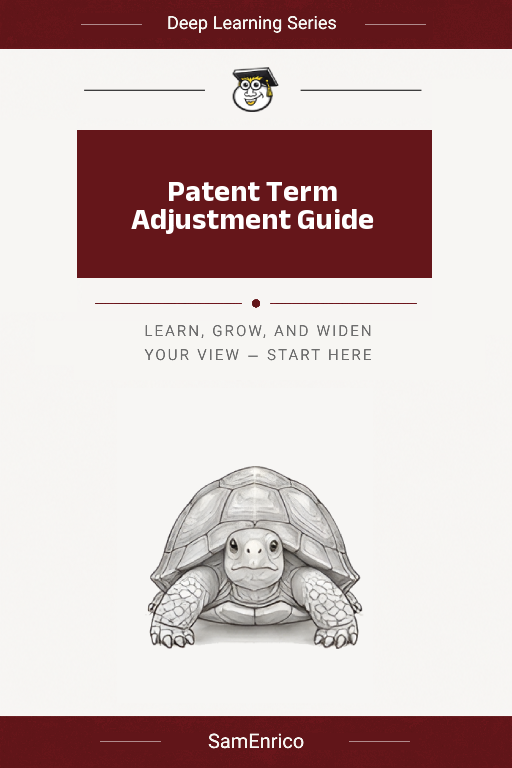
Non-FictionAnnual CheckupPatent TermAdjustment
Patent Term Adjustment Guide
Calculate patent term adjustment for USPTO delays
Calculate patent term adjustment for USPTO delays and file for extension if applicable within deadlines.
Formats
About this book
Free sample
Chapter 1: The 20-Year Lie--–- Your patent says 20 years from filing. But the clock started ticking the day you filed, and every day the USPTO spends examining your application is a day of market exclusivity you will never get back. For patents with prolonged prosecution, the effective term can shrink to 15 years, 12 years, or even less. The "20-year patent term" is one of the most persistent and costly misconceptions in intellectual property.I have sat across the table from patent owners who discovered this truth only after their patent issued—when it was too late to do anything about it. A biotech startup founder who watched a competitor launch a generic version of his drug 18 months before his patent expired.
A university technology transfer officer who licensed a patent with a calculated 4 years of remaining term, only to discover that USPTO delays had reduced it to 2 years. A solo inventor who assumed the patent office would automatically calculate the correct term, never questioning the "0 days adjustment" on his Notice of Allowance.This chapter demolishes the comfortable fiction that a U.S. patent provides exactly 20 years of enforceable protection from its filing date. It traces the statutory evolution of patent term from the pre-1995 system to the current regime. It explains the problem Patent Term Adjustment (PTA) was designed to solve—and why most patent owners still lose days they could have claimed.
And it introduces the foundational principle that runs throughout this book: PTA is not a gift from the USPTO. It is a statutory right that you must calculate correctly, claim proactively, and defend vigorously.The Pre-1995 World: 17 Years from Grant Before June 8, 1995, the United States calculated patent term differently than almost every other country. A U.S. patent expired 17 years from the date the patent issued—not from the filing date. This system had a peculiar incentive: the longer the USPTO took to examine the application, the longer the patent term.
A patent that took 5 years to issue would expire 17 years later, giving the patent owner a total of 22 years from filing. A patent that…
This is the end of the free sample. Get the eBook to keep going. Buy now
Contents
- Chapter 1
- Chapter 2
- Chapter 3
- Chapter 4
- Chapter 5
- Chapter 6
- Chapter 7
- Chapter 8
- Chapter 9
- Chapter 10
- Chapter 11
- Chapter 12
Details
- Author
- Ritchey Loren
- Publisher
- SamEnrico
- Language
- English
- Genre
- Non-Fiction, Annual Checkup, Patent Term, Adjustment
- Released
- 2026-06-01
- Pages (approx.)
- 121
- Available as
- eBook, Audiobook

Read better in the ZLOADR app
Your eBooks on your phone or tablet. Sign in with your SamEnrico account and start reading.
More by Ritchey Loren
 Plant Based Omega 3 Fatty Acids ManualRitchey Loren$11.99
 TM Emotional IntelligenceRitchey Loren$11.99
 Disappointment Tolerance ManualRitchey Loren$11.99
 Upper Back Mobility WorkRitchey Loren$11.99
 Imposter Syndrome in ConsultingRitchey Loren$11.99
 The Siege of the Grand Hotel: 1975 Sydney's Deadliest StandoffRitchey Loren$11.99
 Echoes of the Forbidden: The Lost Love Letters of Elizabeth and DarcyRitchey Loren$11.99
 Understanding Craniosynostosis, Sagittal, With Dandy-walker Malformation and HydrocephalusRitchey Loren$17.99
 UN Department of SafetyRitchey Loren$12.99
 Oracle Database DeveloperRitchey Loren$11.99
 How to Start a Bread (wholesale) Business (Beginners Guide)Ritchey Loren$11.99
You may also like
 Hong Kong Handover 1997Dunn Johnnie$11.99
 Zumba For Postnatal Recovery CourseNeal Christian$11.99
 Zumba for BeginnersLadner Nikia$11.99
 YouTube Comment Mining GuideHumes Pandora$12.99
 Worry Box MeditationCarlin Rudy$11.99
 Workplace Stress MeditationNguyen Lynn$11.99
 Workplace Stress and Sleep RepairHawley Ivory$11.99
 Workplace Perfectionism CureDelaney Jeffry$11.99
 Workplace Injustice Anger GuideWallen Isabelle$11.99
 Work Addiction and Burnout LinkGreenwood Ester$11.99
 Women in Yoga and WellnessBeattie Galina$11.99
 Women in Stand Up ComedyChun Evangeline$11.99