
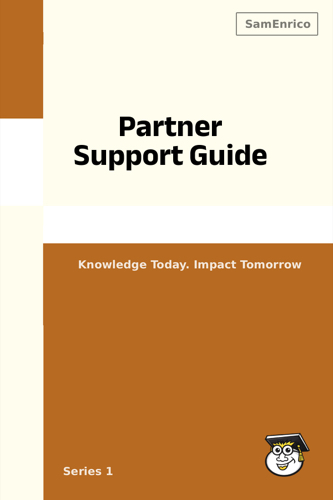
Non-FictionHealth & WellnessRelationships
Partner Support Guide eBook
Teaches recognizing PPD and encouraging treatment
by Cheung Jack
Teaches recognizing PPD and encouraging treatment seeking.
Formats
Free sample
Chapter 1: The Mask You Never Saw...--The first time Mark noticed something was wrong, his wife Emily was standing in front of the refrigerator with the door open. It was 2:00 AM. The baby had been asleep for three hours—a rare gift—and Mark had woken up to find Emily still awake, staring into the light of an open fridge, not moving. She wasn't hungry. She wasn't looking for anything.
She was just... standing there. When he asked what she was doing, she said, "I don't know. I don't know anything anymore." He closed the fridge door, took her hand, and led her back to bed. The next morning, she made pancakes.
She smiled at the baby. She posted a photo on social media captioned "So tired but so in love." Mark almost convinced himself the 2:00 AM moment hadn't happened at all.It took him eight more weeks to realize that the woman in the refrigerator light was the real Emily, and the woman making pancakes was the mask.If you are reading this book, you have already noticed something. Maybe it's small. Maybe it's the way she stopped finishing her sentences. Maybe it's the way she flinches when the baby cries—not with annoyance, but with something that looks like fear.
Maybe it's the way she says "I'm fine" too quickly, or the way she's started organizing the pantry at midnight, or the way she looked at you last week when you asked how she was doing and for just a second, before she smiled, you saw something hollow behind her eyes.You are not imagining it.This book is going to teach you how to be a First Responder. Not a doctor, not a therapist, not a savior. A First Responder. Someone who recognizes the signs of a medical crisis before it becomes an emergency, who knows how to approach a person in distress without making them feel worse, and who can navigate a broken healthcare system to get that person the help they need. The title of this book is Partner Support Guide, but the role you are about to step into is far more active than "support." You are about to become the person who catches her before she falls.But before we talk about symptoms and scripts and emergency rooms, we have to talk about something more fundamental: what actually happened to your partner.
Because you cannot recognize the signs of postpartum depression unless you first understand the earthquake that caused it.The Earthquake You Didn't Feel Pregnancy and childbirth are treated by our culture as a medical event. You go to appointments, you track the baby's size, you pack a hospital bag, and then you bring home a newborn. What no one tells you—what no one told your partner—is that giving birth is also a psychological event of such magnitude that it has its own name: matrescence.Matrescence is the developmental transition into motherhood. It was coined by anthropologist Dana Raphael in the 1970s and later expanded by psychologist Aurelie Athan, who describes it as "the process of becoming a mother." Like adolescence, matrescence involves profound physical changes, hormonal shifts, identity fragmentation, social role renegotiation, and a loss of the old self. Unlike adolescence, which takes years and is expected to be messy, matrescence is supposed to happen in a matter of weeks, and society expects it to look beautiful.Here's what matrescence actually looks like: the death of the woman she used to be.
Not metaphorically. Clinically. The person who went to brunch with friends, who had opinions about things that weren't baby-related, who could take a shower without planning it forty-five minutes in advance, who knew what she wanted for dinner—that person is gone. In her place is someone who is simultaneously a mother, a wife, a daughter, an employee, a housekeeper, a chef, a night watchman, and a stranger to herself. The old identity doesn't fade gradually.
It shatters.Your partner didn't just have a baby. She had an identity crash.The Identity Crash The identity crash is the moment when the gap between expectation and reality becomes too wide to ignore. Every new mother carries an internal image of what a "good mother" looks like. This image comes from everywhere: her own mother, social media, movies, books, friends, and a thousand tiny cultural messages that say a good mother is patient, selfless, joyful, instinctive, and eternally grateful. She imagined herself rocking a sleeping infant in a sunlit nursery, feeling a wave of overwhelming love.
She imagined that her love for the baby would make the sleep deprivation and the recovery and the loss of autonomy feel worth it.Then reality arrives. The baby won't stop crying. She hasn't slept more than ninety consecutive minutes in three weeks. Her body feels foreign—maybe still in pain, maybe leaking milk at random moments, maybe carrying weight that won't budge. She resents the baby for needing her constantly, and then she feels monstrous for resenting the baby because a good mother wouldn't feel that way.
She looks at her partner and feels a mix of longing and irritation because he can sleep through the night and leave the house without packing a diaper bag, and then she feels guilty for resenting him too.The gap between expectation and reality is called cognitive dissonance, and it is unbearable. The human mind cannot hold two opposing truths for very long. So it resolves the dissonance the only way it knows how: by deciding that she is the problem. She isn't a good mother. She is broken.
She is failing. Everyone else seems to be handling it. Why can't she?This is the identity crash. And it happens to nearly every new mother to some degree. For most, it resolves as they adjust to the new identity and build a realistic picture of motherhood.
But for one in five, the crash doesn't resolve. It deepens. And that deepening is the soil in which postpartum depression and anxiety grow.The Good Mother Myth Let me be very clear about something: the identity crash is not her fault. It is not caused by a character flaw, a lack of gratitude, or a failure of will. The identity crash is caused by a lie.
A pervasive, destructive, almost universally believed lie called the Good Mother Myth.The Good Mother Myth says that a good mother is selfless—that she should be happy to give up her sleep, her body, her career, her friendships, her hobbies, and her sense of self for the sake of her child. A good mother is joyful—that the love she feels for her baby should outweigh any difficulty, and if it doesn't, something is wrong with her. A good mother is instinctive—that mothering should come naturally, without instruction or support. A good mother is patient—that she should never raise her voice, never feel rage, never wish for five minutes of silence. A good mother is grateful—that she should never complain, because she asked for this, because the baby is healthy, because others have it worse.The Good Mother Myth is everywhere.
It is in the Instagram feed of the influencer whose baby sleeps through the night and whose hair is always…
This is the end of the free sample. Get the eBook to keep going. Buy now
About this book
Details
- Author
- Cheung Jack
- Publisher
- SamEnrico
- Language
- English
- Genre
- Non-Fiction, Health & Wellness, Relationships
- Released
- 2026-06-06
- Pages (approx.)
- 137
- Available as
- eBook, Audiobook

Read better in the ZLOADR app
Your eBooks on your phone or tablet. Sign in with your SamEnrico account and start reading.
More by Cheung Jack
 Ayurvedic Tongue DiagnosisCheung Jack$11.99
 Waste Management Multiples ManualCheung Jack$11.99
 Tom Watson Duel LifeCheung Jack$11.99
 UAE Virtual Work ProgramCheung Jack$11.99
 The Golf Course LaborerCheung Jack$11.99
 Expert Testimony on Memory FallibilityCheung Jack$11.99
 Alcohol Recovery After TraumaCheung Jack$11.99
 The Phantom Fleet: The Billion-Dollar Luxury Car Laundering RingCheung Jack$11.99
 The Bloodhounds of Scotland Yard: The First K9 Crime Solvers (1930s)Cheung Jack$11.99
 How to Produce Hospital CurtainsCheung Jack$11.99
 EA Remote Internship GuideCheung Jack$12.99
 Responsible Jewellery Council ExportCheung Jack$12.99
You may also like
 Hong Kong Handover 1997Dunn Johnnie$11.99
 Zumba For Postnatal Recovery CourseNeal Christian$11.99
 Zumba for BeginnersLadner Nikia$11.99
 YouTube Comment Mining GuideHumes Pandora$12.99
 Worry Box MeditationCarlin Rudy$11.99
 Workplace Stress MeditationNguyen Lynn$11.99
 Workplace Stress and Sleep RepairHawley Ivory$11.99
 Workplace Perfectionism CureDelaney Jeffry$11.99
 Workplace Injustice Anger GuideWallen Isabelle$11.99
 Work Addiction and Burnout LinkGreenwood Ester$11.99
 Women in Yoga and WellnessBeattie Galina$11.99
 Women in Stand Up ComedyChun Evangeline$11.99