
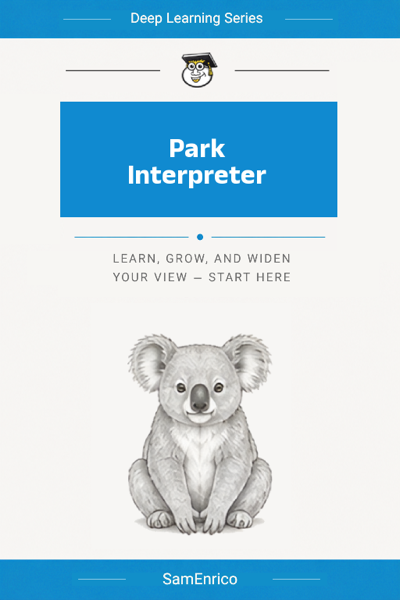
Non-FictionInformativeEducational
Park Interpreter eBook
A Coursebook on Park Interpreter
A Coursebook on Park Interpreter
Formats
Free sample
Chapter 1: The Matchmaker's Secret...--It was 7:15 on a July morning, and I was standing in a half-empty parking lot at a state park in rural Oregon, holding a dead bird.Not a fake bird. Not a prop. An actual, recently deceased, slightly still-warm orange-crowned warbler that had flown into a window twenty minutes earlier. My supervisor had handed it to me in a paper towel and said, "First program starts in forty-five minutes. Make it matter."I had no idea what she meant.
I had a degree in environmental science. I had memorized the names of every tree, every bird call, every geological formation in this 4,000-acre park. I had passed the Certified Interpretive Guide exam with a score that made my mother cry happy tears. But nobody had taught me what to do with a dead bird and a crowd of strangers who had come for a pleasant walk, not a lesson in avian mortality.That morning, I learned the secret that every great park interpreter eventually discovers, usually through humiliation: you are not a teacher. You are a matchmaker.The families who piled out of minivans that day did not want a lecture on window strike mortality rates.
They wanted wonder. They wanted to feel something. They wanted to go home with a story, not a fact sheet. And the bird in my hand—that small, still, impossibly delicate body with feathers like olive velvet—was not a specimen. It was a messenger.
My job was not to explain it. My job was to introduce it to people who did not yet know they needed to meet it.That is what this chapter is about. Not the mechanics of interpretation—we will get to those in later chapters—but the philosophy that underpins everything else. Why do we interpret? For whom?
And what is the single most important shift in thinking that separates a boring guide from an unforgettable interpreter?The answer to that last question is simple, and it will appear throughout this book as a kind of heartbeat: you are a matchmaker between the visitor and the resource. Everything else—the talks, the walks, the signs, the campfire stories, the emergency protocols, the budget reports—is just the machinery of that matchmaking.Let me tell you what that means, where it came from, and why it will save your career.The Death of the Information Model Before we can understand what interpretation is, we have to understand what it is not. And the most persistent, damaging misunderstanding in our field is that interpretation is the transmission of information.Think about how most of us were trained to think about education. You have knowledge. The visitor lacks knowledge.
Your job is to transfer knowledge from your brain to their brain. This is the "empty vessel" model, and it is wrong for three reasons.First, visitors are not empty. They arrive with their own stories, their own fears, their own childhood memories of camping or being lost in the woods or watching a nature documentary with a grandparent. They have already formed opinions about bears, about fire, about whether snakes are scary or sacred. You are not pouring into a blank slate.
You are negotiating with a crowded room.Second, information alone does not change behavior. I can tell you that feeding bread to ducks causes angel wing deformity, and you might nod and say "interesting," and then you will throw your stale baguette into the pond anyway because your toddler is crying and the ducks look hungry. Information does not compete with emotion. It never has.Third—and this is the one that surprises people—information is not actually what visitors want. They say they want information.
They ask for it. "What kind of tree is that?" "How old is this canyon?" "Where did the name come from?" But what they are really asking is: "Why should I care about this? How does this connect to my life? What will I remember when I get back to my desk on Monday?"In 1957, a grumpy, chain-smoking writer named Freeman Tilden published a small book called Interpreting Our Heritage. Tilden had been wandering through national parks, watching rangers give talks, and growing increasingly frustrated.
He saw brilliant scientists who could not tell a story. He saw enthusiastic volunteers who had no factual foundation. And he saw a system that confused "telling" with "teaching."Tilden's six principles of interpretation changed everything. They are worth listing here because they will appear, in various forms, throughout this book:Any interpretation that does not somehow relate what is being displayed or described to something within the personality or experience of the visitor will be sterile.Information, as such, is not interpretation. Interpretation is revelation based upon information.Interpretation is an art, and any art is to some degree teachable.The chief aim of interpretation is not instruction but provocation.Interpretation should aim to present a whole rather than a part.Interpretation addressed to children should not be a dilution of the adult program but should follow a fundamentally different approach.Let me translate those from academic Tilden into what you will actually use on the trail.Principle one means: start with what they already know.
If you are interpreting a lava tube, do not begin with the Pleistocene epoch. Begin with "Have you ever been in a basement so dark you could not see your hand?" That is a universal experience. That is your door.Principle two is the most frequently violated. Information is raw data. Interpretation is data with meaning attached.
"This rock is basalt" is information. "This rock is the frozen breath of a volcano that last spoke two thousand years ago" is interpretation. One is a label. The other is an invitation.Principle three is generous: you can learn this. You do not have to be born a storyteller.
These are skills, not gifts.Principle four is the secret weapon: provocation, not instruction. You are not trying to make them pass a test. You are trying to make them wonder. A successful program ends not with "now you know" but with "now I want to know more."Principle five is about avoiding the trap of trivia. Do not give them a hundred facts about a single acorn.
Show them the acorn, then the tree, then the forest, then the carbon cycle, then the sky. Connect the small to the large.Principle six will get its own chapter later (Chapter 9, on special populations), but the core insight is that children are not small adults. They learn through bodies, not brains. If you are not moving, touching, or playing, you are losing them.Tilden wrote these principles in the 1950s, and they have not aged a day. But they have been misinterpreted.
Too many interpreters read Tilden and thought: "Ah, so I need to be more entertaining." No. You need to be more connecting. Entertainment is passive. Matchmaking is active. You are not performing.
You are introducing.From Law Enforcement to Matchmaking There is a second historical shift that every interpreter needs to understand, because it explains why your job exists at all.For most of the history of parks, the primary relationship between…
This is the end of the free sample. Get the eBook to keep going. Buy now
About this book
Details
- Author
- Renteria Anamaria
- Publisher
- SamEnrico
- Language
- English
- Genre
- Non-Fiction, Informative, Educational
- Released
- 2026-05-09
- Pages (approx.)
- 160
- Available as
- eBook, Audiobook

Read better in the ZLOADR app
Your eBooks on your phone or tablet. Sign in with your SamEnrico account and start reading.
More by Renteria Anamaria
 Born Standing Up MemoirRenteria Anamaria$11.99
 Cognitive Restructuring MDDRenteria Anamaria$11.99
 Foster Care Therapy CouchRenteria Anamaria$11.99
 Failure Resilience for TeensRenteria Anamaria$11.99
 The Gender App Preference StudyRenteria Anamaria$11.99
 Arachne's Web: The Weaver Who Defied the GodsRenteria Anamaria$11.99
 Multiple Domain StrategyRenteria Anamaria$12.99
 Interim CTO GuideRenteria Anamaria$12.99
 The Breeder's Guide to Romeldale SheepRenteria Anamaria$11.99
 How to Become a Oven OperatorRenteria Anamaria$11.99
You may also like
 Hong Kong Handover 1997Dunn Johnnie$11.99
 Zumba For Postnatal Recovery CourseNeal Christian$11.99
 Zumba for BeginnersLadner Nikia$11.99
 YouTube Comment Mining GuideHumes Pandora$12.99
 Worry Box MeditationCarlin Rudy$11.99
 Workplace Stress MeditationNguyen Lynn$11.99
 Workplace Stress and Sleep RepairHawley Ivory$11.99
 Workplace Perfectionism CureDelaney Jeffry$11.99
 Workplace Injustice Anger GuideWallen Isabelle$11.99
 Work Addiction and Burnout LinkGreenwood Ester$11.99
 Women in Yoga and WellnessBeattie Galina$11.99
 Women in Stand Up ComedyChun Evangeline$11.99