
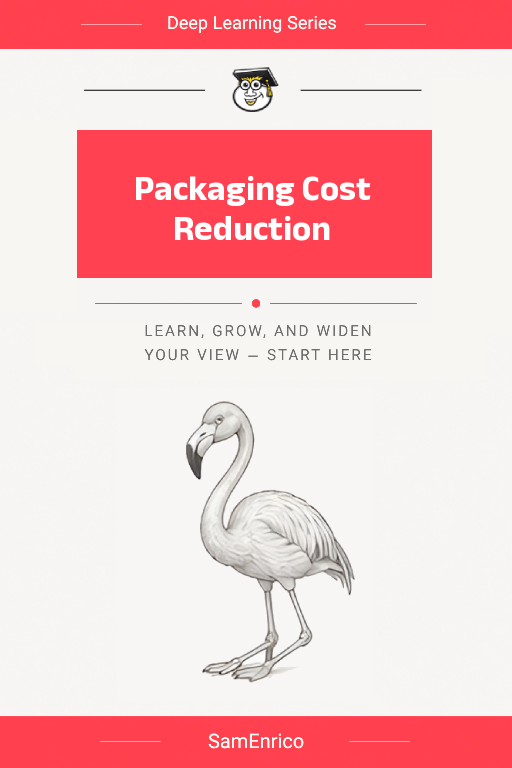
Non-FictionBusiness BriefPackaging
Packaging Cost Reduction eBook
Reduce packaging costs to offset inflation without
Reduce packaging costs to offset inflation without changing perceived product value.
Formats
Free sample
Chapter 1: The Margin Eater--–- Every morning, Maya Chen, founder of a fast-growing snack brand called Wild Rye, logged into her dashboard and watched the same number shrink. Not revenue. Not customers. Margin. Her organic nut butter bars were flying off virtual shelves—up 40% year over year—yet her bank account told a different story.
The culprit wasn't ingredient costs, though those had risen. It wasn't labor, though that had too. It was the box. Specifically, the box inside another box, wrapped in a plastic mailer, stuffed with a cardboard divider, a paper insert, a thank-you card, and a branded sticker. All of it designed to make the customer feel special.
All of it invisible to the customer after five seconds of unboxing. And all of it bleeding $0.87 per order straight into the trash.Maya's story is not unique. It is the story of thousands of founders, supply chain directors, and CFOs who have discovered a painful truth in the age of inflation: packaging has become the single largest controllable cost that almost no one is controlling. Not because they are lazy. Because they are looking in the wrong places.This book is about looking in the right places.
It is about systematically reducing packaging costs without changing what the customer sees, feels, or values. It is about cutting the invisible fat while leaving the visible muscle intact. And it begins with a simple question that most companies never ask: What is the job of my packaging, and which parts of it does the customer actually pay for?The Inflation Trap: Why Raising Prices Is a Losing Game Let us start with the problem that brought you here. Across every major economy, inflation has altered the basic contract between buyer and seller. The data is stark: according to a 2024 global consumer sentiment survey, 72% of shoppers reported changing their purchasing behavior due to rising prices.
They are trading down to private labels. They are buying in bulk and storing at home. They are abandoning non-essential categories entirely. And most dangerously for your brand, they are comparing prices across channels with a precision that did not exist five years ago.Consider what happens when you raise your product's price by 10%. In a brick-and-mortar store, that increase is visible only to the customer who picks up the item and looks at the tag.
Online, it is visible to everyone. Price comparison tools, browser extensions, and simple mental math mean that a 10% increase can trigger a 15-20% drop in conversion rate, depending on the category. The consumer does not see your rising cardboard costs, your increased resin prices, or your higher freight bills. They see a number that is higher than last time, and they ask: Why should I pay more?This is the inflation trap. You cannot absorb rising costs forever.
But you cannot pass them all to the customer without losing share. The solution is not to raise prices. The solution is to lower the cost of getting the product to the customer—specifically, the cost of the package that surrounds it.The False Economy of "Cheaper" Packaging When most companies decide to cut packaging costs, they reach for the obvious lever: cheaper materials. Thinner cardboard. Lower-grade plastic.
Less ink. Fewer inserts. On paper, this works. The unit cost drops. The spreadsheet looks better.
The CFO nods approvingly.Then the returns start coming.Cheaper packaging often means weaker protection. Weaker protection means more damage during shipping. More damage means higher return rates. Higher return rates mean you pay for shipping twice, processing twice, and restocking or disposing of the product. A study by the Reverse Logistics Association found that the average cost of processing a return is 3x to 5x the cost of processing a forward shipment.
If you save $0.10 on packaging but increase your return rate by just 2%, you have likely lost money.And that is only the financial cost. There is also the brand cost. A customer who receives a crushed box, a broken seal, or a product that looks like it survived a war does not think, "Ah, they were optimizing their cost-to-serve." They think, "This brand is cheap." And they do not return.The problem with "cheaper" packaging is that it attacks the wrong target. It reduces the visible cost—the material you touch—while often increasing the invisible costs of returns, labor, storage, and brand damage. What you need is not cheaper packaging.
What you need is smarter packaging.Value Engineering: The Core Concept Value engineering is a systematic method to improve the "value" of a product by examining its function. Value is defined as function divided by cost. In plain English: Deliver the same function for less money, or deliver more function for the same money.In packaging, value engineering means asking five questions for every component:What does this component do? (Protect? Inform?
Delight? Seal? Display?)Does the customer see or feel this component? (If no, it is a candidate for reduction or elimination.)Is there a cheaper way to achieve the same function? (Material substitution, design change, or removal.)What is the total cost of this component, including labor, storage, and shipping?
(Not just the purchase price.)If we removed this component entirely, what would break? (And is that break acceptable?)Notice what this list does not include. It does not ask, "What is the cheapest possible material?" It does not ask, "How can we make this package look less expensive?" It asks functional questions that separate what the customer actually values from what the company has simply always done.The most successful value engineering projects in packaging achieve cost reductions of 20-40% without any change in customer satisfaction. They do this not by making the package cheaper, but by making it exactly as expensive as it needs to be—no more, no less.The Three-Phase Methodology of This Book Before we dive into specific tactics, let me give you the roadmap. This book is organized into three phases, each building on the last.Phase One: Diagnosis (Chapters 2-3)You cannot fix what you cannot measure.
The first phase teaches you how to audit your current packaging for hidden waste. This includes dimensional weight (the "air tax"), labor inefficiency (the "packing line penalty"), material volatility (the "resin rollercoaster"), over-engineering (the "strength trap"), and return logistics (the "reverse squeeze"). You will leave this phase with a clear number: your current waste per unit.Phase Two: Redesign (Chapters 4-7)With diagnosis complete, you move to solutions. This phase covers right-sizing (cutting the box, not the product), material substitution (using sustainable materials that are often cheaper), unboxing optimization (turning your package into a marketing asset), and shrinkflation ethics (how to downsize without destroying trust). Each chapter provides case studies, formulas, and step-by-step implementation guides.Phase Three: Execution & Future-Proofing (Chapters 8-12)The best design is worthless if it never leaves the whiteboard.
This phase covers agile sourcing (buying smarter, not cheaper), warehouse automation (turning your packing line into a profit center), visual perception hacks (making less look like more), smart packaging (QR codes, RFID, and the digital bridge), regulatory compliance (EPR fees, plastic taxes, and how to avoid them), and finally, the 90-day value audit—a complete workbook to…
This is the end of the free sample. Get the eBook to keep going. Buy now
About this book
Details
- Author
- Blocker Cathi
- Publisher
- SamEnrico
- Language
- English
- Genre
- Non-Fiction, Business Brief, Packaging
- Released
- 2026-06-01
- Pages (approx.)
- 139
- Available as
- eBook, Audiobook

Read better in the ZLOADR app
Your eBooks on your phone or tablet. Sign in with your SamEnrico account and start reading.
More by Blocker Cathi
 Creative Conflict Resolution GuideBlocker Cathi$11.99
 The Workaholic's Relationship RepairBlocker Cathi$11.99
 The Physical Sensation CueBlocker Cathi$11.99
 Menopause Breast Pain GuideBlocker Cathi$11.99
 Roy Acuff King of CountryBlocker Cathi$11.99
 Orpheus and Eurydice: A Love That Defied Death’s BargainBlocker Cathi$11.99
 Ibn Battuta's Lost Chronicles: A Scholar's Journey Through the Islamic WorldBlocker Cathi$11.99
 Zero Cost Pre Launch PrimerBlocker Cathi$12.99
 Assistant Head NurseBlocker Cathi$11.99
 Understanding Fructose IntoleranceBlocker Cathi$17.99
 How to Start a Baggage Scanning Equipment Business (Beginners Guide)Blocker Cathi$11.99
You may also like
 Hong Kong Handover 1997Dunn Johnnie$11.99
 Zumba For Postnatal Recovery CourseNeal Christian$11.99
 Zumba for BeginnersLadner Nikia$11.99
 YouTube Comment Mining GuideHumes Pandora$12.99
 Worry Box MeditationCarlin Rudy$11.99
 Workplace Stress MeditationNguyen Lynn$11.99
 Workplace Stress and Sleep RepairHawley Ivory$11.99
 Workplace Perfectionism CureDelaney Jeffry$11.99
 Workplace Injustice Anger GuideWallen Isabelle$11.99
 Work Addiction and Burnout LinkGreenwood Ester$11.99
 Women in Yoga and WellnessBeattie Galina$11.99
 Women in Stand Up ComedyChun Evangeline$11.99