
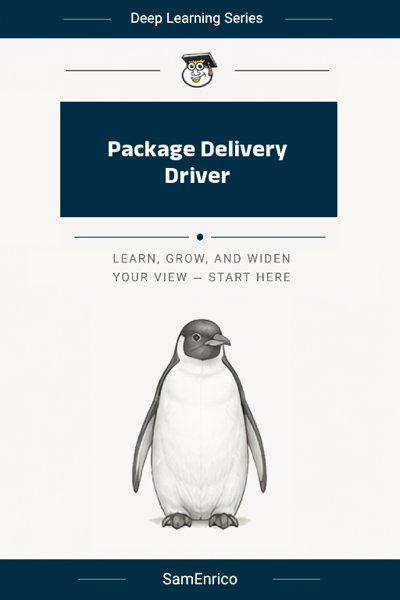
Non-FictionInformativeEducational
Package Delivery Driver eBook
A Coursebook on Package Delivery Driver
by Antonio Leo
A Coursebook on Package Delivery Driver
Formats
Free sample
Chapter 1: Beyond the Cardboard Box...--–- The package weighed exactly four pounds and seven ounces. Not that I weighed it, but after ten thousand deliveries, your hands develop a calibration that scales, shipping scales cannot match. A four-pound box feels like hope when it is medication, anxiety when it is a legal document, and pure annoyance when it is a cast-iron skillet ordered with free same-day shipping. I learned to read parcels the way a mechanic reads engine sounds. But that skill came later, after the mistakes.
After the dog bite on Maple Street. After the apartment building where every gate code was wrong. After the shift where I drove one hundred and forty miles and lost money because I did not understand the math.This chapter is not about how to hold a scanner or where to find the brake pedal. You can learn those things in an afternoon. This chapter is about understanding what you have actually signed up for when you decide to become a package delivery driver in the modern economy.
Because here is the truth that no job posting will tell you: you are not a driver. You are a mobile logistics coordinator, a customer service mediator, an amateur veterinarian (dog body language), a parking ticket risk analyst, and, most importantly, the owner of a tiny, one-person business that either profits or bleeds cash based entirely on the decisions you make between sunrise and sunset.The Delivery Driver's Identity Crisis Before we talk about routes or hand trucks or tax deductions, we need to settle a fundamental question that most drivers never stop to ask: What kind of delivery driver are you? This sounds like a simple question, but it is not. The answer determines everything from how much money you keep at the end of the week to whether you wake up excited or exhausted.I have worked alongside drivers who see themselves as employees. They show up, they load their truck, they follow the app's directions, they come back, they cash a paycheck.
These drivers are not wrong, but they are also not optimizing. They leave money on the table every single shift because they never asked whether the algorithm's route was actually efficient or whether their vehicle choice was bleeding depreciation or whether that "Customer Not Available" scan could have been avoided with one different word choice.Then there are the drivers who see themselves as independent problem solvers. They look at the same route and see a puzzle. They look at the same customer interaction and see a negotiation. They look at the same vehicle and see a capital asset that either appreciates their labor or consumes it.
These drivers are not necessarily smarter or more experienced. They have simply made a psychological shift that costs nothing but pays everything. They have moved from "I work for a delivery company" to "I am a delivery professional who contracts with companies."The Chinese vocational training system has a phrase for this: 岗位认知 (gǎng wèi rèn zhī), which translates roughly to "job cognition" but means something deeper. It means understanding not just the tasks of your role but the reason your role exists within the larger system. A delivery driver with proper job cognition knows that their real product is not package movement.
Their real product is time compression. Every package you deliver is an hour that someone else did not have to spend driving to a store, waiting in line, and driving back. When you understand that, you stop thinking like a laborer and start thinking like a service provider.The Five Delivery Ecosystems You Need to Understand Not all delivery jobs are created equal. In fact, they are not even close. Before you drive a single mile, you need to understand the five major ecosystems that employ package delivery drivers.
Each has its own economics, its own culture, and its own path to profitability or burnout.First, there are the Amazon Delivery Service Partners, or DSPs. These are third-party companies that contract with Amazon to deliver its packages. You are technically employed by the DSP, not by Amazon, but Amazon sets the metrics, the routes, and the expectations. The advantage of DSP work is consistency. You get a regular schedule, a branded van (usually), and a predictable number of stops per day.
The disadvantage is that Amazon's metrics are famously unforgiving. Every stop is timed. Every photo is audited. Every customer complaint follows you. DSP drivers often describe themselves as "yellow-vested robots," which is not entirely fair to robots.Second, there are the legacy carriers: UPS and Fed Ex.
These are union shops (UPS more than Fed Ex) with seniority systems, benefits, and career paths. A UPS driver who stays for twenty years can retire with a pension. But getting those jobs is competitive, and the early years involve irregular shifts, heavy physical labor, and a culture that expects you to prove yourself. Fed Ex Ground, notably, operates on a contractor model where you may own your route but provide your own vehicle. This blurs the line between employee and entrepreneur.Third, there are the gig platforms: Amazon Flex, Uber Direct, Roadie, and a dozen smaller competitors.
Here, you are a true independent contractor. You open an app, you see offers, you accept or reject them. The freedom is real. You can work Tuesday morning and skip Wednesday afternoon. But the costs are also real and hidden.
When a DSP driver's van breaks down, the DSP pays for the tow. When your personal car breaks down during an Amazon Flex block, you pay for the tow, the repair, and you lose the block pay. Gig platforms also excel at a psychological trick called "opaque pricing," where an offer looks profitable until you calculate the deadhead miles back to your starting point.Fourth, there are local and regional courier cooperatives. These are smaller operations that deliver pharmacy prescriptions, auto parts, legal documents, and flowers. The pay per stop is often higher than gig platforms, but the volume is unpredictable.
You might deliver a single envelope for twenty dollars or ten cases of auto parts for forty dollars spread across four hours. These jobs require relationship building. Dispatchers at local courier companies remember drivers who are reliable, and they reward them with better routes.Fifth, and often overlooked, there are the specialized delivery niches: medical couriers (requiring temperature-controlled certification and background checks), alcohol delivery (requiring age verification training), and high-value asset delivery (requiring insurance bonds and signatures from specific individuals). These niches pay significantly more but also require certification and carry higher liability. If you deliver a case of beer to the wrong address, the worst case is a refund.
If you deliver a heart valve to the wrong hospital loading dock, someone might die.The Zen of Ten Thousand Deliveries I want to introduce you to a driver I will call Marcus. Marcus has delivered packages for eleven years, first for Fed Ex, then for an Amazon DSP, then for himself as an independent courier. By his own count, he has made more than ten thousand deliveries. That number matters because ten thousand is the point where the work stops…
This is the end of the free sample. Get the eBook to keep going. Buy now
About this book
Details
- Author
- Antonio Leo
- Publisher
- SamEnrico
- Language
- English
- Genre
- Non-Fiction, Informative, Educational
- Released
- 2026-05-09
- Pages (approx.)
- 131
- Available as
- eBook, Audiobook

Read better in the ZLOADR app
Your eBooks on your phone or tablet. Sign in with your SamEnrico account and start reading.
More by Antonio Leo
 CRPS Mindfulness ProtocolAntonio Leo$11.99
 Body Image for Gynecomastia CourseAntonio Leo$11.99
 Weight Neutral Eating PlanAntonio Leo$11.99
 The Mid Career RefreshAntonio Leo$11.99
 Self Esteem and Dating FatigueAntonio Leo$11.99
 The Last Broadcast: The 1967 Radio Silence That Shook the WorldAntonio Leo$11.99
 Gilded Shadows: The Forgotten Masterpieces of the Silk RoadAntonio Leo$11.99
 Understanding Facial Dysmorphism Macrocephaly Myopia Dandy–walker TypeAntonio Leo$17.99
 Procurement Change ManagementAntonio Leo$12.99
 Executive Summary Power Guide for DirectorsAntonio Leo$12.99
 How to Become a Molding-machine TenderAntonio Leo$11.99
You may also like
 Hong Kong Handover 1997Dunn Johnnie$11.99
 Zumba For Postnatal Recovery CourseNeal Christian$11.99
 Zumba for BeginnersLadner Nikia$11.99
 YouTube Comment Mining GuideHumes Pandora$12.99
 Worry Box MeditationCarlin Rudy$11.99
 Workplace Stress MeditationNguyen Lynn$11.99
 Workplace Stress and Sleep RepairHawley Ivory$11.99
 Workplace Perfectionism CureDelaney Jeffry$11.99
 Workplace Injustice Anger GuideWallen Isabelle$11.99
 Work Addiction and Burnout LinkGreenwood Ester$11.99
 Women in Yoga and WellnessBeattie Galina$11.99
 Women in Stand Up ComedyChun Evangeline$11.99