
Non-FictionBiographyBanking Poverty
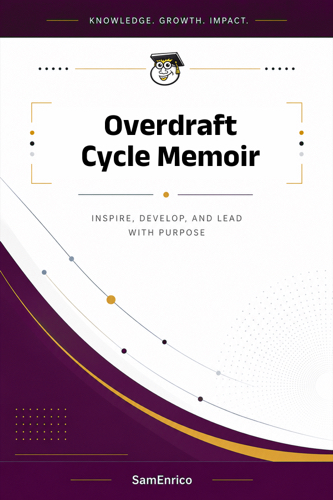
Overdraft Cycle Memoir eBook
Decades trapped by bank fees that ate every payche
Decades trapped by bank fees that ate every paycheck.
Formats
Free sample
Chapter 1: The Arithmetic of Invisibility...--–- The morning it happened, I was holding a coffee I couldn’t afford and a receipt that would become a confession.Thursday, September 14th, 2017. I remember the date because it was payday eve, and payday eve had its own rituals. You check your balance at 6:00 AM, before the day has a chance to ruin anything. You calculate exactly how much is left. You run the numbers like a bomb technician defusing a device: if I spend $4.75 now, and the rent check hasn’t cleared yet, and the gym membership hits on Thursday not Friday, and the gas station hold is only $1.00 not $50, then I have exactly $23.47 left for two days.
That’s doable. That’s rice and eggs. That’s a full tank if I only drive to work and back.I was thirty-four years old. I had a steady job as an administrative coordinator at a mid-sized healthcare nonprofit. I made $42,000 a year, which in 2017 was exactly enough to be invisible—too much for food stamps, too little for an emergency fund, just right for the kind of poverty that doesn’t look like poverty until you open the bank app.
I wore blazers from thrift stores. My kids had new backpacks from Target. My car was a 2012 sedan with a check engine light that had been on so long I’d forgotten what color it was supposed to be.And I was, by every measurable definition, drowning.The latte was a mistake I made on autopilot. I’d been up since 4:30 AM with my youngest, who had an ear infection. I’d driven him to my mother’s house at 6:00, then sat in traffic for forty-five minutes, then walked into the office to find an email from my boss asking why the quarterly reports weren’t done.
The coffee shop was in the lobby. The barista knew my order. I handed over my debit card without thinking—the same way you might scratch an itch or sigh.The card worked. It always worked, because I had overdraft protection. I’d signed up for it at nineteen, when a cheerful bank teller told me it was a courtesy, a safety net, a way to avoid the embarrassment of a declined card.
I remembered nodding and thinking, That sounds responsible. That sounds like something an adult would do.I did not know then that “courtesy” was the most expensive word in the English language.The Mathematics of a Single Swipe Let me show you what happened next, because understanding the math is the only way to stop blaming yourself.Thursday, September 14th, 9:47 AM: I bought a latte for $4.75. My account balance before the purchase was $102.34. That’s not a typo. I had one hundred and two dollars and thirty-four cents to last me until my paycheck deposited early Friday morning.In a fair world, the transaction would have posted immediately.
My new balance would have been $97.59. Then my rent check for $1,000 would have arrived on Friday, after my paycheck. No fees. No problem. Everyone goes home happy.This is not a fair world.Here is what actually happened, reconstructed from bank records I printed and kept in a shoebox for three years because I needed proof that I wasn’t crazy:Thursday, 9:47 AM: I bought the latte.
The transaction was authorized but not yet posted. The bank placed a temporary hold of $4.75 on my account. My available balance dropped to $97.59.Thursday, 2:17 PM: My rent check for $1,000 was presented for payment. The bank processed it immediately, because the law—the Check Clearing for the 21st Century Act, or Check 21—allows banks to clear checks electronically in hours. My balance dropped to -$902.41.Thursday, 2:18 PM: The bank’s automated system assessed an overdraft fee of $35.
My balance became -$937.41.Thursday, 11:59 PM: The latte transaction finally posted. Because I was already negative, the bank assessed a second overdraft fee of $35. My balance became -$972.41.Friday, 2:00 AM: My paycheck of $1,200 was deposited. My balance became $227.59.But here’s the detail that still makes me angry when I type it: the bank processed the rent check before the latte even though the latte happened first. They reordered my transactions from largest to smallest, not in the order they occurred.
This is legal. This is standard practice. And this turned a $4.75 latte into a $74.75 latte ($4.75 plus two $35 fees).Then I checked my account on Friday morning. I saw the $1,200 deposit. I saw the $1,000 rent payment.
I saw the two fees. I did the math. My $500 biweekly paycheck—because after taxes and health insurance, $1,200 was actually $500 take-home—had been reduced to $430 before I paid for groceries, gas, or my child’s antibiotic prescription.I sat in my cubicle with my cold latte and stared at the screen. I had done nothing wrong. I had not bought a boat.
I had not gambled. I had bought coffee and paid my rent. And the bank had taken $70 for the privilege.The Invisible Architecture of Extraction I spent the next six months believing this was my fault. I told myself I should have checked my balance before buying the latte. I should have known the rent check was coming.
I should have woken up earlier, earned more money, been more responsible.But shame, as I would later learn, is not a moral correction. Shame is a tool. And banks have perfected it.Let me explain the architecture of the trap, because you cannot escape a system you do not understand.Check 21, passed by Congress in 2004, was marketed as a modernization law. Before 2004, checks took days to clear because they had to be physically transported from one bank to another. Check 21 allowed banks to convert paper checks into electronic images, clearing them in hours.
This was good for efficiency. This was good for the economy.But here’s what the law did not require: banks to release deposited funds at the same speed. Your employer’s paycheck, if deposited via check, could be held for three to five business days “for verification.” Your rent check, however, could clear in four hours.The result is a legal asymmetry. Money leaves your account instantly. Money arrives slowly.
And in the gap between leaving and arriving, banks generate billions of dollars in fees.I am not exaggerating. In 2017, the year I bought that latte, American banks collected over $34 billion in overdraft fees. That’s more than the GDP of several small countries. That’s more than Americans spent on prescription drugs that year. That’s a river of money flowing from the poorest account holders to the richest institutions, one $35 fee at a time.The average overdraft fee in 2017 was $34.
The average overdraft amount was $24. Think about that: banks were charging $34 to cover a $24 shortfall. That’s an annual percentage rate of over 5,000%—worse than any payday lender, worse than any loan shark, worse than anything you could find in a back alley.And here’s the part that still makes me see red: banks call this a courtesy.The First Time You Realize You’re the Product I did not understand any of this on September 14th. On September 14th, I just felt stupid.I called the bank that…
This is the end of the free sample. Get the eBook to keep going. Buy now
About this book
Details
- Author
- Eldridge Santos
- Publisher
- SamEnrico
- Language
- English
- Genre
- Non-Fiction, Biography, Banking Poverty
- Released
- 2026-06-07
- Pages (approx.)
- 141
- Available as
- eBook, Audiobook

Read better in the ZLOADR app
Your eBooks on your phone or tablet. Sign in with your SamEnrico account and start reading.
More by Eldridge Santos
 Gratitude for SilenceEldridge Santos$11.99
 Academic Imposter Syndrome GuideEldridge Santos$11.99
 Beginner Visualization Meditation GuideEldridge Santos$11.99
 Assertive Boundary SettingEldridge Santos$11.99
 Shadows of the Silk Road: The Poisoned Chalice of BactriaEldridge Santos$11.99
 How to Become a Laboratory HelperEldridge Santos$11.99
 Palo Alto Networks SWOTEldridge Santos$12.99
 Earnings Per Share Formula GuideEldridge Santos$12.99
 Understanding Myopathy and Diabetes MellitusEldridge Santos$17.99
 Cardigan Welsh Corgi BreedingEldridge Santos$11.99
You may also like
 Hong Kong Handover 1997Dunn Johnnie$11.99
 Zumba For Postnatal Recovery CourseNeal Christian$11.99
 Zumba for BeginnersLadner Nikia$11.99
 YouTube Comment Mining GuideHumes Pandora$12.99
 Worry Box MeditationCarlin Rudy$11.99
 Workplace Stress MeditationNguyen Lynn$11.99
 Workplace Stress and Sleep RepairHawley Ivory$11.99
 Workplace Perfectionism CureDelaney Jeffry$11.99
 Workplace Injustice Anger GuideWallen Isabelle$11.99
 Work Addiction and Burnout LinkGreenwood Ester$11.99
 Women in Yoga and WellnessBeattie Galina$11.99
 Women in Stand Up ComedyChun Evangeline$11.99