
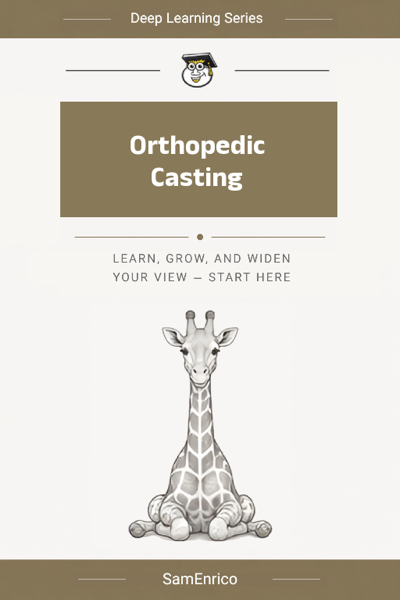
Orthopedic Casting
A Coursebook on Orthopedic Casting
A Coursebook on Orthopedic Casting
Formats
About this book
Free sample
Chapter 1: The Immobilization Paradox--–- The emergency department at St. Mary’s Hospital was its usual chaotic self on a frigid Tuesday evening in February. Nurses navigated a maze of stretchers, the overhead pager crackled with stat orders, and in the corner bay, a 72-year-old woman named Eleanor waited with her forearm resting on a pile of towels. She had tripped on a rug in her hallway—a mundane accident in an otherwise unremarkable life—and now her distal radius was fractured in a classic Colles deformity. Her wrist looked like a dinner fork.
She was in pain, she was frightened, and she had no idea that the piece of fabric and mineral plaster about to be wrapped around her arm would determine not just the alignment of her bones but the quality of her independence, her risk of falling again, and her chances of returning to her weekly bridge game.The resident who saw Eleanor first made a critical decision in less than ten seconds. He chose a splint instead of a cast. He chose fiberglass over plaster. He chose a position of slight wrist extension rather than neutral. And in that moment, without any conscious awareness of the historical weight behind his choices, he participated in a medical tradition that stretches back over three thousand years—a tradition of immobilizing broken bones to restore function, but also a tradition riddled with misconceptions, preventable complications, and missed opportunities for better patient outcomes.This is the immobilization paradox: the very device that heals bones can, if applied incorrectly, destroy the soft tissues, nerves, and joints it is meant to protect.
A cast that is too tight causes compartment syndrome. A cast that is too loose allows malunion. A cast left on too long creates joint stiffness that never fully resolves. And yet, in most medical training programs, orthopedic casting is treated as a low-skill technical task—something to be learned by observation rather than rigorous study, something delegated to the most junior members of the team, something that appears in no board examination's core curriculum despite being one of the most…
This is the end of the free sample. Get the eBook to keep going. Buy now
Contents
- Chapter 1
- Chapter 2
- Chapter 3
- Chapter 4
- Chapter 5
- Chapter 6
- Chapter 7
- Chapter 8
- Chapter 9
- Chapter 10
- Chapter 11
- Chapter 12
Details
- Author
- Matson Jeremy
- Publisher
- SamEnrico
- Language
- English
- Genre
- Non-Fiction, Informative, Educational
- Released
- 2026-06-02
- Pages (approx.)
- 157
- Available as
- eBook, Audiobook

Read better in the ZLOADR app
Your eBooks on your phone or tablet. Sign in with your SamEnrico account and start reading.
More by Matson Jeremy
 Post Work Eating GuideMatson Jeremy$11.99
 Flare Up Meditation KitMatson Jeremy$11.99
 Self Esteem for Disorganized Attachment WorkbookMatson Jeremy$11.99
 The Medical Professional NetMatson Jeremy$11.99
 Self Esteem After MiscarriageMatson Jeremy$11.99
 The Forgotten Navigator: Diogo Cão and the Congo’s Uncharted DepthsMatson Jeremy$11.99
 Silk Road Whispers: The Opium War That Never WasMatson Jeremy$11.99
 How to Become a Monitor Car OperatorMatson Jeremy$11.99
 Executive Summary Grading Rubric for Quality ControlMatson Jeremy$12.99
 Procurement Benchmarking GuideMatson Jeremy$12.99
 Understanding Exudative Retinopathy, FamilialMatson Jeremy$17.99