
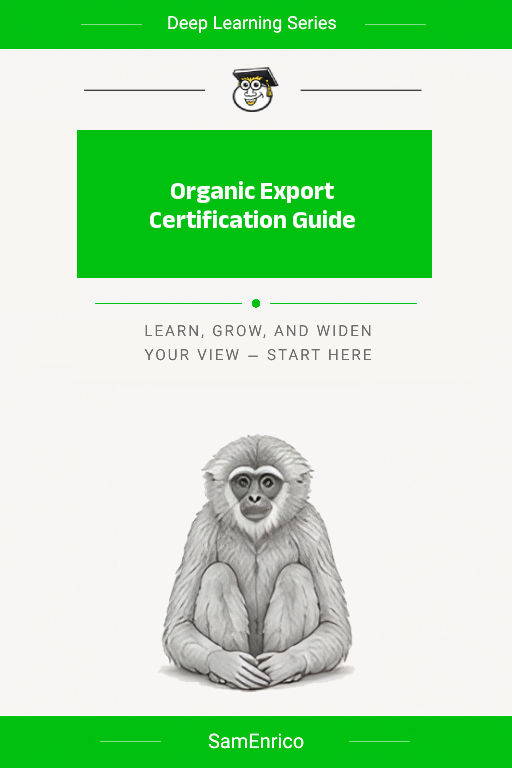
Non-FictionBusiness BriefOrganic Certification
Organic Export Certification Guide eBook
Obtain USDA Organic, EU Organic, and JAS certifica
Obtain USDA Organic, EU Organic, and JAS certification for agricultural exports to premium markets.
Formats
Free sample
Chapter 1: The $47,000 Banana...--–- The集装箱 sat in Yokohama port for eleven days. Inside, stacked neatly on ventilated pallets, were 1,200 boxes of organic bananas from a small cooperative in Ecuador. The farmer, a third-generation grower named Carlos, had spent three years converting his land to organic standards. He had paid $15,000 in certification fees, hired a consultant to navigate USDA paperwork, and personally inspected every bunch before it was loaded onto the ship. He was certain he had done everything right.Then the JAS inspector opened Box 447.The bananas looked perfect.
They were the right shade of yellow, the stems were clean, and the packaging bore the certification number of a recognized Japanese certifying body. But the inspector wasn't looking at the bananas. He was looking at the pallet underneath them. On the wooden base, barely visible to the naked eye, was a faint orange smudge. He swabbed it.
Thirty minutes later, a portable mass spectrometer identified the residue as thiabendazole — a conventional fungicide not allowed under any organic standard anywhere in the world.The entire container was rejected. Not just the boxes near the smudge. All 1,200 boxes. The bananas could not be sold as organic in Japan. They could not be resold as organic anywhere else because the chain of custody was broken.
They could not even be sold as conventional produce in Japan without extensive testing, which the importer refused to pay for. The container was incinerated. Carlos lost 47,000inproduct,plus47,000 in product, plus 47,000inproduct,plus8,000 in shipping, plus his contract with the Japanese buyer. He never exported again.The cause? Three weeks before loading, the warehouse where the bananas were temporarily stored had housed conventional citrus.
A forklift driver had spilled a small amount of fungicide on the concrete floor. A cleaner had wiped it up — or so everyone thought. But a microscopic residue remained. When Carlos's organic bananas were stacked in the same spot, the cardboard boxes absorbed the chemical through capillary action. Not enough to harm a human.
Enough to destroy a business.This is not a cautionary tale. This is a typical Tuesday in the world of organic export certification.The Billion-Dollar Gamble You Didn't Know You Were Making Every year, over $200 billion worth of organic products cross international borders. The United States, the European Union, and Japan together account for more than ninety percent of the high-value organic market. And every year, thousands of exporters — from small cooperatives in Peru to large-scale producers in China to family farms in Eastern Europe — discover that their organic certification is not a passport. It is a trapdoor.The trapdoor works like this: You spend years converting your land.
You pay certifiers thousands of dollars. You follow every rule in the handbook. Then you ship your product, and somewhere between the farm and the foreign port — in a warehouse, on a pallet, inside a container, or on a single piece of paper — something goes wrong. A residue appears. A document is missing.
A label uses the wrong font size. And suddenly, your "certified organic" product is worth nothing. Not less. Nothing.This book exists because most organic export guides are written by certifiers, for certifiers. They explain what the rules are.
They do not explain how to survive them. They tell you to "maintain organic integrity" without telling you that the forklift driver in the shared warehouse has never heard of JAS and does not care. They tell you to "document everything" without giving you a system that works when you have three different regulators demanding three different formats.This chapter is not an introduction. It is a warning and a promise.The warning: If you approach USDA, EU, and JAS certification as three separate problems to be solved independently, you will fail. Not might fail.
Will fail. The three systems contain contradictions that make it impossible to satisfy all of them unless you design your entire operation around the strictest requirements of all three from day one. And even then, you will face trade-offs that force you to choose which market to prioritize when conflicts arise.The promise: By the end of this book, you will have a single, integrated system — what we call the Triple Crown framework — that allows you to export the same product to New York, Berlin, and Tokyo without re-certifying, re-labeling, or re-testing for each destination. You will know exactly where the trapdoors are hidden, and you will have a map to avoid them.But first, you need to understand why the organic export market is simultaneously the greatest opportunity and the greatest risk in modern agriculture.The Geography of Premium Prices Let us begin with numbers, because numbers do not lie. They also do not care about your feelings, which is useful because organic certification is an emotional business.The global organic market reached 220billionin2024,accordingtothe Research Instituteof Organic Agriculture.The United Statesisthelargestsinglemarket,consumingapproximately220 billion in 2024, according to the Research Institute of Organic Agriculture.
The United States is the largest single market, consuming approximately 220billionin2024,accordingtothe Research Instituteof Organic Agriculture.The United Statesisthelargestsinglemarket,consumingapproximately70 billion worth of organic products annually. The European Union, as a bloc, is slightly larger at 75billion,with Germany,France,andthe United Kingdomleadingdemand.Japan,whilesmalleratroughly75 billion, with Germany, France, and the United Kingdom leading demand. Japan, while smaller at roughly 75billion,with Germany,France,andthe United Kingdomleadingdemand.Japan,whilesmalleratroughly20 billion, commands the highest per-unit premiums for specialty organic products, particularly for tea, rice, spices, and tropical fruit.Here is what those numbers mean for an exporter:The USDA Market (United States) offers volume. American consumers buy organic products in bulk, particularly from large retailers like Whole Foods, Costco, and Walmart. The USDA organic seal is widely recognized and trusted.
However, the US market is also the most competitive, with established supply chains from Mexico, Canada, and Peru already dominating categories like produce, coffee, and grains. Premiums over conventional products typically range from fifteen to thirty percent, though this varies dramatically by category. The real advantage of USDA certification is not the price premium but the volume: US importers buy in container lots, not pallet lots.The EU Market offers higher premiums but also higher barriers. European consumers are willing to pay twenty-five to forty percent more for certified organic products, particularly those with additional claims like "fair trade" or "biodynamic." However, the EU regulatory framework under Regulation 2018/848 is the most philosophically demanding of the three systems. It requires not just the absence of prohibited substances but active ecological management, including crop rotation requirements, biodiversity plans, and — for livestock — specific welfare standards that go far beyond USDA requirements.
The EU also has the strictest rules on product origin labeling, which we will cover extensively in Chapter 10.The JAS Market (Japan) is the smallest but the most lucrative for the right products. Japanese consumers pay the highest organic premiums in the world, often exceeding one hundred percent for products like organic matcha, bananas, and soybeans. However, JAS certification is also the most documentation-intensive, requiring fifteen years of record retention and a level of traceability that many Western exporters find exhausting. The Japanese market is also the most relationship-driven: importers expect long-term partnerships and will conduct their own audits beyond the…
This is the end of the free sample. Get the eBook to keep going. Buy now
About this book
Details
- Author
- Crenshaw Jessenia
- Publisher
- SamEnrico
- Language
- English
- Genre
- Non-Fiction, Business Brief, Organic Certification
- Released
- 2026-05-28
- Pages (approx.)
- 159
- Available as
- eBook, Audiobook

Read better in the ZLOADR app
Your eBooks on your phone or tablet. Sign in with your SamEnrico account and start reading.
More by Crenshaw Jessenia
 Prenatal Genetic Screening GuideCrenshaw Jessenia$11.99
 Emperor Meiji Restoration BiographyCrenshaw Jessenia$11.99
 Paleo Meal Planning MasteryCrenshaw Jessenia$11.99
 Business Plan Executive Summary Examples WorkbookCrenshaw Jessenia$11.99
 The Bamboo Forest WalkCrenshaw Jessenia$11.99
 Chasing the Pacific's Fury: The Storm Hunters of the Late 20th CenturyCrenshaw Jessenia$11.99
 Fenrir's Howl: The Binding of the WolfCrenshaw Jessenia$11.99
 Understanding Gestational PemphigoidCrenshaw Jessenia$17.99
 How to Start a Baby Clothing Business (Beginners Guide)Crenshaw Jessenia$11.99
 John Mackey Cash Mission WorkbookCrenshaw Jessenia$12.99
 Financing AnalystCrenshaw Jessenia$11.99
You may also like
 Hong Kong Handover 1997Dunn Johnnie$11.99
 Zumba For Postnatal Recovery CourseNeal Christian$11.99
 Zumba for BeginnersLadner Nikia$11.99
 YouTube Comment Mining GuideHumes Pandora$12.99
 Worry Box MeditationCarlin Rudy$11.99
 Workplace Stress MeditationNguyen Lynn$11.99
 Workplace Stress and Sleep RepairHawley Ivory$11.99
 Workplace Perfectionism CureDelaney Jeffry$11.99
 Workplace Injustice Anger GuideWallen Isabelle$11.99
 Work Addiction and Burnout LinkGreenwood Ester$11.99
 Women in Yoga and WellnessBeattie Galina$11.99
 Women in Stand Up ComedyChun Evangeline$11.99