
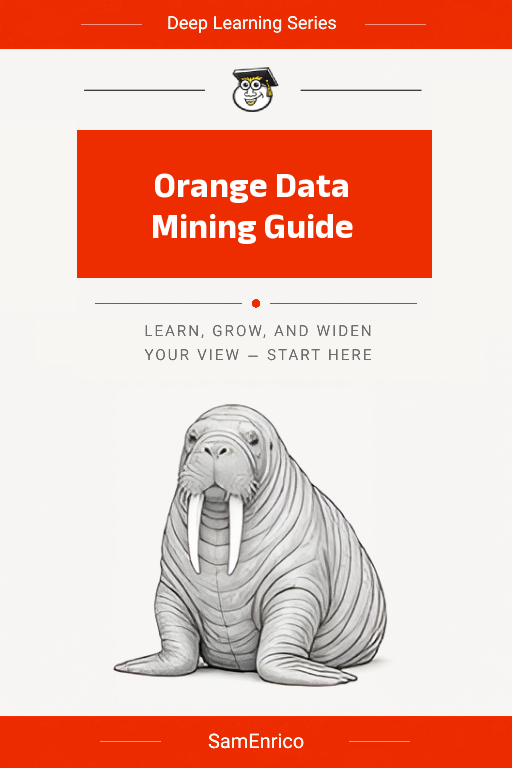
Orange Data Mining Guide eBook
Visualize and mine data using free Orange instead
by Pina Hildred
Visualize and mine data using free Orange instead of expensive Tableau or RapidMiner software.
Formats
Free sample
Chapter 1: The Price of Silence...--You are paying for software you do not need.Not might be paying. Not could be paying less. You are, right now, almost certainly paying too much for tools that claim to unlock the secrets hidden in your data. And the worst part? The vendors want you to believe that price equals power—that a more expensive license buys better insights, faster answers, or smarter algorithms.They are wrong.Let me tell you about a marketing director named Elena. She worked for a mid-sized e-commerce company with seventy-three employees and a data problem. Her team had collected three years of customer transactions, website clicks, and support tickets. Buried in those spreadsheets was the answer to their most urgent question: why were twenty-three percent of new customers leaving within ninety days?Elena had a budget of exactly zero dollars for new software. Her company had just laid off eight people. The Tableau licenses had been revoked the previous quarter. The Rapid Miner trial had expired six months ago. Her boss, a reasonable man named David, gave her a deadline of two weeks and a single instruction: "Figure it out without spending money."She nearly quit.Instead, she found Orange. A free, open-source data mining tool that nobody in her network had ever mentioned. She downloaded it on a Tuesday afternoon, skeptical and exhausted. By Thursday, she had built a workflow that visualized customer churn patterns. By the following Tuesday—one week—she had a predictive model that identified at-risk customers with eighty-one percent accuracy.She presented her findings on a Thursday. David approved a retention campaign that cost less than five thousand dollars and saved the company over two hundred thousand in annual revenue.Elena did not write a single line of code. She did not beg for a budget. She did not ask permission.She used Orange.The Silent Epidemic of Software Overpayment The data analytics industry has built a lucrative business model on a simple, cruel premise: make the tools expensive enough that only enterprises can afford them, then convince everyone else that they cannot compete.Tableau's creator license costs seventy dollars per user per month. Their explorer license? Forty-two dollars. Their viewer license? Fifteen dollars. And those are the published prices—before the add-ons for database connectors, advanced analytics, and multi-user collaboration. A team of ten analysts can easily cost a company over ten thousand dollars annually before they have analyzed a single row of data.Rapid Miner follows a similar playbook. Their free tier is deliberately limited. Their small business tier starts at twenty-five hundred dollars per year. Their enterprise tier? Contact sales—a phrase that translates directly to "if you have to ask, you cannot afford it."Here is the truth that vendors do not want you to know: the marginal cost of software is zero. Once a tool is built, letting one more person use it costs nothing. The high prices are artificial barriers, designed to segment the market and extract maximum revenue from those who can pay.But what about those who cannot pay? Small business owners. Nonprofits. Freelance analysts. Students. Educators. Startups burning through their last round of funding. Data enthusiasts in countries where seventy dollars is a week's wages.For these people, the expensive software myth has created a digital caste system. Those with budgets get insights. Those without budgets get excuses.Orange is the rebellion against that system.What This Chapter Actually Covers Before we go any further, let me be explicit about what you will learn in this chapter and—equally important—what you will not learn here.In this chapter, you will learn:Why Orange exists and who created it (spoiler: it was not a corporation trying to hook you on a free trial)The twelve-point feature map that compares Orange directly to Tableau and Rapid Miner, with no marketing spin How Orange's visual programming environment differs from coding in R or Python The one question you must answer before deciding if Orange is right for you (most people get this wrong)How to think about Orange's limitations honestly—because every tool has them Not in this chapter (because they have their own chapters later):How to install Orange (Chapter 2)How to import data (Chapter 3)How to clean messy datasets (Chapter 4)How to build visualizations (Chapter 5)How to create predictive models (Chapters 6 through 9)Think of this chapter as the strategic foundation. The rest of the book is the tactical execution. If you skip this chapter, you will still learn how to use Orange. But you will miss the why—and the why is what turns a software user into a data rebel.The Origin Story: Why Orange Exists Orange did not emerge from a corporate skunkworks project or a venture-backed startup with a monetization strategy. It was born at the University of Ljubljana in Slovenia, in the Laboratory for Bioinformatics, starting in 1996.Think about that year for a moment. 1996. The first Palm Pilot was released. Java was one year old. Google did not exist. Most people were still connecting to the internet via dial-up modems that screamed like dying robots.A team of researchers led by Prof. Blaž Zupan decided to build a data mining tool that was visual, interactive, and—most radically—free. Not freemium. Not free trial. Not free for academics only. Free as in no cost, forever, for anyone.The first version was called Orange Canvas. It looked like something from an early Windows desktop: blocky icons, limited color palette, and a user interface that prioritized function over form. But the core idea was already there: drag widgets onto a canvas, connect them with lines, and watch data flow from one analysis step to the next.Twenty-eight years later, Orange is still maintained by an international community of researchers, students, and volunteers. It has been downloaded millions of times. It is used in classrooms at Stanford, MIT, and Oxford. It powers research in genomics, text mining, and image analysis.And it is still completely free.Here is what that means for you: Orange has no shareholder demanding quarterly growth. No board of directors pressuring the team to monetize the user base. No hidden agenda to harvest your data or upsell you to a "professional" tier.The people who build Orange do it because they believe data analysis should be accessible to everyone.That is not marketing speak. That is the actual mission of the project. You can verify it yourself by visiting their website, reading their forum discussions, or—if you are technically inclined—examining the source code on Git Hub.Now contrast that with the alternatives. Tableau is owned by Salesforce, a publicly traded company with a fiduciary duty to maximize shareholder value. Rapid Miner has raised over forty million dollars in venture capital. Those investors expect a return. That return comes from your wallet.Orange has no investors. No IPO on the horizon. No quarterly earnings calls.Orange has only users.The Twelve-Point Feature Map: Orange vs. Tableau vs. Rapid Miner Let me show you exactly how these tools compare. This is not a marketing brochure. I have used all three tools extensively. I have hit the limits of each one. I have cursed at Tableau's licensing server, rage-quit Rapid Miner's paywalls, and celebrated Orange's simplicity.The table below is honest. It acknowledges where Orange falls short. No tool is perfect for every job. But for the vast majority of data analysis tasks, Orange does…
This is the end of the free sample. Get the eBook to keep going. Buy now
About this book
Details
- Author
- Pina Hildred
- Publisher
- SamEnrico
- Language
- English
- Genre
- Non-Fiction, Startup Guide, Data Mining, Visualization
- Released
- 2026-05-29
- Pages (approx.)
- 160
- Available as
- eBook, Audiobook

Read better in the ZLOADR app
Your eBooks on your phone or tablet. Sign in with your SamEnrico account and start reading.
More by Pina Hildred
 Collaborative Mind Mapping HandbookPina Hildred$11.99
 Gaming and Anxiety ConnectionPina Hildred$11.99
 Barbadian Professional OutlookPina Hildred$11.99
 Weight Loss Affirmations GuidePina Hildred$11.99
 Caffeine Anger Sensitivity TestPina Hildred$11.99
 The Silent Diplomat: How a Deaf Woman Brokered Peace in a War ZonePina Hildred$11.99
 The Paradox of the 1969 Moon Landing: Did NASA Accidentally Time Travel?Pina Hildred$11.99
 Sprouting Broccoli HarvestingPina Hildred$11.99
 Life Sciences Strategic BuyersPina Hildred$12.99
 Understanding Chromosome 8 DeletionPina Hildred$17.99
 How to Become a DeveloperPina Hildred$11.99