
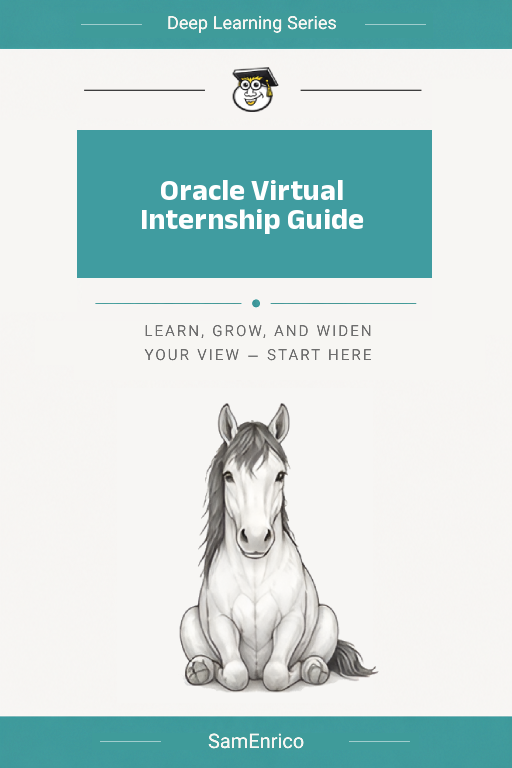
Non-FictionStudent's ShortcutDatabase
Oracle Virtual Internship Guide eBook
Find remote internships at Oracle in database mana
Find remote internships at Oracle in database management, cloud infrastructure, or sales.
Formats
Free sample
Chapter 1: The Three Doors--–- Most people never find the remote internship they want because they are looking for the wrong job at the wrong company. They type "Oracle intern" into Linked In, scroll through three pages of results, apply to everything with a green "Easy Apply" button, and then wonder why their inbox remains empty. This book exists because that approach does not work, and it has never worked. Oracle is not Google. It is not Amazon.
It is not a trendy startup with beanbag chairs and an Instagram-worthy office. Oracle is a seventy-billion-dollar enterprise technology giant that sells products most consumers have never heard of to companies you interact with every day without knowing it. When you swipe a credit card, book a flight, or refill a prescription, there is a significant chance that an Oracle database processed that transaction. When a bank runs its end-of-day reconciliation or a retailer predicts next quarter's inventory needs, Oracle Cloud Infrastructure or Oracle's database technology is often the invisible engine making it happen.This chapter is called "The Three Doors" because before you can successfully pursue a remote internship at Oracle, you must understand that Oracle presents not one opportunity but three fundamentally different career paths. Each door leads to a distinct world with its own technical requirements, work rhythms, remote possibilities, and long-term trajectories.
Choosing the wrong door means spending weeks or months preparing for interviews you cannot pass, developing skills no one will use, and ultimately burning out before you even begin. Choosing the right door means focusing your energy exactly where it belongs, impressing recruiters with your specificity, and landing an internship that actually fits who you are and how you work.The three doors are Database, Cloud Infrastructure, and Sales. Yes, Oracle has many other departments—Human Resources, Finance, Marketing, Legal, and dozens more. But the company's core engine, the reason it has survived for more than four decades and continues to generate massive profits, runs on these three pillars. Oracle hires more interns in these three areas than anywhere else.
It offers more remote flexibility in these three areas than anywhere else. And most importantly, these three areas lead to the highest conversion rates from intern to full-time employee because they are the beating heart of the business.This chapter will walk you through each door, showing you exactly what lies behind it. You will learn what people in these roles actually do all day, not the glossy version from the careers page. You will learn how to distinguish between remote-first roles and hybrid roles, because at Oracle, "remote" is not a single category. You will see hard data on internship conversion rates, average time-to-hire, and which departments have the highest retention for remote workers.
And at the end of this chapter, you will take a self-assessment quiz that will tell you which door you should walk through based on your skills, personality, and career goals.By the time you finish reading, you will never again be the person who blindly applies to every Oracle internship listing. You will be the person who knows exactly what they want and can speak about it with precision and confidence. That is the difference between getting ignored and getting hired.The Oracle You Never Knew Before we open the three doors, you need to understand the company standing behind them. Oracle was founded in 1977 by Larry Ellison, Bob Miner, and Ed Oates. The name came from a CIA project they had worked on, and the original product was a relational database that could handle large amounts of data more efficiently than anything else at the time.
Fast forward nearly five decades, and Oracle has transformed itself multiple times. It survived the dot-com crash, the rise of cloud computing, and the shift to mobile and artificial intelligence. Along the way, it acquired hundreds of other companies including Sun Microsystems (which gave Oracle Java, still one of the most widely used programming languages in the world), People Soft, Siebel Systems, and Net Suite.Today, Oracle is the world's largest database company by a wide margin. According to industry analyst firm Gartner, Oracle holds roughly forty percent of the relational database market, more than Microsoft, IBM, and AWS combined in certain segments. But Oracle is no longer just a database company.
It has built Oracle Cloud Infrastructure (OCI), a direct competitor to Amazon Web Services, Microsoft Azure, and Google Cloud. While OCI trails those three in overall market share, it is growing faster than any of them in specific enterprise segments because Oracle has done something clever: it made its cloud run the same way its on-premise databases run, so companies can migrate without rewriting their entire application stack.Then there is the sales organization. Oracle has one of the largest and most aggressive enterprise sales forces in the world. Thousands of sales professionals, sales development representatives, solution engineers, and customer success managers work to sell Oracle's products to the Fortune 500 and beyond. These are not transactional sales—someone buying a fifty-dollar software license.
These are multi-million-dollar deals that can take six to eighteen months to close, involving legal reviews, security audits, and endless procurement negotiations.Each of these three areas—Database, Cloud Infrastructure, and Sales—operates like a distinct sub-company with its own culture, its own career ladder, and its own remote work policies. An engineer in the database division might spend their day writing C code for a kernel. An engineer in OCI might spend their day writing Terraform scripts to automate server provisioning. A solution engineer in sales might spend their day on Zoom calls, demoing products to skeptical customers. All three work for Oracle.
All three can work remotely. But their days look almost nothing alike.Door One: The Database Path The first door leads to Oracle's oldest and most profitable business: database technology. If you walk through this door, you will join the ranks of people who manage, maintain, optimize, and sometimes build the software that holds the world's critical data. Do not let the word "database" fool you into thinking this is boring or obsolete. Modern Oracle database technology is anything but.
Oracle Database 23c, the latest major release, includes features like JSON Relational Duality (which lets you work with data as both tables and documents simultaneously), AI-powered automated indexing, and blockchain tables that cryptographically verify data hasn't been tampered with.What Database Interns Actually Do So what does a database intern actually do? The answer depends on whether you join a product development team, a customer support team, or a consulting team. On the product development side, you might write code for the database engine itself, fix bugs in the query optimizer, or build new features for the next release. On the customer support side, you might help Oracle's paying customers troubleshoot performance problems, recover corrupted data, or plan migrations from older versions. On the consulting side, you might design database schemas for a specific client project, write complex SQL queries to generate business reports, or automate routine maintenance tasks.The common thread across all database roles is a deep comfort with structured data.
You need to understand what a relational database is, how SQL works, and what it means to normalize data. You…
This is the end of the free sample. Get the eBook to keep going. Buy now
About this book
Details
- Author
- Almanza Edison
- Publisher
- SamEnrico
- Language
- English
- Genre
- Non-Fiction, Student's Shortcut, Database
- Released
- 2026-06-01
- Pages (approx.)
- 151
- Available as
- eBook, Audiobook

Read better in the ZLOADR app
Your eBooks on your phone or tablet. Sign in with your SamEnrico account and start reading.
More by Almanza Edison
 Hypertension and Kidney DiseaseAlmanza Edison$11.99
 Retail Precedent Multiples CourseAlmanza Edison$11.99
 Volcanic Ash CrossingAlmanza Edison$11.99
 Somme Thiepval MonumentAlmanza Edison$11.99
 Holiday Spending AddictionAlmanza Edison$11.99
 Even a Penny Helps GuideAlmanza Edison$11.99
 Sugar Detox for Migraine SufferersAlmanza Edison$11.99
 Substance Use BipolarAlmanza Edison$11.99
 The Fall of the Venezuelan Slugger: David Concepción’s Unfulfilled PromiseAlmanza Edison$11.99
 The Blood Oath: Syria's Prohibition-Era Prison CoupAlmanza Edison$11.99
 A Collector's Handbook to the Ford Rs1600Almanza Edison$11.99
 Cradle to Cradle Export GuideAlmanza Edison$12.99
You may also like
 Hong Kong Handover 1997Dunn Johnnie$11.99
 Zumba For Postnatal Recovery CourseNeal Christian$11.99
 Zumba for BeginnersLadner Nikia$11.99
 YouTube Comment Mining GuideHumes Pandora$12.99
 Worry Box MeditationCarlin Rudy$11.99
 Workplace Stress MeditationNguyen Lynn$11.99
 Workplace Stress and Sleep RepairHawley Ivory$11.99
 Workplace Perfectionism CureDelaney Jeffry$11.99
 Workplace Injustice Anger GuideWallen Isabelle$11.99
 Work Addiction and Burnout LinkGreenwood Ester$11.99
 Women in Yoga and WellnessBeattie Galina$11.99
 Women in Stand Up ComedyChun Evangeline$11.99