
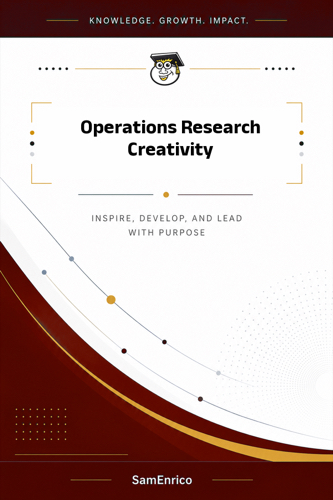
researchSelf-HelpOperations Research
Operations Research Creativity Audiobook
Apply optimization algorithms to generate novel sc
Apply optimization algorithms to generate novel scheduling and logistics solutions.
Formats
Free sample
Chapter 1: The Unasked Question--–- The conference room smelled of stale coffee and desperation. Around a long walnut table, twelve logistics managers stared at a spreadsheet projected onto a white wall. The numbers were colored red—deep crimson, the color of losses. For six months, they had been trying to optimize their delivery schedules using the most sophisticated mixed-integer programming solver their budget could buy. The software returned solutions that were mathematically optimal.
And every single day, drivers ignored them.“The algorithm says this route saves 11.3 percent on fuel,” the operations director said, pointing at a perfectly efficient serpentine path through the city. “But driver Rodriguez refuses to follow it. He says it takes him through a school zone during dismissal. He’s not wrong.”Someone muttered, “Then change the cost function.” Someone else sighed. They had changed the cost function seventeen times.
They had added constraints for left turns, bridge tolls, driver lunch preferences, and even the locations of public restrooms. Each new constraint made the model more accurate and simultaneously more fragile. The algorithm found optimal solutions that no human would ever execute.This is the central paradox of operations research: we build mathematically perfect models, and then reality refuses to cooperate. The problem is not with optimization. The problem is with the question we ask.
For decades, operations researchers have been trained to ask, “What is the optimal schedule?” or “What is the most efficient route?” These are technical questions, and they yield technical answers. But they are almost always the wrong questions.The right question is simpler and far more radical: What problem are we really trying to solve?This chapter is about the first and most creative act in operations research: reframing. Before you write a single constraint, before you choose an algorithm, before you run a single iteration, you must ask whether you have defined the problem correctly. Most scheduling and logistics failures do not occur because the optimization failed. They occur because the optimization solved the wrong problem perfectly.The Anatomy of a Wrong Problem Consider a typical logistics scenario.
A company operates a fleet of delivery vehicles. Customers place orders throughout the day. The dispatcher’s job is to assign each order to a vehicle and sequence the stops to minimize total driving distance while meeting delivery windows. This is the Vehicle Routing Problem with Time Windows (VRPTW). It has been studied for…
This is the end of the free sample. Get the Audiobook to keep going. Buy now
About this book
Details
- Author
- Tibbetts Hedwig
- Publisher
- SamEnrico
- Language
- English
- Genre
- research, Self-Help, Operations Research
- Released
- 2026-06-08
- Pages (approx.)
- 154
- Available as
- eBook, Audiobook

Listen in the VoxFlicks app
Audiobooks and audio dramas wherever you go. Sign in with your SamEnrico account and press play.
More by Tibbetts Hedwig
 Back Pain Body ScanTibbetts Hedwig$11.99
 The Nemonte Nenquimo StoryTibbetts Hedwig$11.99
 Cognitive Distancing AngerTibbetts Hedwig$11.99
 Plan de Vida PurposeTibbetts Hedwig$11.99
 Gambling Addiction for TeensTibbetts Hedwig$11.99
 Low FODMAP Brain BenefitsTibbetts Hedwig$11.99
 Entrepreneur ProcrastinationTibbetts Hedwig$11.99
 The Manchester Martyr: A Mother's Last StandTibbetts Hedwig$11.99
 Nefertiti’s Veil: The Lost Excalibur of EgyptTibbetts Hedwig$11.99
 How to Produce Remote ControlsTibbetts Hedwig$11.99
 How to Produce Eyelets and GrommetsTibbetts Hedwig$11.99
 The Essential Guide to StandardsTibbetts Hedwig$11.99
You may also like
 Scientific Research On TM GuideMartens Nathanial$11.99
 Research Proposal Methodology Section MasteryPauley Debroah$11.99
 Research Proposal Appendix CompilationRaines Tyisha$11.99
 Academic Researcher Distraction GuideFord Virgil$11.99
 TM Research and ScienceCovert Nicki$11.99
 Social Anxiety Research ReviewRoberge Cole$11.99
 Research Proposal Significance Section GuideBock Tory$12.99
 Research Proposal Reviewer PsychologyLugo Tawanda$11.99
 Research Proposal Research Questions DesignLara Robbi$11.99
 Research Proposal References and CitationsPatten Shanice$11.99
 Research Proposal Mixed Methods DesignCameron Omega$11.99
 Research Proposal Data Management PlanAnderson Roberto$12.99