
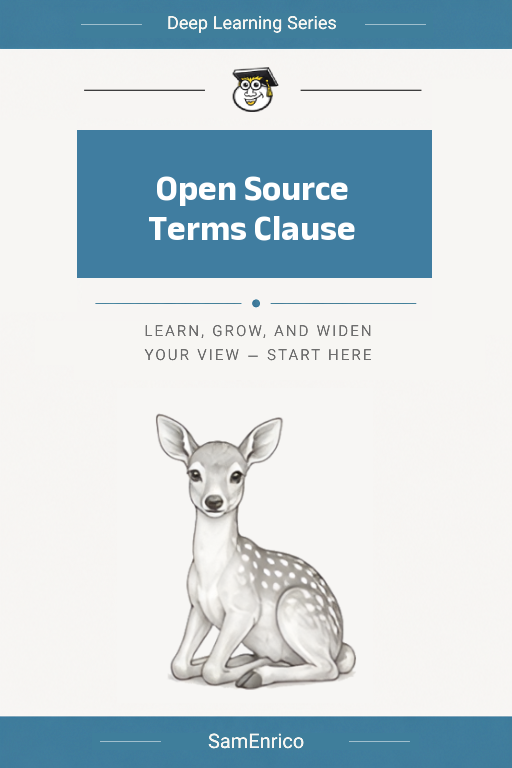
Non-FictionFirst 30 DaysOpen Source
Open Source Terms Clause eBook
Disclose use of open source software and comply wi
Disclose use of open source software and comply with license attribution requirements.
Formats
Free sample
Chapter 1: The Permissionless Fallacy...--–- In the winter of 2021, a mid‑sized logistics company called Logi Track Solutions received a letter that would cost them 4.2million.Theyhadnotstolentradesecrets.Theyhadnotviolatedexportcontrols.Theyhadsimplyusedanopensourcelibrarycalled Gsontoparse JSONdataintheirflagshiproutingengine.Theproblemwasnotthecodeitself.Theproblemwasthat Logi Track’sengineershadnevertoldtheirlegaldepartmentaboutit.Whenanacquirerranaroutinesoftwarecompositionanalysisduringduediligence,theydiscoveredthat Logi Trackhadbeendistributingamodifiedversionofa GPL‑licensedlogginglibraryalongsidetwenty‑sevenotheropensourcecomponents.Notoneofthosecomponentshadbeendisclosedinanyvendoragreement.Notonesetoflicensenoticeshadbeenpreserved.Theacquisition,valuedat4.2 million. They had not stolen trade secrets. They had not violated export controls. They had simply used an open source library called Gson to parse JSON data in their flagship routing engine. The problem was not the code itself.
The problem was that Logi Track’s engineers had never told their legal department about it. When an acquirer ran a routine software composition analysis during due diligence, they discovered that Logi Track had been distributing a modified version of a GPL‑licensed logging library alongside twenty‑seven other open source components. Not one of those components had been disclosed in any vendor agreement. Not one set of license notices had been preserved. The acquisition, valued at 4.2million.Theyhadnotstolentradesecrets.Theyhadnotviolatedexportcontrols.Theyhadsimplyusedanopensourcelibrarycalled Gsontoparse JSONdataintheirflagshiproutingengine.Theproblemwasnotthecodeitself.Theproblemwasthat Logi Track’sengineershadnevertoldtheirlegaldepartmentaboutit.Whenanacquirerranaroutinesoftwarecompositionanalysisduringduediligence,theydiscoveredthat Logi Trackhadbeendistributingamodifiedversionofa GPL‑licensedlogginglibraryalongsidetwenty‑sevenotheropensourcecomponents.Notoneofthosecomponentshadbeendisclosedinanyvendoragreement.Notonesetoflicensenoticeshadbeenpreserved.Theacquisition,valuedat180 million, collapsed.
Logi Track did not go out of business, but it came close. Its founder later described the experience in a deposition: “I thought open source was free. I never knew free came with a contract.”That founder was not alone. A 2025 study by the Open Source Security Foundation found that ninety‑eight percent of commercial software codebases contain open source components, yet fifty‑three percent of those components are not tracked by any formal compliance process. The gap between engineering reality and legal awareness has become the single greatest source of software liability in the modern economy.
And at the center of that gap lies a seemingly simple document: the open source terms clause.This is a book about that clause. But before we can draft it, negotiate it, or enforce it, we must first understand why the words “open source” have become the most dangerously misunderstood phrase in software law. This chapter dismantles the definitional trap that catches engineers, lawyers, and executives alike. It establishes the foundational taxonomy that will govern every subsequent chapter. And it introduces the single most important operational tool for escaping the trap: the Software Bill of Materials, or SBOM.
Because you cannot comply with a license you do not know you have accepted. And you cannot disclose what you have never inventoried.The Four Deadly Misconceptions Every failure of open source compliance begins with a misconception. Not malice. Not even negligence, necessarily. Just a plausible, reasonable misunderstanding that turns out to be catastrophically wrong.
Through hundreds of compliance audits, litigation files, and M&A disasters, four misconceptions appear again and again. We will name them, bury them, and never repeat them.Misconception One: Open Source Means Public Domain The first misconception is also the oldest. Engineers who grew up downloading code from Git Hub often assume that if something is “open,” no one owns it. This is false. Open source software is copyrighted software.
The only thing “open” about it is the license under which the copyright holder permits you to use it. The moment you copy, modify, or distribute open source code, you are exercising exclusive rights granted by copyright law. The license does not extinguish those rights. It merely waives them conditionally.The difference matters enormously. Public domain works carry no restrictions because the copyright has expired or been disclaimed.
Open source works carry very specific restrictions. Violate those restrictions, and the copyright holder can sue you for infringement, not just breach of contract. As we will explore in Chapter 3, the distinction between copyright infringement and contract breach has profound consequences for remedies, damages, and the availability of a cure period. For now, the essential lesson is this: treat every open source component as if a lawyer drafted it. Because one did.Misconception Two: Free Means No Obligations The second misconception is the most seductive.
The word “free” appears in the name “Free Software Foundation.” It appears in the phrase “free and open source software.” Surely, if it is free, there are no strings attached.This is exactly backward. Permissive open source licenses are called permissive precisely because they impose few obligations. But “few” is not “none.” The MIT license requires you to preserve the copyright notice. The BSD license requires the same, and some versions add a prohibition on using the authors’ names to endorse derived works. The Apache 2.0 license requires a NOTICE file.
The GPL family requires you to provide source code to downstream recipients. The AGPL triggers this obligation even for network use.None of these obligations are optional. None are waived by accident. And none disappear because you paid nothing for the code. The license is the price of admission.
Ignoring the license does not make it go away. It makes you an infringer.Misconception Three: Permissive Means No Risk The third misconception is more sophisticated but equally dangerous. Corporate counsel who have survived a GPL compliance audit sometimes develop a comforting belief: as long as we stick to permissive licenses like MIT, BSD, and Apache 2.0, we are safe.This is not false, but it is dangerously incomplete. Permissive licenses do eliminate the risk of being forced to open source your proprietary code. That is their defining feature.
But they do not eliminate patent risk, trademark risk, or attribution risk. The Apache 2.0 license contains an express patent grant that can terminate if you sue a contributor. The MIT and BSD licenses contain no patent grant at all, leaving you vulnerable to patent infringement claims from upstream contributors. All permissive licenses require preservation of copyright notices. And none permit you to use project trademarks without separate permission.A company that treats permissive licenses as a free pass will eventually learn otherwise, usually through a cease‑and‑desist letter from a trademark holder or a patent infringement suit from a contributor who never granted a patent license.
Permissive licenses reduce risk. They do not eliminate it.Misconception Four: Source‑Available Equals Open Source The fourth misconception is the newest and fastest growing. In response to cloud providers monetizing open source code without contributing back, companies like Elastic, Mongo DB, and Redis have adopted source‑available licenses such as the Server Side Public License (SSPL), the Business Source License (BSL), and the Elastic License. These licenses make the source code visible but impose restrictions that violate the Open Source Definition: restrictions on field of use, restrictions on competing services, or time‑limited conversions to proprietary licenses.Calling these licenses “open source” is not merely inaccurate. It is legally hazardous.
A vendor who represents that their software is open source when it is merely source‑available can be sued for fraudulent misrepresentation. A customer who relies on that representation may unknowingly accept terms that prohibit their entire business model. The SSPPL, for example, requires that if you offer the software as a service, you must release all your orchestration code under the same license – effectively forcing you to open source your entire cloud infrastructure. That is not open source. That is a proprietary license with source visibility.Throughout this book, when we say “open source,”…
This is the end of the free sample. Get the eBook to keep going. Buy now
About this book
Details
- Author
- Dollar Maurita
- Publisher
- SamEnrico
- Language
- English
- Genre
- Non-Fiction, First 30 Days, Open Source
- Released
- 2026-06-01
- Pages (approx.)
- 116
- Available as
- eBook, Audiobook

Read better in the ZLOADR app
Your eBooks on your phone or tablet. Sign in with your SamEnrico account and start reading.
More by Dollar Maurita
 Major Depressive Disorder Explained for PoliceDollar Maurita$11.99
 That's Not All Technique GuideDollar Maurita$11.99
 Russian Mafia in GermanyDollar Maurita$11.99
 Building Resilience During PregnancyDollar Maurita$11.99Building Resilience During PregnancyDollar Maurita$11.99
 Brand Value Ranking Methodology CritiqueDollar Maurita$11.99
 Albertina SisuluDollar Maurita$11.99
 Nobel Laureates Who Never WonDollar Maurita$11.99
 Legacy of ForgivenessDollar Maurita$11.99
 The Whispering Scrolls of Timbuktu: Voices of the Golden AgeDollar Maurita$11.99
 The Lion and the Fox: Hannibal and Scipio’s Enduring RivalryDollar Maurita$11.99
 Service Providers Guide to Reminder ServicesDollar Maurita$11.99
You may also like
 Hong Kong Handover 1997Dunn Johnnie$11.99
 Zumba For Postnatal Recovery CourseNeal Christian$11.99
 Zumba for BeginnersLadner Nikia$11.99
 YouTube Comment Mining GuideHumes Pandora$12.99
 Worry Box MeditationCarlin Rudy$11.99
 Workplace Stress MeditationNguyen Lynn$11.99
 Workplace Stress and Sleep RepairHawley Ivory$11.99
 Workplace Perfectionism CureDelaney Jeffry$11.99
 Workplace Injustice Anger GuideWallen Isabelle$11.99
 Work Addiction and Burnout LinkGreenwood Ester$11.99
 Women in Yoga and WellnessBeattie Galina$11.99
 Women in Stand Up ComedyChun Evangeline$11.99