
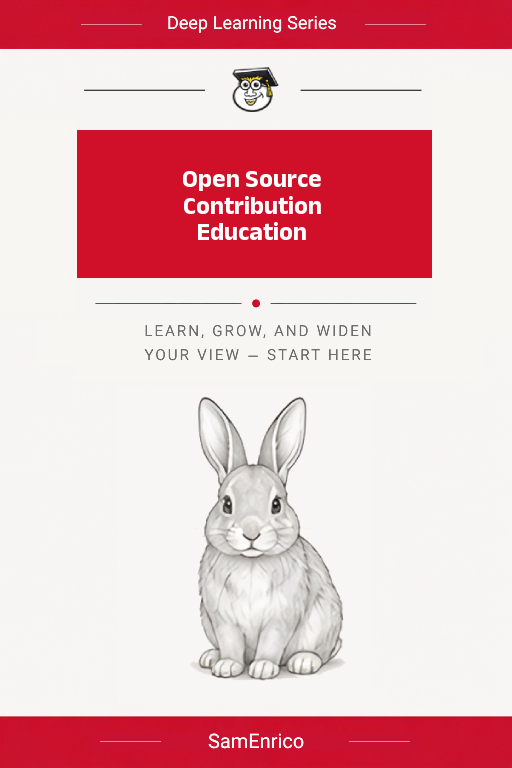
Non-FictionStudent's ShortcutOpen SourceReal World Experience
Open Source Contribution Education eBook
Learn coding through open source contributions as
Learn coding through open source contributions as an alternative to bootcamps and degrees with real world experience.
Formats
Free sample
Chapter 1: The $120,000 Typo--There is a specific moment in every self-taught programmer’s life when they realize that the educational system has failed them. For me, that moment came at 2:47 AM, staring at a merge conflict so terrifying that I genuinely considered changing careers to something less stressful, like beekeeping. I had just completed a twelve-week online course. I had a certificate that said I knew Java Script, React, and Node.js. I had built a to-do list app, a weather dashboard, and a calculator that could handle integers up to about ten thousand before it started doing whatever it wanted.What I did not have was any idea how to work with other humans on actual code.The first time someone asked me to review their pull request, I panicked.
The first time someone left a comment on mine asking why I had committed a file called final_FINAL_real_this_time.js, I wanted to disappear. The first time I saw a CI pipeline turn red, I assumed I had broken the internet. And the first time I looked at a job description that asked for “experience working on production codebases with distributed teams,” I realized that every single dollar I had spent on my education—roughly twelve thousand dollars—had not prepared me for that sentence.The Three Lies You Have Been Told About Learning to Code Let me be blunt about something that career coaches and bootcamp salespeople will never tell you: the coding education industry is built on a structural lie. The lie is not that you can learn to code. You can.
The lie is that the way we teach coding actually prepares you for the work of being a software developer.Lie Number One: “Learn the Syntax, Learn the Job”Bootcamps are extraordinarily good at teaching syntax. You will leave a good bootcamp knowing how to write a for loop, a map function, and a React component. You will know the difference between let and const. You will have built several projects that you can proudly link to on your resume.What you will not know is what happens when your code runs on a server that is not your laptop. You will not know what to do when your pull request triggers a test failure in a file you have never opened.
You will not know how to read a stack trace that stretches across fifteen different files written by twelve different people over eight years. You will not know why your perfectly functional code gets rejected in code review because of something called “idiomatic style.”Syntax is the alphabet. Programming is literature. Bootcamps teach you the alphabet and call you a novelist.Lie Number Two: “A Degree Guarantees You Know the Fundamentals”University computer science degrees do teach fundamentals—algorithms, data structures, computational theory, maybe some discrete mathematics. These are not useless.
They are, however, approximately three to five years behind what you will actually need on your first day of work.The company hiring you does not care that you can prove the halting problem is undecidable. They care whether you can debug a race condition in a multithreaded microservice that handles payments. They care whether you can read a legacy codebase written in a framework that was deprecated before you started college. They care whether you can collaborate with a senior engineer who has strong opinions about variable naming and expresses those opinions through Git Hub comments that contain only the word “Why?”A degree tells an employer that you can finish something that takes four years. It does not tell them that you can ship software.Lie Number Three: “You Need Permission to Write Real Code”This is the most insidious lie of all.
From the moment we start learning, we are conditioned to believe that writing code for real users requires credentials, permission, or a job offer. The bootcamp says: complete our program first. The degree says: finish your four years first. The industry says: get hired first.But open source has no gatekeeper. There is no admissions committee for Git Hub.
No one checks your diploma before you submit a pull request. The only thing that stands between you and contributing to the actual software that millions of people use every day is your willingness to try and your ability to handle feedback.I learned this the hard way. After my late-night merge conflict crisis, I almost gave up. But then I found a small open source library—a tool for formatting dates in Java Script that had exactly one maintainer and about forty open issues. The issues were mostly user error, but one of them was real: a bug that caused the library to return the wrong day of the week for dates in February during leap years.I spent three days reading the code.
I did not write a single line of new code for the first forty-eight hours. I just read. I traced function calls. I ran the tests and watched them fail. I added console logs in places that probably annoyed the maintainer when they saw them in the pull request.
And then, on the third day, I wrote a change: seven lines of code that fixed the leap year bug.The maintainer merged it within twenty-four hours. They left a comment that said “Nice catch, thanks.” That was it. No interview. No credentials check. No degree verification.
Just seven lines of code, reviewed by a stranger, accepted into software that was being used by thousands of developers worldwide.I did not need permission. I needed the willingness to read code before writing it.The Real Cost of Traditional Education Let us talk about money, because that is the elephant in every room where people discuss coding careers.A four-year computer science degree at a public university in the United States costs, on average, between forty thousand and one hundred twenty thousand dollars for in-state students. Out-of-state or private? Double that, easily. Add room and board, textbooks, fees, and the opportunity cost of not working for four years, and you are looking at a quarter of a million dollars for a piece of paper that will be outdated in technology terms before you graduate.A bootcamp costs between ten thousand and twenty-five thousand dollars for twelve to sixteen weeks of instruction.
That is a thousand dollars a week for a curriculum that cannot possibly cover system design, legacy code maintenance, team dynamics, production debugging, or any of the other skills you will actually need. Bootcamps know this. They compensate by teaching you how to interview, how to talk about your projects, and how to appear more experienced than you are. That is not education—that is performance.The open source alternative costs exactly zero dollars. The infrastructure is free.
The code is free. The mentors—the maintainers who will review your pull requests and teach you through feedback—are volunteering their time. The only investment you make is time and emotional resilience.But here is what you get for that investment of zero dollars: experience that is indistinguishable from professional work, because it is professional work. When you fix a bug in an open source project…
This is the end of the free sample. Get the eBook to keep going. Buy now
About this book
Details
- Author
- Beavers Nickolas
- Publisher
- SamEnrico
- Language
- English
- Genre
- Non-Fiction, Student's Shortcut, Open Source, Real World Experience
- Released
- 2026-06-01
- Pages (approx.)
- 131
- Available as
- eBook, Audiobook

Read better in the ZLOADR app
Your eBooks on your phone or tablet. Sign in with your SamEnrico account and start reading.
More by Beavers Nickolas
 Growth Hormone Releasing Hormone GuideBeavers Nickolas$11.99
 Abbasid Astronomy Golden AgeBeavers Nickolas$11.99
 Panic Disorder Gastrointestinal Symptoms WorkbookBeavers Nickolas$11.99
 Self Hypnosis Progressive RelaxBeavers Nickolas$11.99
 Military Parent Reentry Anger GuideBeavers Nickolas$11.99
 The Last Letter: A Mother’s Voice Across TimeBeavers Nickolas$11.99
 Wings Over the World: The Arctic’s Silent SuperhighwayBeavers Nickolas$11.99
 Understanding Brittle Bone Syndrome Lethal TypeBeavers Nickolas$17.99
 Middle East Ecommerce OutlookBeavers Nickolas$12.99
 How to Become a Sawyer IBeavers Nickolas$11.99
 Loan SpecialistBeavers Nickolas$11.99
You may also like
 Hong Kong Handover 1997Dunn Johnnie$11.99
 Zumba For Postnatal Recovery CourseNeal Christian$11.99
 Zumba for BeginnersLadner Nikia$11.99
 YouTube Comment Mining GuideHumes Pandora$12.99
 Worry Box MeditationCarlin Rudy$11.99
 Workplace Stress MeditationNguyen Lynn$11.99
 Workplace Stress and Sleep RepairHawley Ivory$11.99
 Workplace Perfectionism CureDelaney Jeffry$11.99
 Workplace Injustice Anger GuideWallen Isabelle$11.99
 Work Addiction and Burnout LinkGreenwood Ester$11.99
 Women in Yoga and WellnessBeattie Galina$11.99
 Women in Stand Up ComedyChun Evangeline$11.99