
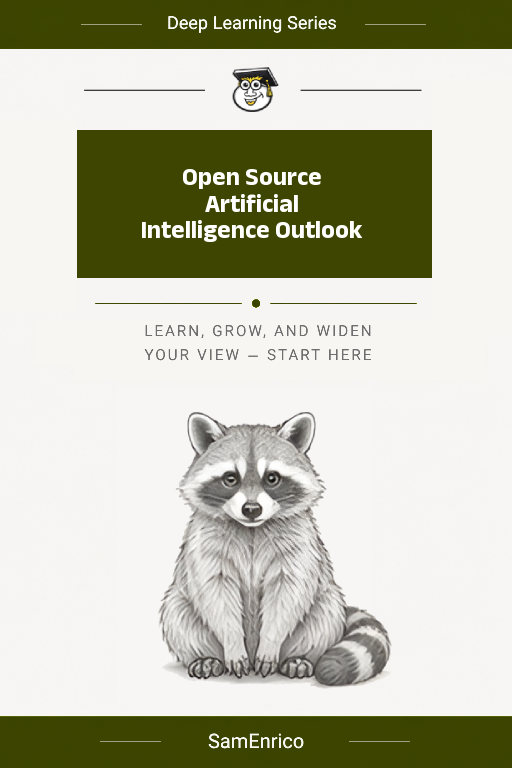
Non-FictionForecast & OutlookOpen Source
Open Source Artificial Intelligence Outlook eBook
Project growth of Llama, Mistral, and community mo
Project growth of Llama, Mistral, and community models versus proprietary systems, plus licensing battles and democratization trends.
Formats
Free sample
Chapter 1: The Great Convergence--The numbers tell a story that most boardrooms haven’t noticed yet. In early 2024, if you wanted a large language model that could pass the bar exam, write production‑ready code, or reason through advanced mathematics, you had exactly three real options: Open AI’s GPT‑4, Anthropic’s Claude, or Google’s Gemini. All were closed. All were accessible only via API. And all came with a pricing model that resembled a utility bill—pay per token, scale with usage, and never ask what happens inside the black box.
The prevailing wisdom was simple: open‑source AI was catching up, but catching up wasn’t winning. The gap, most experts agreed, was structural and permanent.Eighteen months later, that consensus has shattered.By mid‑2026, the benchmark leaderboards tell a radically different story. Models like Llama 3.3 70B, Mistral Large 2, and Qwen 2.5 72B have achieved statistical parity—or near‑parity—with their proprietary counterparts on the industry’s most demanding tests. On MMLU (massive multitask language understanding), the gap between the best closed model and the best open‑weight model has collapsed from nearly twenty percentage points in 2024 to less than five points today. On Human Eval, the gold standard for code generation, open models actually lead in several categories.
And on GSM8K, the grade‑school math benchmark that tripped up early LLMs, the difference between GPT‑4o and a properly fine‑tuned Llama 3.3 is now within the margin of measurement error.This is not a fluke. It is not a temporary convergence that proprietary vendors will reverse with their next release. It is the result of three fundamental shifts that together have rewritten the economics of artificial intelligence: architectural innovation that decouples capability from parameter count, a quantization toolchain that puts enterprise‑grade models on consumer hardware, and a community development model that moves faster than any corporate research lab. The benchmark wars are over. Open‑source AI didn’t just catch up—it changed the game entirely.This chapter dismantles the performance assumption that has guided AI procurement for the past three years.
We will walk through the data, examine the architectural breakthroughs, and introduce the framework that will organize the rest of this book. The central argument is simple but profound: benchmark leadership is no longer a competitive moat. The real battle has shifted to cost, control, compliance, and community velocity—four dimensions where open models now hold decisive advantages.The Numbers That Changed Everything Let us begin with the data, because the data is what makes the argument irrefutable. In 2024, the Open LLM Leaderboard—maintained by Hugging Face in collaboration with the open‑source research community—showed a consistent gap of 15–20 percent between the top proprietary models and the best available open‑weight alternatives. GPT‑4 scored approximately 86 percent on MMLU; the best Llama 2 variant hovered around 68 percent.
On Human Eval, the gap was even wider: GPT‑4 approached 85 percent pass‑rate, while open models struggled to break 70 percent. The narrative wrote itself: closed models were simply better, and the gap might never close.Twelve months later, that narrative collapsed. The release of Llama 3 (8B, 70B, and the experimental 405B) narrowed the gap to single digits on most benchmarks. Then came Mistral’s Mixtral 8x22B, which introduced Mixture‑of‑Experts efficiency without sacrificing accuracy. Qwen 2.5 followed, demonstrating that long‑context performance—up to one million tokens—was not a proprietary advantage.
By the first quarter of 2026, the cumulative evidence was overwhelming.Consider the following anonymized benchmark averages from the second quarter of 2026, compiled from independent evaluations by HEIM (Holistic Evaluation of Language Models), the Berkeley Function‑Calling Leaderboard, and the LMSYS Chatbot Arena:MMLU (5‑shot, weighted average):Top proprietary models (GPT‑4o, Claude 3.5, Gemini Ultra): 87.4%Top open‑weight models (Llama 3.3 70B, Mistral Large 2, Qwen 2.5 72B): 84.2%Human Eval (pass@1):Top proprietary: 89.1%Top open‑weight: 87.6%GSM8K (8‑shot, majority voting):Top proprietary: 94.2%Top open‑weight: 93.1%BIG‑Bench Hard (average over 23 tasks):Top proprietary: 82.7%Top open‑weight: 79.8%The proprietary advantage has not vanished entirely. On complex reasoning tasks, closed models still hold a slim lead, and multimodal capabilities—native image, audio, and video understanding—remain areas where open models lag. But for the vast majority of enterprise use cases, the difference is no longer meaningful. A three‑point gap on MMLU does not determine whether a customer‑support chatbot resolves tickets accurately. A two‑point gap on Human Eval does not determine whether an automated code‑review tool catches bugs.
The only domain where the gap still matters is the frontier: the very hardest tasks, the ones that most organizations never actually need to solve.What changed? Three factors, working in concert.First, architecture. The shift from dense transformers to Mixture‑of‑Experts (Mo E) allowed open models to scale total parameter counts without scaling inference costs. Where a dense 70B model requires 70B operations per token, a Mo E model with 140B total parameters might activate only 20B per token—dramatically reducing the cost of running the model. This innovation came from the open‑source community, not from closed labs.Second, quantization.
The development of 4‑bit and 8‑bit inference techniques—pioneered by projects like llama.cpp, Auto GPTQ, and AWQ—enabled models to run on consumer hardware. A 70B model that required 140GB of VRAM at full precision needs only 35GB at 4‑bit. That is the difference between an eight‑GPU H100 cluster (40,000permonthoncloudrental)andasingleconsumer GPU(40,000 per month on cloud rental) and a single consumer GPU (40,000permonthoncloudrental)andasingleconsumer GPU(2,000 one‑time purchase). The cost reduction is not incremental; it is transformational.Third, community fine‑tuning. The Hugging Face ecosystem now contains over half a million models, many of them specialized variants of base open‑weight releases.
If you need a model for medical question‑answering, legal document summarization, or financial sentiment analysis, someone has likely already fine‑tuned it and shared the weights. This collective intelligence cannot be replicated by any single company, no matter how well‑funded.The Inference Cost Revolution The performance convergence is important, but it is not the most important story. The true game‑changer is cost.Proprietary APIs price their services on a per‑token basis. As of mid‑2026, Open AI charges approximately 2.50permillioninputtokensand2.50 per million input tokens and 2.50permillioninputtokensand10 per million output tokens for GPT‑4o, with higher tiers for longer contexts or specialized capabilities. Anthropic’s Claude 3.5 Opus is similarly priced, and Google’s Gemini Ultra sits in the same range.
For a mid‑sized enterprise generating ten million API calls per month—a typical volume for a company with a customer‑support chatbot, internal knowledge assistant, and code‑review tool—the monthly API bill alone runs between 20,000and20,000 and 20,000and30,000.Self‑hosted open models invert this cost structure. Instead of paying per token, you pay for compute infrastructure. A production deployment of Llama 3.3 70B on four A100 GPUs (the minimum for reasonable latency and throughput) costs approximately 8,000permonthoncloudrentalora8,000 per month on cloud rental or a 8,000permonthoncloudrentalora40,000 upfront purchase for on‑premise hardware. Engineering overhead adds another 5,000to5,000 to 5,000to15,000 per month, depending on the sophistication of your deployment. The total monthly cost for self‑hosting a 70B‑class model ranges from 15,000to15,000 to 15,000to25,000—comparable to or slightly higher than API costs for the same volume.But that comparison misses…
This is the end of the free sample. Get the eBook to keep going. Buy now
About this book
Details
- Author
- Fairbanks Beatriz
- Publisher
- SamEnrico
- Language
- English
- Genre
- Non-Fiction, Forecast & Outlook, Open Source
- Released
- 2026-05-30
- Pages (approx.)
- 121
- Available as
- eBook, Audiobook

Read better in the ZLOADR app
Your eBooks on your phone or tablet. Sign in with your SamEnrico account and start reading.
More by Fairbanks Beatriz
 GAD Depression Comorbidity GuideFairbanks Beatriz$11.99
 Brand Health MapFairbanks Beatriz$11.99
 The Yes Set InductionFairbanks Beatriz$11.99
 Khomeini Death in 1989Fairbanks Beatriz$11.99
 Eisenhower for Work Life BalanceFairbanks Beatriz$11.99
 The Blackout Prophecies: The 1977 New York City Power Grid ParanormalFairbanks Beatriz$11.99
 Crom Dubh's Iron Spire: The Forgotten Tower of the Tuatha Dé DanannFairbanks Beatriz$11.99
 How to Become a Claims ClerkFairbanks Beatriz$11.99
 African Applicant Scholarship ManualFairbanks Beatriz$12.99
 Video Game TesterFairbanks Beatriz$11.99
 Understanding Hairy Palms and SolesFairbanks Beatriz$17.99
You may also like
 Hong Kong Handover 1997Dunn Johnnie$11.99
 Zumba For Postnatal Recovery CourseNeal Christian$11.99
 Zumba for BeginnersLadner Nikia$11.99
 YouTube Comment Mining GuideHumes Pandora$12.99
 Worry Box MeditationCarlin Rudy$11.99
 Workplace Stress MeditationNguyen Lynn$11.99
 Workplace Stress and Sleep RepairHawley Ivory$11.99
 Workplace Perfectionism CureDelaney Jeffry$11.99
 Workplace Injustice Anger GuideWallen Isabelle$11.99
 Work Addiction and Burnout LinkGreenwood Ester$11.99
 Women in Yoga and WellnessBeattie Galina$11.99
 Women in Stand Up ComedyChun Evangeline$11.99