
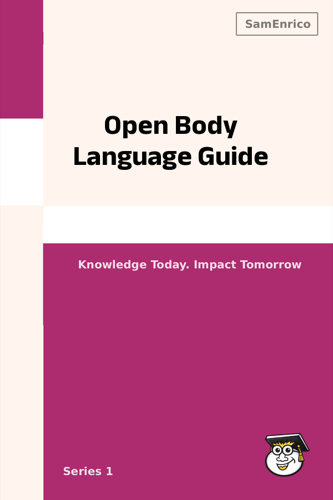
Open Body Language Guide
Uncross arms and maintain eye contact for trust.
by Heaton Kasie
Uncross arms and maintain eye contact for trust.
Formats
About this book
Free sample
Chapter 1: The Chemistry of Connection--–- You are standing in an elevator. The doors open, and a colleague steps in. You smile, say hello, and lean against the back wall. Your arms are crossed loosely over your chest—not because you are angry, but because the air conditioning is cold and it feels comfortable. The conversation lasts forty-five seconds.
You part ways, thinking nothing of it.But something happened in those forty-five seconds that you did not see and cannot feel. Your colleague walked away with a subtle, unconscious impression that you were slightly closed off, slightly defensive, slightly less trustworthy than the person they spoke to five minutes earlier in the coffee queue. Not because of anything you said. Because of your arms. Because of your eyes.
Because of a silent biochemical conversation happening beneath your skin that you never knew you were having.This chapter is about that hidden conversation. It is about the chemistry of connection—the hormones, the neural pathways, and the ancient biological programs that run every interaction you have, whether you are aware of them or not. By the time you finish this chapter, you will never cross your arms casually again without knowing exactly what message you are sending. And you will never look someone in the eyes the same way again, because you will understand that eye contact is not just looking—it is a chemical handshake between two nervous systems.The 93% Misunderstanding Before we dive into the chemistry, we need to clear up one of the most persistent myths in communication research. You have probably heard that 93% of communication is nonverbal.
This statistic appears in countless articles, TED Talks, and business books. It is cited as settled science. And it is mostly wrong—or rather, it is wildly misapplied.The 93% figure comes from a 1967 study by psychologist Albert Mehrabian. In his research, Mehrabian found that when people spoke about emotions and attitudes—specifically when their words and their tone of voice contradicted each other—listeners placed 55% weight on facial expression, 38% on tone of voice, and only 7% on the actual words…
This is the end of the free sample. Get the eBook to keep going. Buy now
Contents
- Chapter 1
- Chapter 2
- Chapter 3
- Chapter 4
- Chapter 5
- Chapter 6
- Chapter 7
- Chapter 8
- Chapter 9
- Chapter 10
- Chapter 11
- Chapter 12
Details
- Author
- Heaton Kasie
- Publisher
- SamEnrico
- Language
- English
- Genre
- Non-Fiction, Self-Help, Openness
- Released
- 2026-06-06
- Pages (approx.)
- 147
- Available as
- eBook, Audiobook

Read better in the ZLOADR app
Your eBooks on your phone or tablet. Sign in with your SamEnrico account and start reading.
More by Heaton Kasie
 Shopping Addiction TherapyHeaton Kasie$11.99
 Self Talk for Creatives GuideHeaton Kasie$11.99
 Dhatu Tissue Layer GuideHeaton Kasie$11.99
 Binge Eating and Perfectionism LinkHeaton Kasie$11.99
 High Blood Pressure CausesHeaton Kasie$11.99
 Panic Relapse PreventionHeaton Kasie$11.99
 Canyon Descent ProtocolsHeaton Kasie$11.99
 The Lion’s Ingenuity: Benjamin Banneker’s Astronomical WondersHeaton Kasie$11.99
 The Vanished Vermeer: A Dutch Master’s Midnight EscapeHeaton Kasie$11.99
 A Collector's Handbook to the Ford FalconHeaton Kasie$11.99
 Service Providers Guide to General Cleaning ServicesHeaton Kasie$11.99
 How to Become a Major-assembly InspectorHeaton Kasie$11.99
You may also like
 Hong Kong Handover 1997Dunn Johnnie$11.99
 Zumba For Postnatal Recovery CourseNeal Christian$11.99
 Zumba for BeginnersLadner Nikia$11.99
 YouTube Comment Mining GuideHumes Pandora$12.99
 Worry Box MeditationCarlin Rudy$11.99
 Workplace Stress MeditationNguyen Lynn$11.99
 Workplace Stress and Sleep RepairHawley Ivory$11.99
 Workplace Perfectionism CureDelaney Jeffry$11.99
 Workplace Injustice Anger GuideWallen Isabelle$11.99
 Work Addiction and Burnout LinkGreenwood Ester$11.99
 Women in Yoga and WellnessBeattie Galina$11.99
 Women in Stand Up ComedyChun Evangeline$11.99