
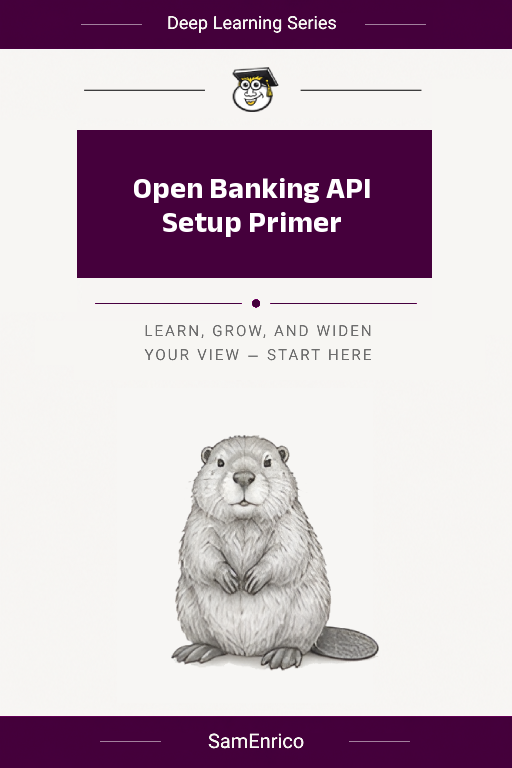
Non-FictionBusiness BriefAPI Setup
Open Banking API Setup Primer eBook
Register for developer access, obtain API keys, an
by Skelton Dale
Register for developer access, obtain API keys, and connect your accounting software to bank feeds.
Formats
Free sample
Chapter 1: The Five Myths--–- Every failed Open Banking project starts the same way. A developer reads a bank’s marketing page that says, “Our Open Banking APIs are RESTful and standardized.” They think, “I’ve done REST APIs before. Stripe took me an afternoon. Google Maps took me two hours. How hard can this be?”Three months later, that same developer is staring at a 401 Invalid Client error at 11 PM on a Sunday.
Their inbox contains fourteen emails from customers asking why their bank feeds stopped working. Their staging environment works perfectly, but production returns a cryptic JWT expiration error that no amount of Googling can solve. They have three different certificates, two client secrets, and absolutely no idea which one the bank is actually validating against.This chapter exists to ensure that is not you.Before we write a single line of code, before we generate a single certificate, before we even create a developer portal account, we must understand why Open Banking feels deliberately difficult. The answer is not that banks are incompetent or that standards bodies enjoy suffering. The answer is that Open Banking solves a fundamentally harder problem than any API you have used before.
Stripe does not need to verify that you are legally allowed to access a specific customer’s transaction history. Google Maps does not need to prove to the Australian government that your mapping application is a registered legal entity. Open Banking must do both, simultaneously, while complying with regulations that vary by country and change every eighteen months.The gap between expectation and reality is where projects die. That gap is filled by five myths – plausible, comforting assumptions that every developer makes when they first approach Open Banking. These myths are not taught in any documentation because banks assume you already know them.
They are not repeated in tutorials because tutorial authors have already internalized them. They exist in the silent space between “here is our API reference” and “why did your integration fail?”This chapter names those myths, dismantles them with concrete examples, and replaces them with the mental model that will guide you through the remaining eleven chapters. By the time you finish this chapter, you will understand why your future self will thank you for reading it twice.Myth #1: “I Can Just Use the API Key from the Developer Portal”The most dangerous myth is also the most understandable. Every modern API you have integrated – Twilio, Send Grid, Stripe, Git Hub, Open AI – uses an API key. You log into a dashboard, click “Generate New Key,” copy a string that looks like sk_live_4e C39Hq Lyj WDarjt T1zdp7dc, paste it into your environment variables, and make requests.
The key authenticates your application. The key never expires unless you revoke it. The key is simple.Open Banking has no API keys.Not “no API keys in production but sandbox has them.” Not “API keys plus something else.” None. Zero. The entire concept of a long-lived, app-scoped secret string does not exist in Open Banking because it cannot exist.
Here is why.An API key authenticates an application. When you send Authorization: Bearer sk_live_... to Stripe, Stripe knows that the request came from your specific application. It does not know which of your customers initiated the request. It does not know whether that customer has given your application permission to read their data.
Stripe does not need to know because Stripe’s data model is application-centric: you own your customer list, and Stripe merely processes payments on your behalf.Banking is customer-centric. The bank does not know you. The bank knows its customer – the person who logs into their online banking portal every week, the person who has a mortgage and a checking account and a credit card with that same bank. When your accounting software asks the bank for transaction data, the bank must answer three questions before returning a single byte:Is your application a legally registered Third Party Provider (TPP) in this jurisdiction? (We will cover this in Chapter 3.)Does your application have a valid certificate proving its identity?
(Chapter 2 and Chapter 6.)Has the specific customer whose data you are requesting explicitly consented to sharing that data with your application, within the last 90 days, for exactly the scope you requested? (Chapter 7.)An API key cannot answer any of these questions. An API key is a static identifier. It does not expire per user. It cannot carry consent granularity.
It cannot be revoked by a customer without contacting you. Therefore, Open Banking does not use API keys.What does it use instead? A combination of three mechanisms that we will spend the rest of this book implementing:OAuth 2.0 with PKCE – The customer logs into their bank, sees a consent screen, and authorizes your application to access specific data. The bank returns a short-lived access token that encodes exactly what the customer allowed.Mutual TLS (m TLS) – Your application presents a client certificate with every API request. The bank verifies that certificate against a list of registered TPPs.
Even if someone steals your OAuth token, they cannot use it without also possessing your private key.Dynamic Client Registration (DCR) – Your application registers itself with each bank programmatically, exchanging a short-lived Software Statement Assertion (SSA) for a long-lived Client ID and Secret. This is the closest thing to an API key, but it is only the first step in a multi-step flow.The absence of API keys is not a design flaw. It is a feature that protects customers from the nightmare of a compromised key exposing every user’s transaction history. Your job is not to fight this complexity. Your job is to build tooling that makes it invisible to your end users.Myth #2: “The Sandbox Works Exactly Like Production”Sandbox environments are lies.
Useful lies, necessary lies, but lies nonetheless. Every bank’s sandbox is designed to make integration appear easy so that you commit to the project before discovering the production complexities. This is not malice. It is economics: if the sandbox reflected production complexity, no developer would ever start.The differences between sandbox and production fall into three categories: certificates, data, and user authentication.Certificates. In every sandbox we have worked with – HSBC UK, Santander Mexico, ICBC China, BBVA Spain – you can generate a self-signed certificate and use it for both transport (TLS) and signing (JWT).
The sandbox accepts openssl req -x509 -newkey rsa:2048 -keyout key.pem -out cert.pem -days 365 -nodes without complaint. In production, the European Union requires two separate certificates from a Qualified Trust Service Provider (QTSP): a QWAC (Qualified Website Authentication Certificate) for TLS and a QSEAL (Qualified Seal Certificate) for JWT signing. Each costs €300–€1,000 per year. Each requires a legal entity registration. Each takes two to six weeks to obtain.
The sandbox never mentions this.Data. Sandbox data is beautiful. Every account has sensible balances. Every transaction has a clean merchant name. Every date is formatted correctly.
Production data is chaos. Accounts go negative. Transactions arrive with null merchant names. The same transaction appears twice – once as pending, once as posted – with different transaction IDs. Dates use local formats that your ISO parser rejects.
The sandbox never shows you the edge cases that will crash your code at 3 AM.User Authentication. In the sandbox…
This is the end of the free sample. Get the eBook to keep going. Buy now
About this book
Details
- Author
- Skelton Dale
- Publisher
- SamEnrico
- Language
- English
- Genre
- Non-Fiction, Business Brief, API Setup
- Released
- 2026-06-01
- Pages (approx.)
- 152
- Available as
- eBook, Audiobook

Read better in the ZLOADR app
Your eBooks on your phone or tablet. Sign in with your SamEnrico account and start reading.
More by Skelton Dale
 DBT For Emotional FlashbacksSkelton Dale$11.99
 The Single Tasking PrioritySkelton Dale$11.99
 Pelvic Floor for Professional SingersSkelton Dale$11.99
 Breath Meditation For DrivingSkelton Dale$11.99
 The Environmentalist Who Cleaned RiverSkelton Dale$11.99
 Breaking Inherited Low Self WorthSkelton Dale$11.99
 Pomodoro For BudgetingSkelton Dale$11.99
 Antwerp Heist Lecture NotesSkelton Dale$11.99
 The Great Fire Insurance Fraud of 1883: A Colonial ConspiracySkelton Dale$11.99
 The Battle of Nagae: The Yamato Dynasty's Last StandSkelton Dale$11.99
 A Collector's Handbook to the Fairthorpe ZetaSkelton Dale$11.99
 How to Produce Antiseptic Hand CleanerSkelton Dale$11.99
You may also like
 Hong Kong Handover 1997Dunn Johnnie$11.99
 Zumba For Postnatal Recovery CourseNeal Christian$11.99
 Zumba for BeginnersLadner Nikia$11.99
 YouTube Comment Mining GuideHumes Pandora$12.99
 Worry Box MeditationCarlin Rudy$11.99
 Workplace Stress MeditationNguyen Lynn$11.99
 Workplace Stress and Sleep RepairHawley Ivory$11.99
 Workplace Perfectionism CureDelaney Jeffry$11.99
 Workplace Injustice Anger GuideWallen Isabelle$11.99
 Work Addiction and Burnout LinkGreenwood Ester$11.99
 Women in Yoga and WellnessBeattie Galina$11.99
 Women in Stand Up ComedyChun Evangeline$11.99