
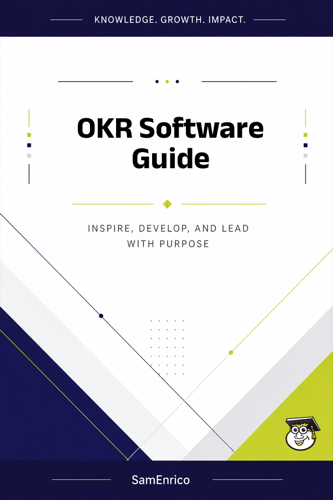
OKR Software Guide eBook
Use digital tools to track objectives and results.
Use digital tools to track objectives and results.
Formats
Free sample
Chapter 1: The Strategy Graveyard--–- In 2018, a Fortune 500 retail chain spent six months and $4 million developing a bold new strategy to compete with Amazon. The board approved it unanimously. The CEO presented it to thunderous applause. The leadership team cascaded it down through Power Point decks and town halls. Eight months later, not a single strategic objective had been achieved.
The company had not launched the new logistics platform. The customer retention target had moved from 42% to 43%—far short of the 55% goal. The planned expansion into three new markets had been reduced to a half-hearted pilot in one city that was later abandoned. When a consultant was brought in to diagnose the failure, the answer was not bad strategy. The strategy was sound.
The problem was execution. And the most damning finding was this: when surveyed, only 11% of the company’s managers could name even one of the company’s top three strategic priorities for the year. The other 89% were busy doing something else.This is not an outlier. It is the rule.For decades, management research has pointed to a single, brutal statistic that should terrify every executive, every team lead, and every employee who cares about doing meaningful work: 90% of well-formulated strategies fail not because the strategy was wrong, but because execution broke down. The strategy-to-execution gap is the single largest source of wasted time, money, and human potential in modern organizations.This book is about closing that gap.
It is about building a bridge between the inspirational words on a conference room whiteboard and the daily work that happens at individual desks. And it is about using digital tools—specifically OKR software—to make that bridge permanent, visible, and accountable.But before we talk about software, we have to talk about the disease. Because if you do not understand why execution fails, no tool in the world will save you.The 90% Problem: Why Strategy Dies Let us start with a simple question: What is a strategy? Most people would say it is a plan to achieve a competitive advantage. A direction.
A bet on the future. That is correct. But a strategy that is not executed is not a strategy at all. It is a fantasy.The 90% failure rate is not a guess. It comes from decades of research.
In 1999, Fortune magazine reported that seven out of ten CEOs failed not because of bad strategy but because of bad execution. In 2005, a study by the Economist Intelligence Unit found that 90% of executives admitted their organizations consistently failed to execute strategy successfully. In 2014, the Harvard Business Review published research showing that 61% of executives felt their companies struggled to bridge the gap between strategy formulation and day-to-day actions. And in 2022, a global study by Bright Strategy found that 67% of well-formulated strategies still fail due to execution issues—despite the explosion of project management tools, collaboration software, and OKR platforms.The problem has not gotten better. It has only gotten more expensive.Why does this happen?
The answer is surprisingly simple and devastatingly consistent across industries, company sizes, and geographies. There are four primary killers of strategy execution.Killer One: The Translation Gap The first killer is the gap between what leadership says and what teams hear. When a CEO says, "We need to become more customer-centric," that is a sentence. It is a vague aspiration. The product team hears, "Build more features users ask for." The sales team hears, "Spend more time on customer calls." The support team hears, "Reduce ticket resolution time." None of these are wrong, but none of them are the same thing.
And none of them are measurable.Without a common language for strategy, every department translates the same words into different actions. By the end of the quarter, the company is not executing one strategy. It is executing four or five different interpretations of one strategy. And none of them are aligned.Killer Two: The Activity Trap The second killer is the most seductive and dangerous: confusing activity with progress. Here is how it works.
A team is busy. They are working long hours. They are checking boxes. They are closing tickets. They are sending emails.
They are attending meetings. And at the end of the quarter, when asked what they achieved, they point to the volume of work they did. But volume is not value.The activity trap is the default state of most organizations. People do things because those things are on a list. They are not doing things because those things move the needle on a strategic priority.
And the cruel irony is that the busier a team is, the harder it is for them to realize they are not actually progressing toward the strategy. Busyness becomes a shield against the uncomfortable question: "Are we doing the right things?"Killer Three: The Visibility Void The third killer is invisibility. In most organizations, strategy exists in three places: the CEO's head, a Power Point deck from the last offsite, and a spreadsheet that was last updated six weeks ago. Nobody can see where the strategy stands right now. Nobody knows if they are ahead or behind.
Nobody knows if their piece of the puzzle is green, yellow, or red.Without visibility, accountability evaporates. When a manager cannot see that her team's key result is off track, she cannot intervene. When an executive cannot see that two departments are working at cross purposes, he cannot realign them. When an individual contributor cannot see how her daily work connects to the company's top priority, she defaults to whatever feels urgent—which is almost never what is important.Visibility is not just a nice-to-have. It is the oxygen of execution.
Without it, strategy suffocates.Killer Four: The Cadence Collapse The fourth killer is the lack of a regular, structured rhythm for reviewing and revising execution. Most organizations set annual goals in January, review them in June, and panic in November. That is not a cadence. That is a slow-motion disaster.Strategy execution requires a heartbeat. Weekly check-ins.
Monthly progress reviews. Quarterly resets. Without this rhythm, small problems become large problems. Misalignments compound. Confidence erodes.
And by the time leadership realizes something is wrong, it is too late to fix it.These four killers—the translation gap, the activity trap, the visibility void, and the cadence collapse—are the real reasons 90% of strategies fail. They are not technical problems. They are human problems. But they can be solved with systems. And the best system ever designed for solving them is called OKRs.The OKR Promise: A Bridge Across the Chasm OKR stands for Objectives and Key Results.
It is a goal-setting framework that was developed at Intel in the 1970s, popularized by Google in the 1990s, and has since been adopted by thousands of organizations including Linked In, Spotify, Airbnb, and The Gates Foundation. But despite its pedigree, most people misunderstand what OKRs actually are. They think OKRs are a template. A worksheet. A way to write goals differently.They are wrong.OKRs are not a document.
They are a discipline. They are a system for translating strategy into measurable action, and for making that translation visible to everyone in the organization. An OKR has two…
This is the end of the free sample. Get the eBook to keep going. Buy now
About this book
Details
- Author
- Tanner Tomiko
- Publisher
- SamEnrico
- Language
- English
- Genre
- Non-Fiction, Self-Help, OKR Tools
- Released
- 2026-06-06
- Pages (approx.)
- 147
- Available as
- eBook, Audiobook

Read better in the ZLOADR app
Your eBooks on your phone or tablet. Sign in with your SamEnrico account and start reading.
More by Tanner Tomiko
 Teamster Pension Fund Looting After HoffaTanner Tomiko$11.99
 Burnout Prevention For Single ParentsTanner Tomiko$11.99
 Yemen War WhistleblowerTanner Tomiko$11.99
 Steemit Rewards Comparison TrapTanner Tomiko$11.99
 Self Esteem for Shift Workers GuideTanner Tomiko$11.99
 Inflation Financial StressTanner Tomiko$11.99
 Walking Program GuideTanner Tomiko$11.99
 The Poisonous Partnership: Canada's Deadly Victorian CoupleTanner Tomiko$11.99
 The Ghosts of Cambrai: The Birth of Blitzkrieg and the Haunted Tanks of 1917Tanner Tomiko$11.99
 How to Produce Rubber Processing MachineryTanner Tomiko$11.99
 Growing Brahea (Hesper Palm)Tanner Tomiko$11.99
 A Collector's Handbook to the Rover 105sTanner Tomiko$11.99