
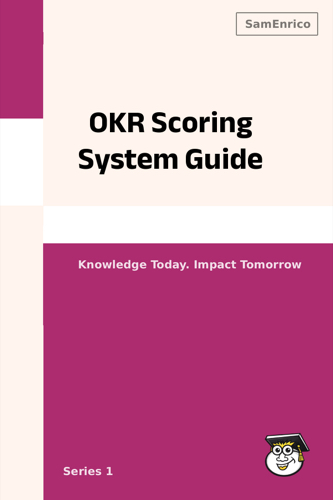
Non-FictionBusiness BriefGrading Systems
OKR Scoring System Guide
Grade progress from 0.0 to 1.0 and learn from part
by Shook Gail
Grade progress from 0.0 to 1.0 and learn from partial success.
Formats
About this book
Free sample
Chapter 1: The 0.7 Lie--–- The email arrived at 11:47 PM on a Tuesday. Sarah, the VP of Product at a fast-growing Saa S company, had just closed her laptop when her phone buzzed. It was her CEO. The subject line: “Q3 OKR scores – congratulations?”She opened it, confused by the question mark. Attached was a spreadsheet showing her team’s quarterly scores.
Seven Key Results. Seven 1.0s. A perfect quarter. Every metric hit. Every milestone delivered on time.
By any traditional measure, her team had just executed a flawless three months.The CEO’s message was brief: “This is the third perfect quarter in a row for Product. Can we talk tomorrow? I’m not sure this is good news.”Sarah stared at the screen. Not good news? They had done everything asked of them.
They had shipped features, improved response times, increased adoption. What more could leadership want?The next morning, the CEO explained. “Sarah, your team is talented. But if you keep hitting 100% of your goals, quarter after quarter, you’re not stretching. You’re not learning.
You’re running in place while telling me you’re sprinting. A perfect score doesn’t mean you’re winning. It means you’re playing it safe.”That conversation changed everything for Sarah. Over the next two quarters, she restructured her team’s OKRs to be more ambitious. The scores dropped.
One quarter, they averaged 0.6. Another quarter, 0.7. No more perfect 1.0s. And yet, the CEO celebrated. The team was finally taking real risks, learning from near-misses, and achieving breakthroughs that would never have emerged from safe, predictable targets.This chapter dismantles the most dangerous myth in goal-setting: the belief that a perfect score indicates success.
Drawing on data from Google, Intel, and hundreds of high-growth companies, we will prove that consistently achieving 1.0 is not a badge of honor—it is a warning sign. The most effective teams aim for 0.7. They celebrate partial success. And they investigate perfection as a potential failure of ambition.The Spectrum of Success: Redefining What Each Score Actually Means Before we can fix how we score, we must…
This is the end of the free sample. Get the eBook to keep going. Buy now
Contents
- Chapter 1
- Chapter 2
- Chapter 3
- Chapter 4
- Chapter 5
- Chapter 6
- Chapter 7
- Chapter 8
- Chapter 9
- Chapter 10
- Chapter 11
- Chapter 12
Details
- Author
- Shook Gail
- Publisher
- SamEnrico
- Language
- English
- Genre
- Non-Fiction, Business Brief, Grading Systems
- Released
- 2026-06-10
- Pages (approx.)
- 135
- Available as
- eBook, Audiobook

Read better in the ZLOADR app
Your eBooks on your phone or tablet. Sign in with your SamEnrico account and start reading.
More by Shook Gail
 Social Status Self Worth GuideShook Gail$11.99
 US Solar ITC Step DownShook Gail$11.99
 Facebook Group Comparison GuideShook Gail$11.99
 The Family Recovery Companion HandbookShook Gail$11.99
 Silent Echoes: The Lost Symphony of the Ice AgeShook Gail$11.99
 Professional Development AI GuideShook Gail$12.99
 Employer Anti-Union Compliance HandbookShook Gail$12.99
 Understanding Ichthyosis, Lamellar RecessiveShook Gail$17.99
 Ultimate Handbook Guide to Tolyatti : (Russia) Travel GuideShook Gail$11.99
 PinballShook Gail$11.99
You may also like
 Hong Kong Handover 1997Dunn Johnnie$11.99
 Zumba For Postnatal Recovery CourseNeal Christian$11.99
 Zumba for BeginnersLadner Nikia$11.99
 YouTube Comment Mining GuideHumes Pandora$12.99
 Worry Box MeditationCarlin Rudy$11.99
 Workplace Stress MeditationNguyen Lynn$11.99
 Workplace Stress and Sleep RepairHawley Ivory$11.99
 Workplace Perfectionism CureDelaney Jeffry$11.99
 Workplace Injustice Anger GuideWallen Isabelle$11.99
 Work Addiction and Burnout LinkGreenwood Ester$11.99
 Women in Yoga and WellnessBeattie Galina$11.99
 Women in Stand Up ComedyChun Evangeline$11.99