
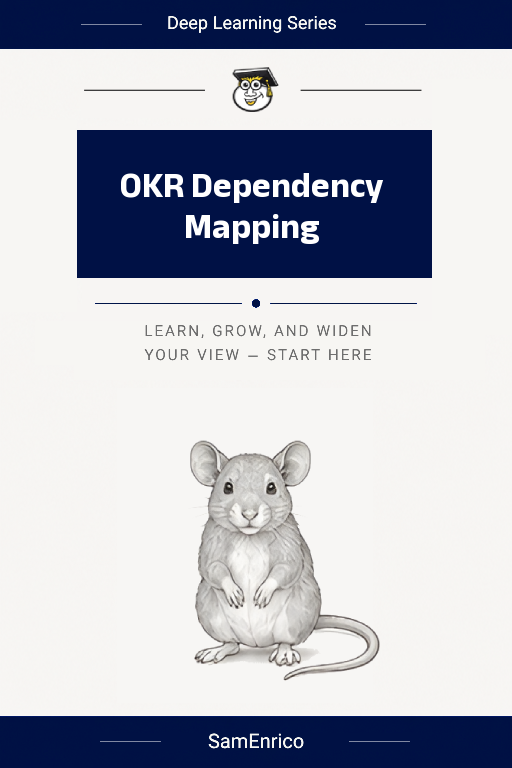
Non-FictionProfessional's Cheat SheetDependencies
OKR Dependency Mapping eBook
Map cross-team dependencies to identify blockers a
Map cross-team dependencies to identify blockers and coordinate goal achievement.
Formats
Free sample
Chapter 1: The Frozen Quarter--The meeting room smelled of stale coffee and desperation.It was the first week of Q4, and Sarah, the VP of Product at a 400-person Saa S company called Lumos, was staring at a spreadsheet that made no sense. Three months ago, her team had celebrated. They had written the most ambitious OKRs of their careers: increase net revenue retention from 92% to 110%, launch the AI-powered churn prediction engine, and expand into the European market. The board had applauded. The CEO had called it "the year's most important quarter."Now, twelve weeks later, every single Key Result was red.Not yellow.
Not "at risk." Deep, bloodshot, fire-drill red.The churn prediction engine was built but not integrated. The European launch had marketing collateral in English only. The revenue retention number had actually dropped to 89% because a critical data pipeline broke in Week 8 and no one noticed until Week 11.Sarah wasn't lazy. Her team wasn't incompetent. They had worked nights and weekends.
They had held every standup, every review, every retrospective. And still, they had failed.The problem wasn't what they had done. The problem was what they hadn't seen.The 85% Illusion Here is a truth that most leadership books are too polite to say: writing OKRs is easy. You gather your team, you argue about priorities for two hours, you emerge with a set of ambitious goals that feel like a stretch but not impossible. You post them on the wall.
You feel productive.That feeling is a lie.The hard part is not setting the destination. The hard part is realizing that you cannot get there alone. And the vast majority of organizations discover their dependencies not before the quarter begins, but after the quarter has already fallen apart.In the research conducted for this book, we analyzed OKR data from 127 companies across technology, manufacturing, healthcare, and financial services. The findings were stark: between 60% and 70% of OKRs miss their target. But here is what surprised us.
When we asked teams why they failed, only 12% blamed the objective itself (too ambitious, wrong focus). Only 8% blamed team skill or effort. The remaining 80% blamed something else entirely: dependencies they didn't know existed until it was too late.A marketing team discovered that legal needed three weeks for compliance review, not three days. An engineering team learned that the data pipeline they depended on was scheduled for migration in the middle of their sprint. A sales team realized that the pricing approval they assumed was automatic required a monthly committee that met on the wrong Tuesday.These are not failures of strategy.
These are failures of visibility.I call this the 85% Illusion. Teams believe they have 85% control over their OKRs because they control their own tasks. But the dependencies that cross team boundaries represent the remaining 15% – and that 15% determines success or failure. You can execute your 85% perfectly and still fail if the 15% you don't control breaks.Sarah at Lumos had fallen into this trap. Her team had mapped their tasks meticulously.
They had not mapped their handoffs.The Anatomy of an Undocumented Dependency To understand why dependencies are so dangerous, we need to understand how they hide.A dependency, at its simplest, is anything you need from someone else to achieve your Key Result. That sounds obvious. But here is what makes dependencies the silent killer of OKRs: they are almost never written down.Think about the last OKR you set. Did you create a column on your tracking spreadsheet for "Things Other Teams Must Do For Us"? Probably not.
Did you ask every upstream team to sign a document committing to their delivery date? Unlikely. Did you build a dashboard that shows, in real time, whether your dependencies are on track? Almost certainly no.And yet, every OKR has dependencies. The question is not whether you have them.
The question is whether you have mapped them before they block you.Consider the anatomy of a typical undocumented dependency:The Assumption: "Legal will get back to us quickly. They always do."The Reality: Legal is processing end-of-quarter contracts and has a seven-day backlog.The Discovery: Day 45 of the quarter, when the launch is already delayed.Or:The Assumption: "The data team will have the pipeline ready. It's their top priority."The Reality: The data team has six other "top priorities" from six other teams.The Discovery: Day 52, when the dashboard shows null values and no one knows why.Or:The Assumption: "We don't need to talk to Sales – we know what they need."The Reality: Sales changed their lead scoring model in Week 2 and didn't tell anyone.The Discovery: Day 60, when the campaign launches to the wrong audience.Every undocumented dependency is a time bomb. The fuse burns slowly for the first half of the quarter, then detonates in the second half when it is too late to recover.The Knowing-Doing Gap There is a famous concept in management literature called the knowing-doing gap. It describes the chasm between what organizations know they should do and what they actually do.
Companies know they should communicate across silos. They know they should align on handoffs. They know they should document assumptions.And yet, they don't.The knowing-doing gap persists because the cost of mapping dependencies is upfront and visible, while the cost of failing to map them is delayed and diffuse. When you schedule a two-hour workshop to map dependencies, that feels like overhead. When you skip that workshop and your OKR fails twelve weeks later, the failure is attributed to "bad luck" or "execution challenges" – not to the meeting you didn't have.This is a classic error of temporal discounting.
Humans consistently undervalue future costs and overvalue present effort. A two-hour meeting today feels expensive. A failed quarter three months from now feels abstract.The most successful organizations reverse this calculation. They recognize that the two-hour meeting is cheap. The failed quarter is catastrophic.Sarah at Lumos had fallen into the knowing-doing gap.
She knew she should talk to the data team before the quarter started. But she was busy. Her plate was full. She sent an email instead of scheduling a workshop. The data team replied with a thumbs-up emoji.
That emoji became the entire dependency management system for a $4 million revenue OKR.Twelve weeks later, the thumbs-up emoji looked like a tombstone.The Saa S Case Study: How Lumos Lost Q3Let me take you inside the Lumos Q3 failure in detail because it illustrates exactly how undocumented dependencies destroy OKRs. The names have been changed, but the numbers are real.The Objective: Drive expansion revenue in the European market.Key Result 1: Launch fully localized product (French, German, Spanish) by September 30.Key Result 2: Achieve 25 enterprise pilot customers in the EU.Key Result 3: Generate $1.2M in annual recurring revenue from new EU contracts.These were good OKRs. Ambitious but plausible. The product was already mature in North America. The sales team had European experience.
The marketing team had run regional campaigns before.Here is what Sarah's team did correctly:They wrote the OKRs with clear, measurable outcomes.They communicated the OKRs to the entire company.They held weekly check-ins on progress.They tracked their own tasks in Jira with obsessive precision.Here is what they did…
This is the end of the free sample. Get the eBook to keep going. Buy now
About this book
Details
- Author
- Krebs Vernice
- Publisher
- SamEnrico
- Language
- English
- Genre
- Non-Fiction, Professional's Cheat Sheet, Dependencies
- Released
- 2026-05-29
- Pages (approx.)
- 154
- Available as
- eBook, Audiobook

Read better in the ZLOADR app
Your eBooks on your phone or tablet. Sign in with your SamEnrico account and start reading.
More by Krebs Vernice
 The Foster Care Library CardKrebs Vernice$11.99
 Growth Hormone and Muscle PreservationKrebs Vernice$11.99
 Gig Platform Insurance GuideKrebs Vernice$11.99
 Mindfulness for WorryKrebs Vernice$11.99
 Essential Travel Authorization KitKrebs Vernice$11.99
 Opioid Constipation ManagementKrebs Vernice$11.99
 Meal Prep Weekly ReviewKrebs Vernice$11.99
 Heart Rate TrainingKrebs Vernice$11.99
 The Barefoot Warriors: How a Village Team Conquered the 1936 Far Eastern GamesKrebs Vernice$11.99
 Battling for Gold: The Secret Science of Olympic GloryKrebs Vernice$11.99
 How to Produce Massage Stone WarmersKrebs Vernice$11.99
 Service Providers Guide to Word ProcessingKrebs Vernice$11.99
You may also like
 Hong Kong Handover 1997Dunn Johnnie$11.99
 Zumba For Postnatal Recovery CourseNeal Christian$11.99
 Zumba for BeginnersLadner Nikia$11.99
 YouTube Comment Mining GuideHumes Pandora$12.99
 Worry Box MeditationCarlin Rudy$11.99
 Workplace Stress MeditationNguyen Lynn$11.99
 Workplace Stress and Sleep RepairHawley Ivory$11.99
 Workplace Perfectionism CureDelaney Jeffry$11.99
 Workplace Injustice Anger GuideWallen Isabelle$11.99
 Work Addiction and Burnout LinkGreenwood Ester$11.99
 Women in Yoga and WellnessBeattie Galina$11.99
 Women in Stand Up ComedyChun Evangeline$11.99