
Non-FictionSelf-HelpCorrections
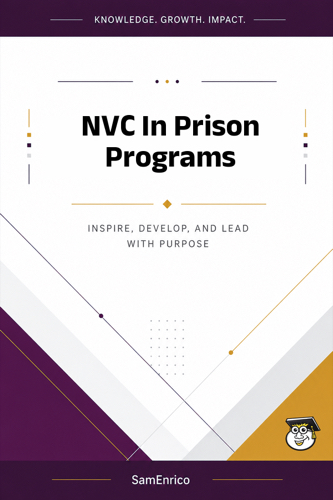
NVC In Prison Programs eBook
Reduce violence and build empathy among incarcerat
Reduce violence and build empathy among incarcerated individuals.
Formats
Free sample
Chapter 1: The Language That Kills--You are about to learn something that might save your life. It is not a weapon. It is not a fighting technique. It is not a way to spot a snitch before they spot you. It is something far more dangerous to the order of the prison yard: a new way to speak.Every prison has a secret language.
Not the slang you use to pass messages or the codes that keep you safe during a shakedown. The secret language I am talking about is much older and much more destructive. It is the language of moralistic judgment. It is the language that calls a man a "monster," a "predator," a "snitch," a "waste of air." It is the language that separates the world into two categories: the deserving and the undeserving, the strong and the weak, the ones who get hurt and the ones who do the hurting.This language has a name in the work you are about to study. It is called Jackal Language.
And it is killing you.Not literally, not in the moment you speak it. But Jackal Language is the fuel that powers every violent act inside these walls. It is the justification every inmate uses before they swing. It is the voice in your head that says, "He disrespected me. He deserves what is coming." And until you learn to recognize that voice, name it, and replace it with something else, you will remain trapped in a binary that guarantees violence.That binary has a name.
In this book, we call it the Garrison Binary. A garrison is a military fortification—a place where the only laws are domination or submission. Either you are the hammer, or you are the anvil. Either you dominate, or you are dominated. Either you submit, or you rebel.
Inside a prison yard, which is, after all, a garrison, this binary feels like the only law that matters. It feels like gravity. It feels like breathing.But here is the truth that can set you free: the Garrison Binary is not a law of nature. It is a story. It is a story that begins with the words you choose.
And if you can change the words, you can change the story. If you can change the story, you can change the outcome of a confrontation before anyone throws a punch. If you can change the outcome, you can survive these walls without becoming the very thing you hate.This chapter is the foundation of everything that follows. It will introduce you to the enemy of connection: Jackal Language. It will teach you the difference between Static Language (which labels people as fixed, evil, or irredeemable) and Process Language (which describes the fluid reality of feelings and needs).
It will show you, through the painful logic of prison hierarchies, how labels like "sex offender," "cop killer," and "snitch" create a ladder of "deserving" victims—allowing inmates to justify violence against those on the lower rungs. And it will close with the beginning of a story that will follow us through all twelve chapters: the story of Dow Gordon, a career criminal who entered an NVC class intending to mock it, and who emerged six weeks later as a skeptic on the verge of something terrifying and wonderful: hope.But let us be clear about one thing from the very start. This chapter is not going to tell you that labels are "evil." That would be a moralistic judgment, which is exactly the kind of language we are trying to unlearn. Labels are not evil. They are something more dangerous: they are ineffective.
They predict violence. They block understanding. They turn human beings into objects. And when you turn a human being into an object, you give yourself permission to do things to them that you would never do to a person.So let us begin. Let us learn the language that kills.
And then let us learn how to stop speaking it.The Jackal in Your Mouth In Nonviolent Communication, the jackal is the symbol for the voice of judgment, criticism, and blame. Why a jackal? Because jackals are scavengers. They feed on what is already dead. And Jackal Language feeds on dead connections—relationships that have already been poisoned by words that separate, diagnose, and condemn.Think about the last time you saw a fight break out on the yard.
What was said in the thirty seconds before the first punch? If you replay it in your mind, you will almost certainly hear some version of the following:"You think you're tough?""You're nothing.""You're a dead man.""Snitch.""Predator.""Waste of breath."None of these are observations. They are evaluations. They are diagnoses. They are labels that reduce a complex human being—with a history, with wounds, with needs—into a single, flat, evil thing.
And here is the mechanical truth of violence: it is much easier to hurt a label than it is to hurt a person.When you call someone a "snitch," you are not describing anything they actually did. You are interpreting their action through a lens of betrayal. The action might have been: "He spoke to a CO for three minutes." That is an observation. But "snitch" is a diagnosis. And once you have diagnosed someone as a snitch, you have placed them outside the circle of human protection.
You have labeled them as deserving of whatever happens next.This is not abstract philosophy. This is the daily reality of prison life. The hierarchy of labels creates a ladder of violence. At the top of the ladder are inmates convicted of "street crimes"—robbery, assault, drug charges. They are labeled as "real convicts." Lower down are inmates convicted of crimes against children or sexual assault.
They are labeled as "the lowest." And at the very bottom are inmates who have cooperated with authorities. They are labeled as "snitches."Here is the question this book asks you to sit with: Who made that ladder? Who decided that violence against a "snitch" is justified but violence against a "real convict" is not? The answer is that the ladder is made of words. And words can be unmade.Static Language vs.
Process Language One of the most important distinctions you will learn in this entire book is the difference between Static Language and Process Language.Static Language treats people as fixed, finished, unchangeable objects. It says: "You are a criminal." "You are a monster." "You are weak." These statements have no room for growth, for context, for the possibility that a person might change. Static Language is the language of the Garrison Binary because it locks people into roles. Once you are a "criminal," you will always be a criminal. Once you are "weak," you will always be weak.
The only way to change your label is to fight—to prove you are not weak by dominating someone else.Process Language, by contrast, describes actions, feelings, and needs in motion. It says: "You stole a car." That is an action. "You were convicted of robbery." That is a fact. "I feel angry when you stand in my cell line." That is a feeling…
This is the end of the free sample. Get the eBook to keep going. Buy now
About this book
Details
- Author
- Dyson Kristeen
- Publisher
- SamEnrico
- Language
- English
- Genre
- Non-Fiction, Self-Help, Corrections
- Released
- 2026-06-09
- Pages (approx.)
- 141
- Available as
- eBook, Audiobook

Read better in the ZLOADR app
Your eBooks on your phone or tablet. Sign in with your SamEnrico account and start reading.
More by Dyson Kristeen
 Teen Self Worth After FailureDyson Kristeen$11.99
 Canva Brand Identity for RoofersDyson Kristeen$11.99
 Finding the Right SponsorDyson Kristeen$11.99
 How to Start a Cleansing Tissues Business (Beginners Guide)Dyson Kristeen$11.99
 Learn to Play the YotarDyson Kristeen$11.99
 AI for Policy Gap AnalysisDyson Kristeen$12.99
 Guestroom Attendant Self InspectorDyson Kristeen$11.99
You may also like
 Hong Kong Handover 1997Dunn Johnnie$11.99
 Zumba For Postnatal Recovery CourseNeal Christian$11.99
 Zumba for BeginnersLadner Nikia$11.99
 YouTube Comment Mining GuideHumes Pandora$12.99
 Worry Box MeditationCarlin Rudy$11.99
 Workplace Stress MeditationNguyen Lynn$11.99
 Workplace Stress and Sleep RepairHawley Ivory$11.99
 Workplace Perfectionism CureDelaney Jeffry$11.99
 Workplace Injustice Anger GuideWallen Isabelle$11.99
 Work Addiction and Burnout LinkGreenwood Ester$11.99
 Women in Yoga and WellnessBeattie Galina$11.99
 Women in Stand Up ComedyChun Evangeline$11.99