
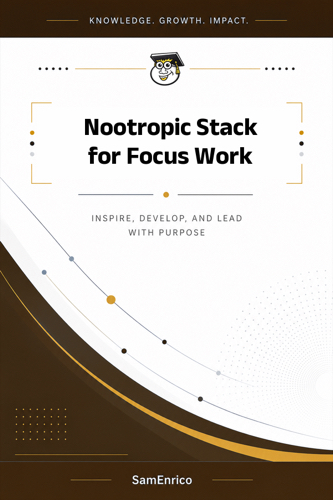
Nootropic Stack for Focus Work eBook
Research cognitive enhancers that support sustaine
by Lacey Zita
Research cognitive enhancers that support sustained attention without side effects.
Formats
Free sample
Chapter 1: The Caffeine Paradox--–- Sarah had done everything right. She woke at 6:00 AM, skipped breakfast for intermittent fasting, and brewed her first mug of specialty-grade dark roast by 6:15. By 7:30 AM, she had answered forty-seven emails, revised a client proposal, and felt like a productivity deity. Then 2:00 PM arrived. The fog descended like a physical weight.
Her third coffee sat half-finished, cold and bitter. Her heart raced, but her brain refused to cooperate. By 3:30 PM, she was scrolling Instagram with no memory of opening the app. At 5:00 PM, she snapped at her partner over a minor question. At 11:00 PM, she lay awake, exhausted but wired, dreading the next day's repeat performance.Sarah is not a cautionary tale.
She is the norm.Ninety percent of the global adult population consumes caffeine daily. In the United States, the average coffee drinker consumes three cups per day, often more. Add in energy drinks, pre-workout powders, caffeinated teas, and the proliferating category of "functional" sodas, and the picture becomes clear: we are a civilization running on stimulants. Yet the same population reports epidemic levels of afternoon crashes, sleep disturbances, generalized anxiety, and a pervasive sense of cognitive fog. The National Sleep Foundation found that sixty-five percent of adults report poor sleep quality at least several nights per week.
The American Psychological Association notes that anxiety levels have risen steadily across all demographics. And the average worker loses nearly three hours of productive time each day to self-reported "brain fog."These two facts—widespread caffeine use and widespread cognitive dysfunction—are not coincidental. They are causally linked. But the link is not as simple as "caffeine is bad." Caffeine, when understood and deployed with surgical precision, remains one of the most effective cognitive enhancers known to pharmacology. The problem is not the molecule.
The problem is how we use it.This chapter reframes the conversation. It does not demonize caffeine, nor does it declare it a villain. Instead, it positions caffeine as what it truly is: a powerful tool that ninety percent of people wield incorrectly. The goal of this chapter—and this book—is to teach you how to use caffeine surgically, or to replace it entirely with next-generation alternatives that provide sustained attention without the crash, the jitters, or the insomnia.The Four M's Framework: Nootropics as Support, Not Driver Before we dissect caffeine’s pharmacology, we must establish the philosophical backbone of everything that follows. Call it the Four M's Framework: Mindset, Motivation, Methods, Momentum.Here is the single most important sentence in this book: Nootropics support the ship; they do not sail it.A stack of supplements—no matter how expertly formulated—cannot fix a fundamentally broken approach to focus.
If your Mindset is riddled with self-doubt or perfectionism, no pill will make you productive. If your Motivation is rooted in fear or external validation, no stimulant will provide sustainable drive. If your Methods (workflows, task management, environment design) are chaotic, no amount of cognitive enhancement will create order. And if your Momentum is destroyed by chronic sleep deprivation, dehydration, or poor nutrition, you are asking supplements to bail water from a sinking ship with a teaspoon.Let us be precise about what nootropics cannot do. They cannot:Replace eight hours of sleep with four hours and a pill.Override toxic motivation patterns like grinding through burnout.Compensate for a work environment designed for distraction (open offices, notifications on, phone at hand).Fix a nutrient-deficient diet.Eliminate the need for basic behavioral hygiene like hydration, movement, and task switching.What nootropics can do is optimize an already functional system.
They can raise the ceiling of your cognitive performance. They can smooth the rough edges of normal biological variability (that 2 PM dip is real and universal). They can provide a tactical advantage during periods of high demand—exam weeks, product launches, creative sprints. But they are amplifiers, not origins.This framework will recur throughout the book. Every time you are tempted to reach for a stack to solve a problem, first ask: Is this a biological problem (neurochemistry, fatigue, attention span) or a behavioral problem (workflow, environment, motivation)?
The self-audit quiz at the end of this chapter will help you distinguish between the two.Caffeine: The Most Successful Nootropic No One Understands Caffeine is, by any measure, a remarkable molecule. It belongs to a class of compounds called methylxanthines, and its primary mechanism of action is brilliantly simple: it blocks adenosine receptors. Adenosine is a neurotransmitter that accumulates in the brain throughout the day, binding to receptors and producing a sensation of drowsiness. By occupying those receptors without activating them, caffeine prevents you from feeling the fatigue that your body is genuinely experiencing.This is simultaneously the source of caffeine's power and its danger. You are not actually less tired after drinking coffee.
You are simply prevented from feeling tired. The adenosine is still there, accumulating, waiting for the caffeine to clear from your system. When that happens—usually three to six hours after consumption—the accumulated adenosine binds all at once, producing the infamous "caffeine crash."This crash is not a sign of weakness. It is basic receptor pharmacology.Most people respond to the crash with more caffeine. This initiates a cycle of diminishing returns.
Your brain, sensing the constant blockade of adenosine receptors, responds by upregulating—growing more receptors—to maintain sensitivity. Over time, you require more caffeine to achieve the same level of alertness. This is tolerance. And when you finally stop, all those extra adenosine receptors produce a withdrawal syndrome characterized by headache, fatigue, irritability, and cognitive fog that can last five to ten days.None of this makes caffeine a bad tool. It makes it a tool that requires understanding.Consider the difference between a carpenter who uses a hammer to drive nails and one who uses a hammer to unscrew bolts.
The second carpenter blames the hammer. The first carpenter blames his own ignorance. Caffeine is a precision instrument for blocking adenosine receptors. When used at the right dose, at the right time, with the right modulators, it is extraordinarily effective. When used without precision—randomly, throughout the day, in unmeasured doses—it produces the exact pattern of dysfunction that drove Sarah to Instagram at 3:30 PM.The Problem Is Not Caffeine.
The Problem Is How We Use It.Let us name the specific errors that transform caffeine from a nootropic into a neurotoxin.Error One: Unmeasured Dosing. Coffee brewing methods vary wildly in caffeine content. A single shot of espresso contains approximately 64mg. A 12-ounce drip coffee from Starbucks contains approximately 235mg. A 16-ounce cold brew can exceed 300mg.
Most people have no idea how many milligrams they are consuming. They pour, sip, and guess. This is not precision; it is gambling.Error Two: No Modulators. Caffeine alone is an unopposed stimulant. It increases dopamine and norepinephrine but does nothing to support GABA (the brain's primary inhibitory neurotransmitter) or acetylcholine (critical for cognitive flexibility).
The result, as we saw in Sarah's case, is jittery, tunnel-vision focus followed by a hard crash. The solution, as we will explore in Chapter 6, is to pair caffeine with L-Theanine, an amino acid that modulates the stimulant effect, producing calm…
This is the end of the free sample. Get the eBook to keep going. Buy now
About this book
Details
- Author
- Lacey Zita
- Publisher
- SamEnrico
- Language
- English
- Genre
- Non-Fiction, Business Brief, Cognitive Enhancement
- Released
- 2026-06-06
- Pages (approx.)
- 151
- Available as
- eBook, Audiobook

Read better in the ZLOADR app
Your eBooks on your phone or tablet. Sign in with your SamEnrico account and start reading.
More by Lacey Zita
 Remote Retreats Partner InclusionLacey Zita$11.99
 French Resistance Train DerailmentLacey Zita$11.99
 Difficult Talks with StepchildrenLacey Zita$11.99
 Predictive Positioning GuideLacey Zita$11.99
 Deep Dive: The Race to the Mariana Trench’s AbyssLacey Zita$11.99
 The Last Laugh: The Day the Smiler CrashedLacey Zita$11.99
 Nonprofit Department BudgetingLacey Zita$12.99
 JEE Biotechnology Branch GuideLacey Zita$12.99
 How to Start a Pouch for Tobacco Business (Beginners Guide)Lacey Zita$11.99
 Understanding Chromosome 1, Duplication 1p21 P32Lacey Zita$17.99
 Recruiting Manager Rh Finance and AccountingLacey Zita$11.99