
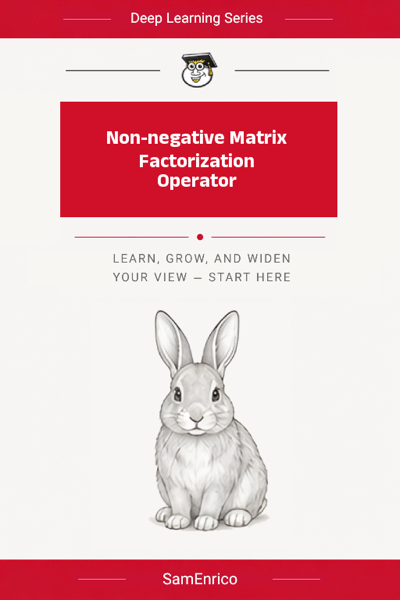
Non-negative Matrix Factorization Operator Audiobook
A Coursebook on Non-negative Matrix Factorization
by Hutton Shyla
A Coursebook on Non-negative Matrix Factorization Operator
Formats
Free sample
Chapter 1: The Addition Paradox--–- The face on the screen was made of eyes, noses, and mouths—but not in the way you might expect. Each eye was not a complete eye from a single photograph. Instead, it was a statistical ghost, an average of hundreds of eyes from hundreds of different people, blended together into a single grayish image that looked like an eye if you squinted, but dissolved into noise if you looked too closely. The nose was the same: an average nose, neither too long nor too short, neither too wide nor too narrow, the Platonic ideal of a nose that existed only in mathematics. And the mouth—well, the mouth looked like someone had taken a hundred smiling lips and pressed them together into a single blurry line.This was the result of running Principal Component Analysis on a dataset of face images.
The algorithm had done exactly what it was supposed to do: find the most efficient way to represent the data using the fewest possible numbers. And it had succeeded brilliantly. With only forty-nine numbers per face, the algorithm could reconstruct any face in the dataset with 99 percent accuracy. It could recognize faces across different lighting conditions, different expressions, even different angles. By any quantitative measure, the algorithm was a triumph.And yet, standing in front of that screen in the winter of 1998, a young researcher named Ada felt a profound sense of disappointment.
The algorithm could recognize faces, but it could not see them. It had no understanding of what a face was. Its internal representation—the forty-nine numbers that encoded each face—was a black box. Change one number, and the face changed in ways that were impossible to predict. Increase the first number, and the face became brighter on the left side and darker on the right.
Increase the second number, and the cheeks puffed out while the forehead narrowed. These transformations were mathematically optimal but semantically meaningless.Ada's advisor, a distinguished professor who had built his career on PCA, dismissed her concerns. "The features don't need to be interpretable," he said, not looking up from his own screen. "They just need to work. Do you want your algorithm to be beautiful, or do you want it to be right?"Ada wanted both.She spent the next several months trying different approaches.
She tried Independent Component Analysis, which gave her slightly more interpretable features but struggled with noise. She tried sparse coding…
This is the end of the free sample. Get the Audiobook to keep going. Buy now
About this book
Details
- Author
- Hutton Shyla
- Publisher
- SamEnrico
- Language
- English
- Genre
- Non-Fiction, Informative, Educational
- Released
- 2026-05-09
- Pages (approx.)
- 137
- Available as
- eBook, Audiobook

Listen in the VoxFlicks app
Audiobooks and audio dramas wherever you go. Sign in with your SamEnrico account and press play.
More by Hutton Shyla
 Shift Work Sleep Tracking AppsHutton Shyla$11.99
 The Relationship LedgerHutton Shyla$11.99
 Self Esteem for Infertility WorkbookHutton Shyla$11.99
 Germanium Health Claims ExaminedHutton Shyla$11.99
 Self Esteem Same Sex RelationshipHutton Shyla$11.99
 Divine Decree: The Breaking of Gods and MarriagesHutton Shyla$11.99
 The Phantom North: How Soviet Scientists Faked an Arctic DiscoveryHutton Shyla$11.99
 Understanding Exogenous Lipoid PneumoniaHutton Shyla$17.99
 Procurement Automation HandbookHutton Shyla$12.99
 Executive Summary Checklist Before You SendHutton Shyla$12.99
 How to Become a Molder HelperHutton Shyla$11.99