
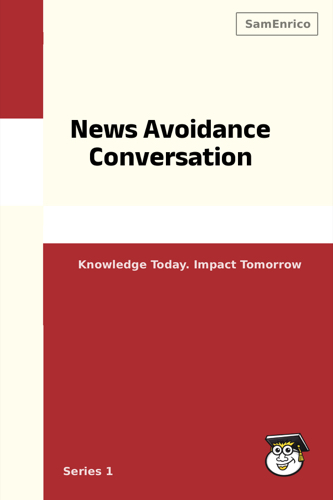
Non-FictionSelf-HelpTopic Steering
News Avoidance Conversation eBook
Redirect stressful topics to lighter ground withou
Redirect stressful topics to lighter ground without seeming dismissive.
Formats
Free sample
Chapter 1: The Heavy Air...--I want you to recall the last time you felt it.You were at a dinner party, perhaps, or standing around a backyard grill. The light was golden. Someone had just told a funny story about a dog stealing a sandwich. Laughter was still warm in the air. Then—someone else cleared their throat.
Not dramatically. Just a small, preparatory sound. And then the words came: "So, did you see what happened in the capital today?"Or maybe it was a coffee break at work. You were enjoying the last sips of something warm and sweet, stealing five minutes of peace between meetings. A coworker slid into the chair across from you, phone already in hand, and said, "I can't believe they're letting this happen.
Have you read the latest projections?"Or perhaps it was family dinner. The food was good. The wine was better. For a blessed forty-five minutes, no one had mentioned politics, the economy, or the slow-burning crisis on the news. Then your uncle—it is always an uncle, isn't it?—leaned back in his chair and said, "Well, I don't know about you all, but I'm terrified about where this is headed."And just like that, the air changed.You felt it in your chest first.
A subtle tightening. Then your shoulders, which you hadn't realized were relaxed, began to creep up toward your ears. Your jaw maybe clenched. You took a slightly deeper breath than usual, then let it out slowly, hoping no one noticed. The room didn't get hotter, but it felt heavier.
The laughter that had been floating around the table like soap bubbles now seemed to have popped and vanished entirely. In its place was something denser. Something with weight.This book is about that moment.It is about the physiological shift that happens when stressful news enters casual conversation, why that shift matters more than you think, and—most importantly—why your instinct to avoid it is not cowardice but wisdom. By the time you finish this chapter, you will understand why the "heavy air" is not just a metaphor, why forcing yourself to engage with every hard topic is actually damaging your relationships, and how to tell the difference between a conversation that demands your attention and one you are morally permitted—even encouraged—to sidestep.But first, let us name the thing you have been feeling but perhaps could not articulate.The Weight Shift There is a reason we say the air feels heavy when a conversation turns toward distressing news. It is not merely poetic license.
It is a description of a real physiological process, one that has been studied extensively by researchers in affective neuroscience, psychoneuroimmunology, and social psychology.Here is what happens inside your body when someone introduces a stressful topic into a previously relaxed social setting.Your brain, specifically your amygdala—that small, almond-shaped cluster of nuclei deep in the temporal lobe—acts as a kind of smoke detector. It is constantly scanning your environment for threats. When you hear language associated with danger, loss, injustice, or uncertainty, your amygdala does not stop to ask whether the threat is immediately present or merely being described. It simply sounds the alarm. That alarm takes the form of a cascade of neurochemicals: cortisol, adrenaline, and norepinephrine.
These are the same chemicals your body releases if you were actually being chased by a predator.Your heart rate increases. Your breathing becomes shallower. Blood flow shifts away from your digestive system and toward your large muscle groups—preparing you, ancestrally, to fight or flee. Your peripheral vision narrows. Your hearing becomes more acute.
And critically, your prefrontal cortex—the part of your brain responsible for complex reasoning, empathy, and nuanced social interaction—begins to down-regulate. It is not that you become dumber. It is that your brain has decided, in its ancient wisdom, that survival matters more than conversation.Now, here is the crucial insight: your body does not distinguish between experiencing a threat and hearing about a threat. To your amygdala, a detailed description of a political crisis, an economic crash, or a distant tragedy is not meaningfully different from the crisis itself. The cortisol spike is real.
The physical discomfort is real. The narrowing of attention is real.This is not a design flaw. It is a design feature—one that kept your ancestors alive on the savanna. If someone in your tribe described a lion near the watering hole, your body needed to react as if the lion were already in front of you. Hesitation could mean death.
So evolution baked into you a profound sensitivity to threat-related information, regardless of whether that information was immediate or merely reported.The problem, of course, is that you no longer live on the savanna. You live in a world where threat-related information is not rare and urgent but constant and often irrelevant to your immediate safety. And yet your body still reacts to every reported tragedy, every political outrage, every economic prediction, as if the lion were already charging.So when your uncle brings up the latest disaster at the dinner table, he is not merely sharing information. He is unwittingly triggering a stress response in everyone within earshot. The air feels heavy because your body is literally preparing for an emergency that does not exist.Why "Toughing It Out" Backfires Given this physiological reality, you might assume that the rational response is to limit your exposure to stressful topics in social settings.
But most people do the opposite. They double down. They tell themselves that it would be rude to change the subject, irresponsible to avoid the news, or cowardly to walk away from a hard conversation.This is a mistake, and it is one that the research literature on emotional contagion has documented extensively.Emotional contagion is the phenomenon by which one person's emotions—and their associated physiological states—spread to others in close proximity. It happens automatically, often below the level of conscious awareness. When you are in a room with someone who is anxious, your own anxiety levels rise within minutes, even if you have no idea why they are anxious.
When you are with someone who is calm, your heart rate tends to slow and your breathing deepens. This is why meditation groups work. It is also why panicked crowds are so dangerous.Now consider what this means for your social life. You gather with friends or family to relax, to bond, to feel safe and connected. But if someone introduces a high-stress news topic, the emotional contagion that follows works directly against those goals.
Within minutes, everyone at the table experiences a measurable increase in cortisol. Their heart rates rise. Their breathing becomes shallower. Their ability to experience humor, warmth, and playfulness—all of which require a calm, open neurological state—plummets.You are not relaxing. You are suffering together.And crucially, this suffering does not come with the benefits of collective action.
If you were at a protest or a community meeting, the shared stress would at least serve a purpose. It would be channeled into coordinated effort. But at a dinner table or a coffee break…
This is the end of the free sample. Get the eBook to keep going. Buy now
About this book
Details
- Author
- Hartman Emilia
- Publisher
- SamEnrico
- Language
- English
- Genre
- Non-Fiction, Self-Help, Topic Steering
- Released
- 2026-06-08
- Pages (approx.)
- 142
- Available as
- eBook, Audiobook

Read better in the ZLOADR app
Your eBooks on your phone or tablet. Sign in with your SamEnrico account and start reading.
More by Hartman Emilia
 Non Stick Dental Floss GuideHartman Emilia$11.99
 Difficult Coworker Anger ControlHartman Emilia$11.99
 Casino Addiction Survival GuideHartman Emilia$11.99
 AAA Game Buyer ProfileHartman Emilia$11.99
 The Serpent and the Sun: A Mythic ConspiracyHartman Emilia$11.99
 Community Marketing One Page PlanHartman Emilia$12.99
 Virtual Landing for Express EntryHartman Emilia$12.99
 How to Start a Hobby in Wargame terrain makingHartman Emilia$11.99
 Finance AccountantHartman Emilia$11.99
 Understanding Pulmonary Fibrosis /granulomaHartman Emilia$17.99
You may also like
 Hong Kong Handover 1997Dunn Johnnie$11.99
 Zumba For Postnatal Recovery CourseNeal Christian$11.99
 Zumba for BeginnersLadner Nikia$11.99
 YouTube Comment Mining GuideHumes Pandora$12.99
 Worry Box MeditationCarlin Rudy$11.99
 Workplace Stress MeditationNguyen Lynn$11.99
 Workplace Stress and Sleep RepairHawley Ivory$11.99
 Workplace Perfectionism CureDelaney Jeffry$11.99
 Workplace Injustice Anger GuideWallen Isabelle$11.99
 Work Addiction and Burnout LinkGreenwood Ester$11.99
 Women in Yoga and WellnessBeattie Galina$11.99
 Women in Stand Up ComedyChun Evangeline$11.99