
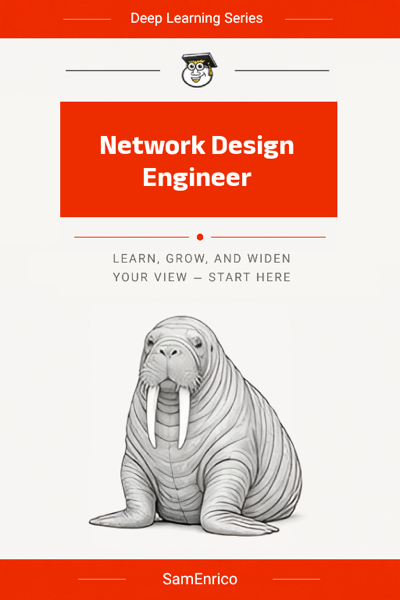
Non-FictionInformativeEducational
Network Design Engineer eBook
A Coursebook on Network Design Engineer
by Yost Melodee
A Coursebook on Network Design Engineer
Formats
Free sample
Chapter 1: The Wiring Closet Lie--–- The email arrived at 4:47 PM on a Friday. Subject line: "Urgent – Network keeps dropping." No other context. No topology diagram. No "please" or "thank you." Just the implicit assumption that you, the network designer, would somehow divine the problem from fourteen time zones away and produce a solution by Monday morning.This is how most network careers begin: not with an elegant architectural vision, but with a crisis. And the universal temptation—one that separates competent engineers from truly great designers—is to immediately ask, "What hardware should I buy?" or "Which protocol should I reconfigure?" You have been trained, by years of troubleshooting guides and certification exams, to reach for technical solutions to what are almost never purely technical problems.The Wiring Closet Lie is the belief that networks are built from cables, switches, and routers.
They are not. Networks are built from conversations. The hardware is merely the scaffolding that holds those conversations in place. And if you do not first understand which conversations matter, to whom, and under what constraints, then your "solution" will be nothing more than an expensive rearrangement of the furniture.This chapter will teach you the single most important skill a network design engineer can possess: the ability to start before the technology. You will learn why most designs fail, what the PPDIOO lifecycle actually means for your daily work, how to interview stakeholders like a forensic detective, and how to translate the messy language of business into the precise grammar of technical requirements.
By the end, you will never again open a bill of materials before opening a conversation.The Anatomy of a Design Failure Consider two hypothetical network projects. Both started with the same vague request: "Our remote office is slow."Engineer A (let us call him the Gadget Seeker) immediately ran speed tests, confirmed high latency, and ordered an upgraded circuit from 50 Mbps to 200 Mbps. He installed the new link, showed the CFO a pretty graph of increased bandwidth, and closed the ticket. Two weeks later, the users were still complaining. The problem, it turned out, was not bandwidth at all—it was a misconfigured Qo S policy that was dropping voice packets during the daily 10 AM backup window.
The upgrade cost $18,000 per year. The real fix cost nothing but required understanding the traffic pattern.Engineer B (the Designer) spent her first day asking questions. "What does 'slow' mean? When does it happen? Which applications are affected?
What changed three weeks ago when this started?" She discovered that the slowness was isolated to Vo IP calls between 10:00 and 10:15 AM. The backup job started at 10:00. The existing circuit had plenty of bandwidth—60 Mbps average utilization during the backup window—but the router's default queuing was treating voice and backups identically. She reconfigured the Qo S policy to prioritize voice. The problem vanished.
Cost: zero. Customer satisfaction: total.The Gadget Seeker is not incompetent. He is trained incorrectly. Certification exams reward the ability to identify the correct command syntax for a given scenario. They rarely reward the ability to discover that you are solving the wrong scenario entirely.
The wiring closet lie persists because it is comfortable: technology is knowable, measurable, and controllable. People are not.This is why the top-down methodology exists. It forces you to resist the gravity of the command line and ascend instead to the level of business strategy.The PPDIOO Lifecycle: Your Architectural Compass Before you design anything, you need a map of the journey. The PPDIOO lifecycle—Prepare, Plan, Design, Implement, Operate, Optimize—is that map. Cisco developed it, but it has become a vendor-neutral industry standard because it works.
Memorize it not as an acronym but as a sequence of questions you must answer before touching a single piece of hardware.Prepare – Why are we doing this? What business outcome is required? This is the executive conversation. Deliverable: a high-level business case and initial project charter.Plan – What do we have now? What do we need?
What are the constraints? This is the discovery phase. Deliverable: requirements document, legacy assessment, gap analysis.Design – How will we build it? This is the technical architecture phase. Deliverable: High-Level Design (HLD) and Low-Level Design (LLD) documents.Implement – We build it.
This is the deployment phase. Deliverable: installed and configured network, test results.Operate – We run it. This is the day-to-day management phase. Deliverable: monitoring baseline, operational procedures.Optimize – We improve it. This is the continuous refinement phase.
Deliverable: performance improvements, cost reductions, technology refresh plans.Most engineers treat PPDIOO as a linear waterfall. That is wrong. In real design work, you will loop back constantly. You will discover during Planning that the Prepare assumptions were flawed. You will realize during Design that Implementation will require a new tool you had not budgeted for.
You will find during Operation that your Optimization targets were set incorrectly. The lifecycle is not a prescription. It is a checklist to ensure you have not forgotten a critical phase.Here is the most common failure pattern in network design: engineers skip Planning entirely. They receive a Prepare-level directive ("We need a new data center") and jump directly to Design ("Let's use spine-leaf with EVPN-VXLAN"). They have not measured the existing network, interviewed the stakeholders who will actually use it, or understood the budget and staffing constraints.
Their design may be technically flawless. It will still fail because it solves a problem no one has.This entire book follows the PPDIOO structure. Part I (Chapters 1–3) covers Prepare and Plan. Part II (Chapters 4–6) and Part III (Chapters 8–11) cover Design. Part IV (Chapter 12) covers Implement, Operate, and Optimize.
By the time you finish this book, you will have executed every phase of the lifecycle—not in theory, but through the exercises and case studies embedded in each chapter.The Stakeholder Matrix: Who Actually Cares?A network has many users but only a few stakeholders. Stakeholders are the people who can say "no" to your design, approve its budget, or reject its operation. You must identify them before you write a single requirement. If you miss a stakeholder, they will surface late in the project—usually during Implementation—and demand changes that unravel months of work.The stakeholder matrix organizes your discovery. It has four quadrants, each representing a role and their primary concern.Quadrant 1: The Finance Stakeholder (CFO, Budget Owner, Procurement)Their language: dollars, ROI, TCO, capex vs.
opex. They do not care about throughput or convergence times. They care about whether this project will increase revenue, reduce cost, or mitigate financial risk. When you speak to them, translate every technical parameter into financial terms. "We need redundant power supplies" becomes "We need redundant power supplies to avoid a $500,000 per hour outage during trading hours." The CFO will understand the second sentence.Quadrant 2: The Strategy Stakeholder (CIO, CTO, IT Director)Their language: capabilities, competitive advantage, time-to-market, scalability.
They want to know whether this network will enable the company's five-year plan. They care about agility—can you provision a new site in days instead of months? Can you support the upcoming merger? Your conversation with them is about architecture, not configuration.Quadrant 3: The Operational Stakeholder (Network Manager, IT Operations Lead)Their language: reliability…
This is the end of the free sample. Get the eBook to keep going. Buy now
About this book
Details
- Author
- Yost Melodee
- Publisher
- SamEnrico
- Language
- English
- Genre
- Non-Fiction, Informative, Educational
- Released
- 2026-06-02
- Pages (approx.)
- 147
- Available as
- eBook, Audiobook

Read better in the ZLOADR app
Your eBooks on your phone or tablet. Sign in with your SamEnrico account and start reading.
More by Yost Melodee
 Mindfulness For Plantar FasciitisYost Melodee$11.99
 Campus Involvement Overload HandbookYost Melodee$11.99
 Vegan Soup Nutrition GuideYost Melodee$11.99
 Retirement Plan Recordkeeper GuideYost Melodee$11.99
 Road Rage and Low Blood Sugar LinkYost Melodee$11.99
 The Flying Monk: How a 16th-Century Athlete Defied the Church and Changed RunningYost Melodee$11.99
 AI Fraud Detection for Small BusinessYost Melodee$12.99
 Scholarship Financial Literacy GuideYost Melodee$12.99
 Understanding NeurofibrosarcomaYost Melodee$17.99
 How to Start a Chlorination Plant for Water Treatment Business (Beginners Guide)Yost Melodee$11.99
You may also like
 Hong Kong Handover 1997Dunn Johnnie$11.99
 Zumba For Postnatal Recovery CourseNeal Christian$11.99
 Zumba for BeginnersLadner Nikia$11.99
 YouTube Comment Mining GuideHumes Pandora$12.99
 Worry Box MeditationCarlin Rudy$11.99
 Workplace Stress MeditationNguyen Lynn$11.99
 Workplace Stress and Sleep RepairHawley Ivory$11.99
 Workplace Perfectionism CureDelaney Jeffry$11.99
 Workplace Injustice Anger GuideWallen Isabelle$11.99
 Work Addiction and Burnout LinkGreenwood Ester$11.99
 Women in Yoga and WellnessBeattie Galina$11.99
 Women in Stand Up ComedyChun Evangeline$11.99