
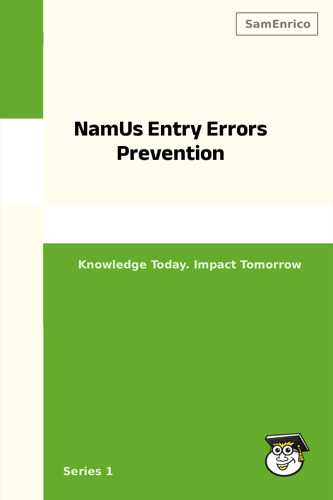
NamUs Entry Errors Prevention eBook
Avoid common data mistakes that prevent matches be
Avoid common data mistakes that prevent matches between missing and unidentified.
Formats
Free sample
Chapter 1: The Silo Effect...--–- The call came in at 11:47 on a Tuesday night. A mother in Spokane, Washington, reported her 19-year-old daughter missing. The young woman had left for a party the previous Friday and never returned. The dispatcher took down the details: name, date of birth, height (5'6"), weight (130 pounds), hair color (brown), last seen wearing a blue hoodie and jeans. Within the hour, a patrol officer entered the information into NCIC—the National Crime Information Center—the FBI's database that law enforcement agencies across the country rely upon.
The case was active. The search had begun. Or so everyone believed.What no one knew that night was that the same information would never make it fully into Nam Us—the National Missing and Unidentified Persons System—the public, forensic-focused database used by medical examiners, anthropologists, and families to identify unknown remains. For sixteen years, that young woman's skeletal remains would lie in a county morgue less than fifty miles from her mother's home, labeled simply "Jane Doe, cause of death undetermined." The mother would die of a heart attack in 2008, never knowing what happened to her daughter. The case would be featured on three true crime podcasts, two Netflix documentaries, and countless Reddit threads.
And the entire tragedy—the sixteen years, the wasted millions in search costs, the mother's broken heart—could be traced back to a single, unremarkable Tuesday night when two databases failed to speak to one another.This is the silo effect. And it is the single greatest obstacle to solving missing and unidentified person cases in America today.The Two Databases That Don't Talk To understand why matches don't happen, you must first understand the two systems that are supposed to make them possible. They could not be more different in design, purpose, and accessibility—and those differences are the root of nearly every error this book will address.NCIC, the National Crime Information Center, is law enforcement's database. It was created in 1967 by the FBI and has grown into a massive repository of criminal justice information: wanted persons, stolen vehicles, protective orders, and—relevant to this book—missing persons and unidentified remains. NCIC is fast, efficient, and designed for police use.
An officer at a traffic stop can query NCIC from their patrol car and receive a response in seconds. The system uses cryptic codes—SEX=F, RAI=3 (meaning "race: Black"), HGT=511—that are second nature to law enforcement but completely opaque to civilians. NCIC entries are brief, often containing only basic identifiers: name (if known), date of birth, height, weight, hair and eye color, and a brief narrative.But NCIC has a critical limitation for our purposes: it is not public-facing. A medical examiner cannot log into NCIC. A forensic anthropologist at a university cannot search NCIC.
A family member desperately scrolling through photos of unidentified remains cannot access NCIC. The information exists in a law enforcement silo, invisible to the very people who need it most.Nam Us, the National Missing and Unidentified Persons System, was designed to fill this gap. Launched in 2007 by the Department of Justice, Nam Us is free, public, and forensic-focused. It contains far more detailed fields than NCIC: dental charts, DNA status, tattoo descriptions measured in centimeters, scar locations using anatomical landmarks, photographs, radiographs, and narrative case histories. Nam Us is designed for collaboration—any registered user, including medical examiners, coroners, anthropologists, and victim advocates, can view cases, add information, and flag potential matches.But Nam Us has its own limitation: it is not mandatory.
While every law enforcement agency in America is required by federal regulation to enter missing persons into NCIC, no such requirement exists for Nam Us. An agency can—and thousands do—enter a missing person into NCIC and never publish a full, accurate entry in Nam Us. The case becomes a ghost: visible to police but invisible to the forensic professionals who could identify remains.The 34% Problem This is not a theoretical concern. In 2023, the Government Accountability Office (GAO) conducted a comprehensive audit of NCIC and Nam Us data alignment. The results were devastating.
Of all missing person records in NCIC, approximately 34 percent had no corresponding Nam Us entry at all. These cases existed in law enforcement's world but were completely absent from the forensic community's world. If those individuals were dead and their remains found, no match could ever occur because the missing person report was invisible to the medical examiner.Let that sink in. More than one in three missing persons in the FBI's database are invisible to the very system designed to identify them if they are found deceased. They are statistical ghosts.
They are the reason morgues across America are filled with "John Does" and "Jane Does" whose names are known to police but never entered into the system that could match them to their own remains.The GAO report identified a second, equally troubling statistic: of the cases that do exist in both systems, only 42 percent have fully matching biometric, dental, and case narrative data. The remaining 58 percent contain errors: heights that differ by inches, ages that are off by years, tattoos that are described in one system and omitted in the other, dental records marked "available" in Nam Us but never uploaded. These errors are not minor. They are the difference between a match and a permanent cold case.Together, these two statistics mean that roughly 86 percent of missing person cases in NCIC are either completely absent from Nam Us or contain significant errors that prevent algorithmic matching. The system is not failing because of bad technology.
It is failing because of bad data entry. And bad data entry, unlike bad technology, can be fixed by humans following a better protocol.The Anatomy of a Ghost Case Let me walk you through how a ghost case is born. It happens every day, in every jurisdiction, often without malice or negligence—just the normal friction of overworked professionals navigating two incompatible systems.Officer Martinez responds to a missing person report. A mother is frantic. Her son, twenty-three years old, hasn't been seen in three days.
Officer Martinez takes down the information: name, date of birth, height (the mother says 5'11"), weight (the mother says "about 170"), hair (brown), last seen (the mother's apartment, Tuesday evening). Officer Martinez returns to the station and opens NCIC. The system is familiar, the codes automatic. Within fifteen minutes, the entry is complete. A case number is generated.
Officer Martinez moves on to the next call.What Officer Martinez does not do—because no one has ever trained him to do it—is open Nam Us. He may not even know Nam Us exists. Or he may have heard of it vaguely, as "that website for families," not as a critical law enforcement tool. Or his department may have a policy that "the victim advocates handle Nam Us entries," but the victim advocate is on vacation and no one wants to step on their toes. Or the department may simply be understaffed, with a backlog of cases, and entering the same information into two separate systems feels like bureaucratic duplication rather than essential work.So Officer Martinez closes NCIC and moves on.…
This is the end of the free sample. Get the eBook to keep going. Buy now
About this book
Details
- Author
- Carroll Enrique
- Publisher
- SamEnrico
- Language
- English
- Genre
- Non-Fiction, True Crime, Data Management
- Released
- 2026-06-11
- Pages (approx.)
- 130
- Available as
- eBook, Audiobook

Read better in the ZLOADR app
Your eBooks on your phone or tablet. Sign in with your SamEnrico account and start reading.
More by Carroll Enrique
 Minecraft Excessive Play SolutionsCarroll Enrique$11.99
 Workplace Hierarchy NonverbalCarroll Enrique$11.99
 The Self Esteem for Creatives CourseCarroll Enrique$11.99
 Crush Injury Care ProtocolCarroll Enrique$11.99
 Remote Work Team BuildingCarroll Enrique$11.99
 Chronic Illness Money StressCarroll Enrique$11.99
 BiPAP Machine GuideCarroll Enrique$11.99
 The Last Whisper of the Old Growth: The Battle for the RedwoodsCarroll Enrique$11.99
 The Burning of Washington: America's Humiliation and ReckoningCarroll Enrique$11.99
 How to Produce Musical Keyboard StandsCarroll Enrique$11.99
 How to Produce 100% Linen YarnCarroll Enrique$11.99
 Growing Bulbophyllum (An Orchid Genus)Carroll Enrique$11.99