
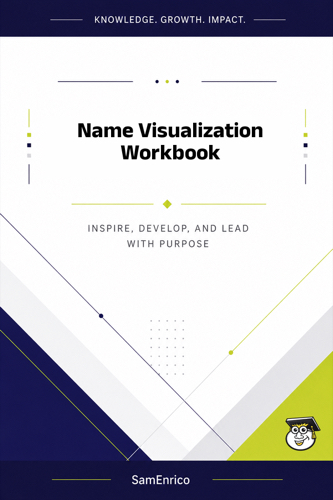
Name Visualization Workbook eBook
Includes exercises to convert names into vivid men
Includes exercises to convert names into vivid mental images.
Formats
Free sample
Chapter 1: The Attention Trap--–- The name slipped away before the handshake ended. Again. You smiled, nodded, and within three seconds, the sound that was supposed to stick had dissolved into mental static. This is not a memory problem. It is an attention problem, and until you understand the difference, no visualization technique in this workbook will save you.Every bestselling memory book agrees on one hidden truth: forgetting a name is almost never a failure of storage.
It is a failure of encoding. Your brain cannot retrieve what it never properly filed. The moment you hear "Nice to meet you, I'm Michael," your cognitive resources are already racing ahead to your own response—"I'm Sarah, great to meet you too"—and in that brief overlap, the name Michael is never registered. Neuroscientists call this phenomenon nexting: the brain's automatic habit of preparing the next action while still processing the current one. Nexting is efficient for survival.
You do not want to pause for ten seconds to decide whether to brake or swerve. But nexting is disastrous for name memory because names are arbitrary, abstract, and carry no inherent meaning. Your brain, trained by evolution to prioritize threats and rewards, treats a new name as low-priority noise unless you intervene.This chapter introduces the foundational ritual that underpins every technique in this workbook: the A.I.R. System. A.I.R.
stands for Attention, Interest, and Repetition. These three micro-actions, taking less than ten seconds combined, transform name memory from a passive hope into an active choice. Unlike generic advice that tells you to "just pay attention," A.I.R. provides a neurological off-ramp for nexting. You will learn why intention precedes visualization, how a two-second shift in focus rewires your encoding, and why every subsequent chapter in this workbook depends entirely on the habits you build here.The Neurology of Nexting: Why Your Brain Sabotages You Before you can fix a problem, you must understand its architecture.
Functional magnetic resonance imaging (f MRI) studies of social interaction reveal a consistent pattern: when a person is introduced to someone new, the dorsolateral prefrontal cortex—the region responsible for planning and anticipation—activates more strongly than the hippocampus, which is responsible for memory formation. In plain language, your brain is more interested in what you will say next than in the name you just heard. This is not rudeness. This is evolution.The average human processes approximately seven hundred words per minute in internal monologue. During a three-second introduction, your brain cycles through approximately thirty-five words of self-directed speech: "Okay, say your name, smile, don't forget to ask about the project, oh his name is something, wait, what was it?" By the time you reach the end of that internal sentence, the name is gone.
Nexting creates a temporal blind spot. The name arrives during a moment of cognitive overload, and because your attentional spotlight is aimed at your own upcoming response, the name never reaches working memory.Working memory, the brain's temporary scratchpad, can hold approximately four discrete items for about fifteen to thirty seconds without active rehearsal. A new name occupies one of those four slots. But if your working memory is already occupied by your planned response, your emotional state (anxiety about making a good impression), and environmental distractions (background noise, eye contact, handshake pressure), the name has no slot. It falls out before it ever arrives.
The A.I.R. System is designed to clear one dedicated slot for the name by temporarily suspending the nexting loop.The A.I.R. System: Attention, Interest, Repetition The A.I.R. System is not a technique. It is a pre-technique.
Every visualization method in later chapters—phonetic substitution, dynamic absurdity, the memory palace—depends on a name that has already been successfully encoded. If you skip A.I.R., you are trying to build a house on sand. The three components work in sequence, each solving a specific neurological bottleneck.Attention is the conscious decision to interrupt nexting. You cannot will yourself to pay attention in a general sense. "Try harder" is neurologically meaningless.
Instead, Attention requires a specific, repeatable trigger—a micro-ritual that hijacks the brain's orienting response. The orienting response is an automatic reaction to novelty or sudden change. Your brain cannot ignore a sudden loud noise or a flash of light. Attention uses this reflex by creating an internal novelty event: you silently say to yourself, "I am choosing to remember this." This self-directed statement, repeated in the same internal voice every time you meet someone, acts as a cognitive reset button. It interrupts the nexting loop by introducing a novel instruction.
The brain, trained to prioritize new information, briefly pauses its forward planning and redirects resources to the present moment.Interest is often misunderstood as "finding the person interesting." That is not the requirement. Interest, as defined in this system, means actively scanning for one concrete, observable, distinctive feature on the person's face or appearance. Not a judgment ("nice smile") but a catalogable detail: a scar above the left eyebrow, a gap between the front teeth, an unusually sharp jawline, one ear that sits lower than the other. The act of scanning—moving your eyes deliberately across the face—forces the brain out of nexting because visual search consumes cognitive bandwidth that would otherwise go to internal monologue. You cannot simultaneously plan your next sentence and catalog facial topography.
Interest hijacks the visual cortex and redirects attention outward. Importantly, this Interest step is purely observational. It does not yet involve visualization or absurdity. You are simply gathering data. That data will become the anchor for every image in later chapters, but here it serves a simpler purpose: it keeps you present.Repetition is the most mechanically straightforward but psychologically difficult component.
Within ten seconds of hearing the name, you must say it aloud. Not in your head. Aloud. The standard script is simple: "Nice to meet you, [Name]." If the introduction already included your name, you can say, "[Name], good to meet you." The act of vocalizing the name engages the motor cortex, the auditory cortex (hearing your own voice), and the hippocampus simultaneously. This multimodal encoding creates three separate neural pathways to the same memory, vastly improving retrieval.
The ten-second window is critical. Beyond ten seconds, the name has either been lost or has moved into fragile short-term storage without a strong anchor. Repetition within ten seconds locks the name into a temporary buffer long enough for you to apply the visualization techniques in later chapters.Why Intention Precedes Visualization Every visualization system on the market makes the same error: it teaches you how to create vivid, bizarre, memorable images before teaching you how to capture the raw material. This is like teaching a student how to carve a marble statue before teaching them how to mine the marble. The visualization techniques in Chapters 3 through 11 are powerful, but they are useless if you have nothing to visualize.
A.I.R. is the quarry. It extracts the raw name from the noise of social interaction and holds it steady long enough for your imagination to work.Consider the difference between passive and active encoding. Passive encoding is what…
This is the end of the free sample. Get the eBook to keep going. Buy now
About this book
Details
- Author
- Dejesus Meggan
- Publisher
- SamEnrico
- Language
- English
- Genre
- Non-Fiction, Self-Help, Visualization
- Released
- 2026-06-10
- Pages (approx.)
- 146
- Available as
- eBook, Audiobook

Read better in the ZLOADR app
Your eBooks on your phone or tablet. Sign in with your SamEnrico account and start reading.
More by Dejesus Meggan
 Self Esteem for StutterersDejesus Meggan$11.99
 Andrew Johnson ImpeachmentDejesus Meggan$11.99
 Vaping Cessation Action PlanDejesus Meggan$11.99
 Scarcity Sales PsychologyDejesus Meggan$11.99
 Divorce Therapy GuideDejesus Meggan$11.99
 Mendeleev Final PortraitDejesus Meggan$11.99
 When the Sky Fell Silent: The Day the Dinosaurs DisappearedDejesus Meggan$11.99
 The Visionary Who Built the Beautiful Game: Alexandre de Carvalho and the Rise of Brazilian FootballDejesus Meggan$11.99
 How to Setup and Launch Heat AthleticsDejesus Meggan$11.99
 How to Produce Food Additive ProductsDejesus Meggan$11.99
 How to Become a Medical Radiation DosimetristDejesus Meggan$11.99
 How to Produce Shaper CuttersDejesus Meggan$11.99
You may also like
 White Room InductionHostetler Vasiliki$11.99
 The Gambling Free Identity VisualizationFinn Clement$11.99
 Spending Visualization ExerciseCantwell Michaele$11.99
 Guided Imagery for RestGuillen Stevie$11.99
 Financial Visualization PracticeIsbell Gerri$11.99
 Emotional Regulation VisualizationFelix Lanell$11.99
 Anger Visualization TechniquesYounger Verona$11.99
 Visualization Sleep MeditationStull Dodie$11.99
 Visualization for ConfidenceMilliken Bok$11.99
 Road Rage Visualization GuideStratton Latrina$11.99
 The Affirmation Visualization ComboHopper Nyla$11.99
 Teen Visualization Self EsteemClick Jere$11.99