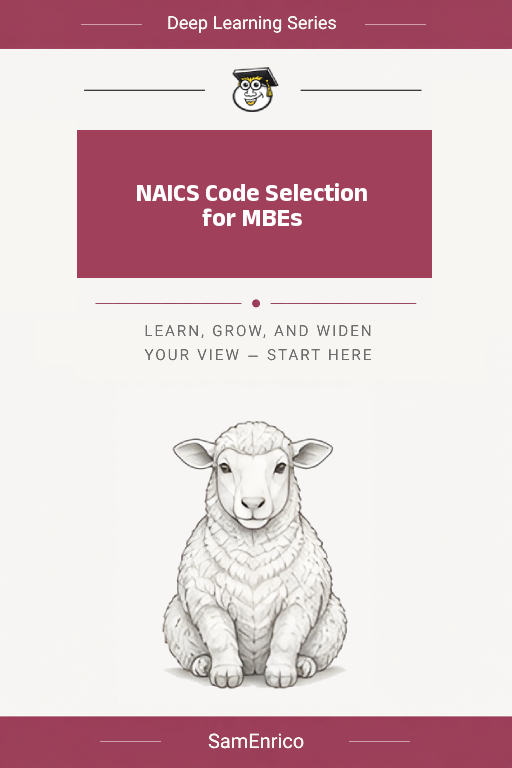
NAICS Code Selection for MBEs eBook
Choose correct industry codes that align with your
Choose correct industry codes that align with your capabilities and set-aside eligibility.
Formats
Free sample
Chapter 1: The Passive Quarry--–- Most Minority Business Enterprises (MBEs) lose their first million dollars in federal set-asides before they ever submit a bid. They do not lose because of poor performance, weak pricing, or inexperienced staff. They lose because they treat a six-digit code as paperwork rather than weaponry. This chapter dismantles the single most destructive habit among certified MBEs: passive NAICS code acceptance. You will learn why “any code” is the enemy of strategic advantage, how the SBA’s Principal Purpose rule transforms your competitive positioning, and why the difference between winning a $4 million sole-source contract and watching it go to a non-minority firm often comes down to nothing more than a number you never bothered to question.The Pathology of Passive Selection Walk into any MBE certification workshop and you will witness the same ritual.
The instructor projects a slide of SAM.gov registration. Attendees dutifully note that they must select NAICS codes. Someone raises a hand and asks, “How many codes should I pick?” The instructor answers, “As many as apply to your capabilities.” The room nods. The session ends. And another generation of MBEs begins its federal contracting journey convinced that NAICS codes are a clerical checkbox—an administrative nuisance to be completed once and forgotten.This is the pathology of passive selection.
It is the single greatest strategic error in minority business development. And it costs MBEs billions in unrealized revenue annually.Passive selection means you choose codes based on what you have done in the past rather than what you want to win in the future. You look at your capability statement, find codes that seem to match, and check the boxes. Maybe you ask your banker or your mentor. Maybe you simply copy what a competitor uses.
But you never ask the question that separates strategic MBEs from the passive quarry: What code gives me the best chance to win this specific contract?Consider two MBEs. Both are certified. Both have identical capabilities. Both pursue the same $3.5 million IT services contract. MBE A registered three years ago with NAICS 541511 (Custom Computer Programming Services) because that was their primary revenue source at the time.
MBE B registered with the same code but also monitors solicitations daily. When the contract opportunity appears, MBE B notices that the Statement of Work focuses heavily on systems integration rather than custom programming. MBE B files a pre-solicitation comment arguing that NAICS 541512 (Computer Systems Design Services) is the correct principal purpose. The contracting officer agrees. MBE A, still operating under the old code, does not even realize the contract is now set aside under a different classification.
MBE B wins. MBE A never bid.This is not a hypothetical. It happens every day across every federal agency. And it happens because the overwhelming majority of MBEs treat NAICS codes as static labels rather than dynamic strategic tools.The Principal Purpose Revolution To understand why passive selection is so destructive, you must first understand the legal foundation that makes proactive selection so powerful. That foundation is the Principal Purpose rule, codified at 13 CFR §121.402.Here is what the rule actually says: When determining whether a business is small for a particular contract, the SBA looks not at what the business does generally, but at the primary purpose of the specific contract being bid.
In plain English: your size follows the work, not the other way around.Let me give you a concrete example that shocks most MBEs the first time they hear it. Suppose your MBE is a general construction firm. You have 25millioninaverageannualrevenuefrombuildingofficeparksandretailcenters.Youare,byanynormalmeasure,asubstantialbusiness.Nowsupposeafederalagencyreleasesasolicitationforasoftwaredevelopmentproject—buildingacustomdatabaseforinventorymanagement.Thecontractvalueis25 million in average annual revenue from building office parks and retail centers. You are, by any normal measure, a substantial business. Now suppose a federal agency releases a solicitation for a software development project—building a custom database for inventory management.
The contract value is 25millioninaverageannualrevenuefrombuildingofficeparksandretailcenters.Youare,byanynormalmeasure,asubstantialbusiness.Nowsupposeafederalagencyreleasesasolicitationforasoftwaredevelopmentproject—buildingacustomdatabaseforinventorymanagement.Thecontractvalueis8 million. Your firm happens to have a small software division that generates 2millionannually.Underthe Principal Purposerule,your2 million annually. Under the Principal Purpose rule, your 2millionannually.Underthe Principal Purposerule,your25 million construction revenue is completely irrelevant. Your size for this contract is determined solely by your software revenue. If the size standard for that software NAICS code is 30million,youaresmall.Youcanbidonaset−asidecontractdespitebeinga30 million, you are small.
You can bid on a set-aside contract despite being a 30million,youaresmall.Youcanbidonaset−asidecontractdespitebeinga25 million company.This is not a loophole. It is the explicit design of federal size determination. And it opens extraordinary opportunities for MBEs who understand it.But the rule cuts both ways. The same principle that can make you small can also make you other-than-small if you are not careful. Suppose your MBE is a niche consulting firm with 8millioninrevenue.Younormallyworkinmanagementconsultingunder NAICS541611,whichhasasizestandardof8 million in revenue.
You normally work in management consulting under NAICS 541611, which has a size standard of 8millioninrevenue.Younormallyworkinmanagementconsultingunder NAICS541611,whichhasasizestandardof19 million. You are comfortably small. Now a solicitation appears for logistics consulting under NAICS 541614, which has a size standard of 9million.Thecontractingofficerassignsthatcode.Suddenlyyour9 million. The contracting officer assigns that code. Suddenly your 9million.Thecontractingofficerassignsthatcode.Suddenlyyour8 million firm is small—barely.
But if you had grown to $9.5 million without updating your NAICS portfolio, you would be other-than-small for that contract. Your general consulting revenue does not help you. The principal purpose locks you into the logistics code’s standard.The principal purpose rule is the most powerful and most misunderstood tool in federal contracting. This chapter gives you the foundation. Chapter 6 will show you how to appeal when an agency gets the code wrong.
Chapter 12 will embed the rule into your annual audit. But for now, internalize this: Every contract has its own size determination. Your historical revenue is only relevant insofar as it matches the contract’s primary purpose.Why MBEs Are Especially Vulnerable Minority-owned businesses face a unique set of pressures that make passive NAICS selection even more dangerous than it is for non-minority small businesses. Understanding these vulnerabilities is the first step to overcoming them.Pressure 1: The Certification Chase. When you pursue MBE certification—whether from the SBA’s 8(a) program, a state transportation agency, or a corporate supplier diversity office—the application asks for NAICS codes.
The implicit message is that you must provide them immediately. In your rush to complete the application, you grab the first codes that seem plausible. You tell yourself you will update them later. Later never comes. You are now locked into a set of codes that may or may not reflect your true capabilities or your strategic targets.Pressure 2: The Capability Statement Trap.
Most MBEs build capability statements based on past performance. That is logical. But when you list past projects, you naturally describe them using NAICS codes that fit those projects. Over time, your capability statement becomes a rearview mirror—excellent at showing where you have been, useless at showing where you want to go. When a contracting officer reads your capability statement, they see a business that does X, Y, and Z.
They assign NAICS codes accordingly. You never correct them because you are proud of your past work. But past work may not be the work you want to win next.Pressure 3…
This is the end of the free sample. Get the eBook to keep going. Buy now
About this book
Details
- Author
- Creamer Mitsue
- Publisher
- SamEnrico
- Language
- English
- Genre
- Non-Fiction, Business Brief, NAICS
- Released
- 2026-05-30
- Pages (approx.)
- 147
- Available as
- eBook, Audiobook

Read better in the ZLOADR app
Your eBooks on your phone or tablet. Sign in with your SamEnrico account and start reading.
More by Creamer Mitsue
 Central African RepublicCreamer Mitsue$11.99
 Bipolar Exercise GuideCreamer Mitsue$11.99
 IBS And Sexual HealthCreamer Mitsue$11.99
 Gacy First Murder Jeffrey RignallCreamer Mitsue$11.99
 Normal Forgetfulness ManagementCreamer Mitsue$11.99
 Home Improvement SpendingCreamer Mitsue$11.99
 LA Police Night Stalker Task ForceCreamer Mitsue$11.99
 Progesterone HRT GuideCreamer Mitsue$11.99
 The Healing Hearts of Florence: The Love That Saved MedicineCreamer Mitsue$11.99
 The Sneaker Alchemist: How George Taylor Created the First Mass-Produced Athletic ShoeCreamer Mitsue$11.99
 How to Produce General Lubricant and PenetrantCreamer Mitsue$11.99
 Understanding Pervasive Developmental DisordersCreamer Mitsue$11.99