
Non-FictionSelf-HelpArt Memory
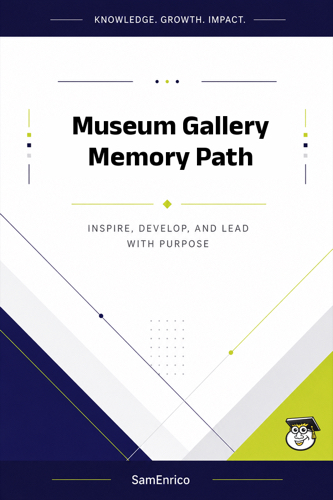
Museum Gallery Memory Path eBook
Use art museum rooms as elegant memory palaces for
Use art museum rooms as elegant memory palaces for historical facts.
Formats
Free sample
Chapter 1: The Empty Museum--–- Maria had never thought of herself as stupid. She had graduated high school with a B average, could assemble IKEA furniture without swearing, and had once talked her way out of a speeding ticket by charming the officer with a detailed history of roadside diner architecture. But there she sat, in a fluorescent-lit study carrel at the university library, staring at a flashcard that read "Treaty of Versailles – 1919," and the number might as well have been written in Sumerian cuneiform. She had reviewed this same card forty-seven times in the past three hours. She had written it out by hand.
She had recited it aloud to her cat, who had walked away in disgust. And still, when she closed her eyes, the date evaporated like breath on a mirror.What Maria did not know, as she slumped over her mountain of defeated flashcards, was that she possessed an extraordinary memory. Not an average memory. Not a "she'll get by" memory. A genuinely, frighteningly powerful memory that would have impressed the scholars of ancient Rome.
She just had no idea how to use it.The evidence was sitting in her phone, three miles away, on the fourth floor of the Westfield Mall. Maria had visited that mall exactly once, two years ago, to buy a birthday gift for her sister. She had been there for forty-five minutes. And yet, blindfolded, she could walk from the Apple Store to the food court to the shoe repair kiosk without a single wrong turn. She could tell you that the pretzel stand was directly across from the escalator bank, that the restrooms were behind the pillar with the cracked tile, that the hallway to the parking garage smelled faintly of popcorn and regret.
She had not studied the mall. She had not made flashcards of its floor plan. She had simply walked through it, and her brain had done the rest.This, in a single anecdote, is the entire thesis of this book. Your brain is not a spreadsheet processor. It is not a filing cabinet.
It is not a hard drive waiting to be formatted. Your brain is a spatial navigation engine, honed by three hundred million years of evolution, and it is the most powerful pattern-recognition device in the known universe. You have simply been asking it to do its job in the wrong language.The language your brain speaks is not repetition. It is not rote memorization. It is not the grim, joyless grind of flashcards.
The language your brain speaks is space, movement, emotion, and image. And no human space is richer in image, emotion, and narrative than an art museum.This book will teach you to turn any art museum—the Louvre, the Met, your local gallery with six paintings and a dusty diorama—into a cognitive cathedral for historical facts. You will learn to walk through galleries not as a tourist, but as a mnemonist. You will learn to see paintings not as decoration but as data structures. You will learn to read architecture not as background but as a mnemonic grid.
And by the time you finish this chapter, you will have taken the first step toward a memory that would have made the scholars of the Renaissance weep with envy.But first, you must unlearn almost everything you think you know about how memory works.The Myth of the Bad Memory Let us begin with a confession. I have, at various points in my life, believed that I had a bad memory. I have forgotten anniversaries, misplaced car keys, and once introduced the same person to the same colleague at the same party, twice, within eleven minutes. I have stood in front of an open refrigerator with no memory of why I was there. I have walked into a room and felt the idea evaporate from my mind like steam from a hot cup of coffee.For years, I assumed this meant something was wrong with me.
I assumed that other people—the ones who could recite poetry, remember names at parties, quote statistics from memory—possessed some genetic gift that I lacked. I assumed that memory was a fixed trait, like height or eye color, and I had drawn the short straw.This is nonsense. And it is the most damaging myth in all of education.The scientific consensus, supported by decades of research in cognitive psychology and neuroscience, is that there is no such thing as a "bad memory" in the sense most people mean it. There are only untrained memories and trained memories. There are only people who have learned the language their brain actually speaks and people who are still shouting at their hippocampus in a dialect it cannot understand.Consider the case of Solomon Shereshevsky, a Russian journalist in the 1920s whose editor noticed something strange: Shereshevsky never took notes.
He never wrote down assignments. He never forgot a single instruction, no matter how complex. Curious, the editor sent him to a neurologist named Alexander Luria, who spent the next thirty years studying Shereshevsky's mind. What Luria discovered was astonishing. Shereshevsky did not have a photographic memory in the sense of literally seeing images.
Rather, he had accidentally discovered—without any formal training—the fundamental principles of ancient mnemonic technique. He visualized everything. He turned abstract words into vivid, often bizarre images. And he placed those images into spatial locations: a street he knew, a room in his apartment, a path through a garden. Shereshevsky could recall lists of a hundred random words, twenty years later, in perfect order, simply by taking a mental walk.Shereshevsky was not a genius.
He was not a savant. He was a man with a normal brain who had stumbled upon the correct operating system for human memory. The rest of us, trained by a school system that worships repetition, are still running the wrong software.The good news is that you do not need thirty years of practice to achieve what Shereshevsky achieved. You need this book, a willingness to think differently, and a single visit to a museum. Not because museums are magic—though they are, in their own way—but because museums are the most perfectly designed memory palaces ever built.
And no one told you.Neuro-Aesthetics: Why Art Is Not Optional Let me introduce you to a word you may not know: neuro-aesthetics. It is the study of how the brain responds to art and beauty, and it is one of the most exciting frontiers in modern neuroscience. Researchers in this field have discovered that when you look at a painting you find beautiful, your brain does something remarkable. It activates the same reward circuits that fire when you eat chocolate, hear music you love, or fall in romantic love. The ventral striatum lights up.
The orbitofrontal cortex hums with activity. Dopamine—the neurotransmitter of pleasure and motivation—floods your synapses.But neuro-aesthetics has also revealed something stranger and more relevant to our purposes. When you look at a painting, your brain does not just see it. Your brain enters it. Mirror neurons fire as if you were reaching out to touch the brushstrokes.
The parahippocampal place area—a region专门用于 encoding spatial environments—activates as if you were walking into the scene. A landscape painting by…
This is the end of the free sample. Get the eBook to keep going. Buy now
About this book
Details
- Author
- Beckman Willian
- Publisher
- SamEnrico
- Language
- English
- Genre
- Non-Fiction, Self-Help, Art Memory
- Released
- 2026-06-07
- Pages (approx.)
- 150
- Available as
- eBook, Audiobook

Read better in the ZLOADR app
Your eBooks on your phone or tablet. Sign in with your SamEnrico account and start reading.
More by Beckman Willian
 Pandemic Sales Pipeline RescueBeckman Willian$11.99
 Macros for PCOSBeckman Willian$11.99
 My Adoption Day FinallyBeckman Willian$11.99
 Loving Kindness for Speech Language PathologistsBeckman Willian$11.99
 Grief and Taxes After SpouseBeckman Willian$11.99
 Cognitive Restructuring For DelayBeckman Willian$11.99
 Podcast Listening Weekly ReviewBeckman Willian$11.99
 Whispers in the Black Dust: The Vanished Children of the Great PlainsBeckman Willian$11.99
 Wolf of the Wilderness: Rogers' Rangers and the Birth of American Guerrilla WarfareBeckman Willian$11.99
 How to Start a Metallic Paint Business (Beginners Guide)Beckman Willian$11.99
 How to Produce Wig Glue and TapeBeckman Willian$11.99
 How to Produce Masonry Edgers and GrooversBeckman Willian$11.99
You may also like
 Hong Kong Handover 1997Dunn Johnnie$11.99
 Zumba For Postnatal Recovery CourseNeal Christian$11.99
 Zumba for BeginnersLadner Nikia$11.99
 YouTube Comment Mining GuideHumes Pandora$12.99
 Worry Box MeditationCarlin Rudy$11.99
 Workplace Stress MeditationNguyen Lynn$11.99
 Workplace Stress and Sleep RepairHawley Ivory$11.99
 Workplace Perfectionism CureDelaney Jeffry$11.99
 Workplace Injustice Anger GuideWallen Isabelle$11.99
 Work Addiction and Burnout LinkGreenwood Ester$11.99
 Women in Yoga and WellnessBeattie Galina$11.99
 Women in Stand Up ComedyChun Evangeline$11.99