
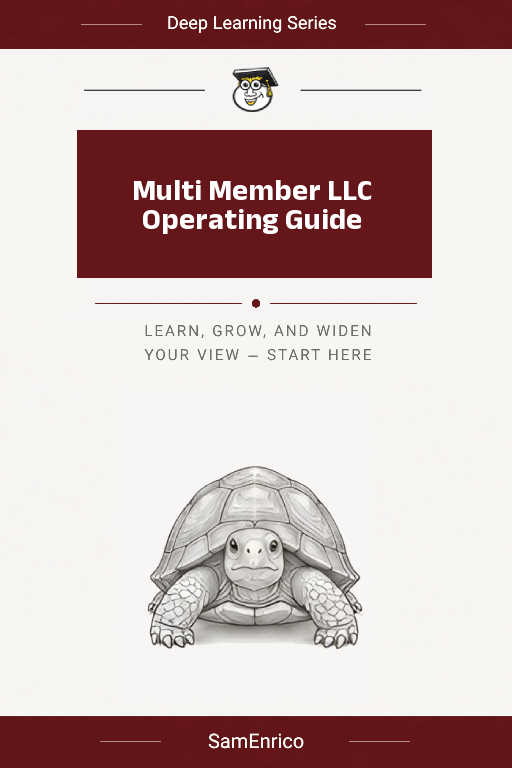
Multi Member LLC Operating Guide eBook
Structure ownership percentages and profit distrib
Structure ownership percentages and profit distribution for business partners.
Formats
Free sample
Chapter 1: The Fair Split Lie...--You are about to start a business with someone you trust. Maybe it is your best friend from college, your spouse, a former coworker who always seemed to have the right answers, or a sibling who just gets you. You have stayed up late mapping out the dream, sketched logos on napkins, and promised each other that this time will be different. You have both agreed on the obvious: you will split everything fifty-fifty. Half the ownership, half the profits, half the decisions.
It feels fair. It feels equal. It feels like the foundation of a partnership built to last.That foundation is made of sand.The fifty-fifty split is the single most dangerous ownership structure in multi-member LLCs, yet it remains the default choice for nearly every new partnership. Not because it works, but because it feels safe. Equal sounds fair.
Fair sounds stable. But stability requires something that equal ownership never provides: a mechanism for breaking ties when two reasonable people disagree about something fundamental.This chapter will show you why most states default to equal control even when capital contributions are wildly unequal, why the fifty-fifty split has destroyed more partnerships than bad revenue or failed products combined, and how a simple tie-breaker provision can save your business from deadlock. More importantly, you will complete a ten-question diagnostic tool called the Hungry Partner Test that will reveal, in black and white, whether your current ownership percentages actually match the risk, work, and capital each partner is bringing to the table.If you skip this chapter, you will almost certainly sign an operating agreement that default state law will later undo. If you read it and do nothing, you will have no excuse when the deadlock comes. And if you read it and act, you will build a partnership that can survive the inevitable disagreements that every successful business faces.The Default Trap That No One Sees Coming Here is what most entrepreneurs believe about LLC ownership.
They believe that if they put in more money, they should have more control. They believe that if they agree to split things fifty-fifty, the law will respect that agreement. They believe that their handshake and their shared vision are stronger than any legal technicality.All of these beliefs are wrong.Under the Uniform Limited Liability Company Act, which has been adopted in some form by most states including Delaware, New York, California, Texas, and Florida, if your operating agreement is silent on how decisions are made, the law assumes equal control regardless of capital contributions. That is not a typo. If you and a partner form a two-member LLC, you contribute ninety percent of the money, and your partner contributes ten percent, but your operating agreement does not specifically say otherwise, then you each have exactly one vote.
Your partner can block any major decision. Your partner can prevent you from taking a loan, hiring a CEO, or selling the business. Your partner can force a deadlock that paralyzes the company indefinitely.This is not a theoretical risk. In the case of Smith v. Jones, a California appellate court upheld a deadlock ruling where a ninety-percent capital contributor was prevented from making any major decisions for eighteen months because the operating agreement was silent and the ten-percent partner refused to agree to anything.
The business eventually sold for pennies on the dollar. The ninety-percent partner walked away with nothing but legal bills.The fifty-fifty split is dangerous for the same reason, but with an additional twist. When two partners each own fifty percent, neither can outvote the other. Every major decision requires consensus. And consensus, as anyone who has been married or run a business knows, is not always possible.
You may disagree about hiring your cousin. You may disagree about taking on debt. You may disagree about whether to accept a buyout offer. In a fifty-fifty LLC with no tie-breaker, these disagreements become permanent roadblocks.The Case of the Organic Bakery That Died by Tie Vote Consider the story of Green Sprout Bakery, a real partnership that collapsed in 2018. Two friends, Maya and Elena, started an organic gluten-free bakery in Portland, Oregon.
They put in equal money, equal time, and equal passion. They signed a simple operating agreement they found online, which said almost nothing about voting other than that major decisions required a majority vote.For two years, the bakery thrived. Revenue hit two million dollars. They had thirty employees. Everything was working.
Then the landlord sold the building, and the new landlord wanted to double the rent. Maya wanted to relocate to a cheaper space across town. Elena wanted to stay and negotiate. They could not agree. They voted.
Fifty-fifty. Deadlock.The operating agreement had no tie-breaker provision. It did not name a third-party mediator. It did not give one partner final say over real estate decisions. The lawyers got involved.
The legal fees consumed fifty thousand dollars. The bakery could not sign the new lease because Elena refused, and could not move because Maya refused. The landlord evicted them. The business closed. Two million dollars in revenue, zero dollars in exit proceeds.
All because no one had thought to ask the simple question: what happens when we disagree?The fifty-fifty split did not cause the disagreement. Disagreements are normal, healthy, and inevitable in any partnership. What destroyed the bakery was the absence of a mechanism to break the tie. A fifty-one percent majority threshold would have solved it. A rotating tie-breaker where partners take turns having final say on different categories of decisions would have solved it.
A clause giving one partner final authority over real estate and the other final authority over hiring would have solved it. But there was nothing. And nothing, in business partnerships, is always worse than something.Why Equal Control Is Not Equal Fairness The instinct to split ownership equally comes from a noble place. You want your partner to feel valued. You want to avoid the awkward conversation where someone says "I deserve more than you." You believe that if you treat each other as equals, you will act as equals.
But equal control without equal contribution is a recipe for resentment, not fairness.Imagine this scenario. You contribute one hundred thousand dollars in cash. Your partner contributes ten thousand dollars in cash plus a used laptop and a promise to work hard. You split ownership fifty-fifty. A year later, the business has three hundred thousand dollars in the bank.
Your partner wants to take a fifty-thousand-dollar distribution to buy a new car. You want to reinvest that money into hiring a salesperson. Under a fifty-fifty voting structure with no tie-breaker, your partner can force the distribution. You have no recourse. You contributed ten times the cash, but you have exactly the same voting power.This is not a hypothetical edge case.
It happens constantly. The partner who contributed less cash often wants cash distributions sooner because they have less personal savings. The partner who contributed more cash often wants to reinvest for growth because they can afford to wait. Without a voting structure that aligns control with economic contribution, the partnership becomes a battlefield…
This is the end of the free sample. Get the eBook to keep going. Buy now
About this book
Details
- Author
- Fernandez Kevin
- Publisher
- SamEnrico
- Language
- English
- Genre
- Non-Fiction, First 30 Days
- Released
- 2026-05-30
- Pages (approx.)
- 146
- Available as
- eBook, Audiobook

Read better in the ZLOADR app
Your eBooks on your phone or tablet. Sign in with your SamEnrico account and start reading.
More by Fernandez Kevin
 Breath for Mass ShootingsFernandez Kevin$11.99
 Transcendental Meditation vs MindfulnessFernandez Kevin$11.99
 Productivity Porn Comparison GuideFernandez Kevin$11.99
 Childrens Environmental Toxin GuideFernandez Kevin$11.99
 Bipolar Spectrum GuideFernandez Kevin$11.99
 Bomb Squad Technician StressFernandez Kevin$11.99
 Vaping Aerosol Exposure GuideFernandez Kevin$11.99
 Chemical Peel Wrinkle Reduction WorkbookFernandez Kevin$11.99
 Arthritis Home ModificationsFernandez Kevin$11.99
 The Butcher of Boston: A Mind UnraveledFernandez Kevin$11.99
 The Bone Orchard Rebellion: When Women Turned the Tides of WarFernandez Kevin$11.99
 Golden Arches of Atlantis: The Fast Food Empire That DrownedFernandez Kevin$11.99
You may also like
 Hong Kong Handover 1997Dunn Johnnie$11.99
 Zumba For Postnatal Recovery CourseNeal Christian$11.99
 Zumba for BeginnersLadner Nikia$11.99
 YouTube Comment Mining GuideHumes Pandora$12.99
 Worry Box MeditationCarlin Rudy$11.99
 Workplace Stress MeditationNguyen Lynn$11.99
 Workplace Stress and Sleep RepairHawley Ivory$11.99
 Workplace Perfectionism CureDelaney Jeffry$11.99
 Workplace Injustice Anger GuideWallen Isabelle$11.99
 Work Addiction and Burnout LinkGreenwood Ester$11.99
 Women in Yoga and WellnessBeattie Galina$11.99
 Women in Stand Up ComedyChun Evangeline$11.99