
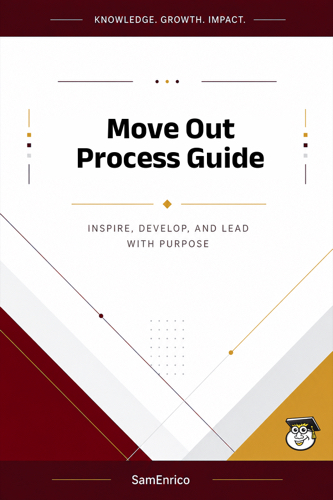
Non-FictionBusiness BriefTransition Management
Move Out Process Guide eBook
Inspects and returns deposit promptly.
Inspects and returns deposit promptly.
Formats
Free sample
Chapter 1: The $1,000 Lie...--Every year, over one million security deposit disputes clog up small claims courts across the United States. The average amount in contention? Just over $1,000. That thousand dollars—sometimes less, sometimes more—represents more than just money. It represents a broken relationship, a lost afternoon in court, sleepless nights for landlords and tenants alike, and a system that seems designed to make everyone angry.Here is the paradox that most people never see coming: the vast majority of these disputes are completely preventable.
Not only preventable, but predictable. And the single most important moment that determines whether you will win or lose that $1,000 is not the day the tenant moves out. It is not the day you conduct the final inspection. It is not the day you write the deduction letter or step into the courtroom.The most important moment is the day the tenant signs the lease.This chapter makes a bold claim that will reshape how you think about the entire move-out process: The move-out process is won or lost on the day the tenant signs the lease. If you are a landlord reading this book, every dollar you hope to keep from a security deposit is only keepable because you put the right words on paper months or years earlier.
If you are a tenant reading this book, every dollar you hope to get back is only recoverable because you read and understood what you signed before you ever unpacked a single box.This chapter is the foundation upon which every subsequent chapter is built. It covers why most standard leases are legally weak, how to draft clauses that actually hold up in court, the critical distinction between cleaning standards that work and those that backfire, and the single document that will save you thousands of dollars in legal fees. By the end of this chapter, you will either rewrite your lease (if you are a landlord) or know exactly what to look for before signing (if you are a tenant).The Invisible Contract: Why What You Don't Write Will Hurt You Most landlords use a lease they downloaded from the internet, borrowed from a friend, or inherited from the previous owner of the property. Most tenants skim that lease for the rent amount and the move-in date, then sign without reading the fine print. Both parties are making a catastrophic mistake.The law operates on a simple principle: If it isn't in the lease, you cannot enforce it.
This is not a suggestion. This is not a guideline. This is black-letter law in every jurisdiction in the United States. A judge cannot read your mind. A judge cannot assume what you intended.
A judge can only read what you wrote.Consider these real-world examples from court cases:A landlord in Florida tried to withhold $800 for professional carpet cleaning. The lease said the unit must be returned "in clean condition." The judge ruled against the landlord because "clean condition" does not explicitly require professional cleaning. The tenant had vacuumed. That was enough.A landlord in California deducted $1,200 for repainting after a five-year tenancy. The lease was silent on painting schedules.
The judge ruled that after five years, repainting is normal wear and tear regardless of the walls' condition. The landlord lost every dollar.A tenant in Texas argued that nail holes from hanging pictures were not damage. The lease did not define what constituted a hole versus a nail puncture. The judge split the difference and awarded only half of what the landlord sought.In each case, the outcome was determined not by the facts of the damage, but by the words (or lack of words) on a piece of paper signed months or years earlier. The landlords had the evidence.
They had the photos. They had the receipts. They lost anyway because their leases were silent on the specific standard they tried to enforce.This is why Chapter 1 exists. Everything else in this book—the inspections, the photos, the deduction letters, the court appearances—is built on top of the foundation you create in the lease. If the foundation is cracked, the entire building collapses.The One Page That Saves Thousands: The Move-In Checklist Before we dive into lease clauses and legal language, we must address the single most important document you will ever use as a landlord or as a tenant.
It is not the lease itself. It is the Move-In Checklist.This book consolidates all checklists into a single master document located in the Appendix. That checklist is a multi-page grid that covers every room, every appliance, every surface, and every system in the rental unit. It includes columns for the condition at move-in (with photo numbers), the condition at move-out (with photo numbers), and estimated repair costs. For the rest of this chapter, whenever we refer to "the Checklist," we mean that master document.Here is why the Checklist is non-negotiable: Without a signed, dated, and witnessed Checklist completed at move-in, you have no baseline for comparison at move-out.
A judge looking at move-out photos alone cannot know whether that scuff on the wall existed before the tenant moved in or appeared during their tenancy. The burden of proof falls on the landlord to show the condition at the start of the tenancy. The Checklist, signed by both parties, shifts that burden.For landlords: You must complete the Checklist with the tenant present on move-in day. Walk through every room together. Note every imperfection, no matter how small.
Take photos of each item listed on the Checklist and write the corresponding photo numbers in the Checklist columns. Both parties sign and date every page. Give the tenant a copy immediately. Keep the original in your files for at least four years (the statute of limitations for deposit disputes in most states).For tenants: Do not sign a lease unless the landlord provides a Move-In Checklist or allows you to create one together. If the landlord refuses, create your own.
Video the entire unit before moving in a single item. Send that video to the landlord via email and keep the email. That timestamped video becomes your de facto Checklist. Never, under any circumstances, move into a unit without documenting its condition. The landlord's memory of "that scratch was already there" will evaporate the moment money is on the line.The Checklist appears in the Appendix of this book.
Do not skip ahead and copy it without reading the rest of this chapter. The Checklist is a tool, but the lease is the legal authority that gives that tool power. A Checklist without a corresponding lease clause is just a piece of paper. A lease without a Checklist is a lawsuit waiting to happen.The Cleaning Standard: Why "Broom Clean" Will Cost You Money This section addresses one of the most common and most dangerous mistakes in lease drafting. Many landlords write some version of this sentence into their leases:"The tenant shall return the premises in broom clean condition."On its surface, this seems reasonable.
"Broom clean" means swept, free of debris, no trash left behind. In many jurisdictions, this has been interpreted to mean exactly that and nothing more. A…
This is the end of the free sample. Get the eBook to keep going. Buy now
About this book
Details
- Author
- Donahue Regena
- Publisher
- SamEnrico
- Language
- English
- Genre
- Non-Fiction, Business Brief, Transition Management
- Released
- 2026-06-06
- Pages (approx.)
- 152
- Available as
- eBook, Audiobook

Read better in the ZLOADR app
Your eBooks on your phone or tablet. Sign in with your SamEnrico account and start reading.
More by Donahue Regena
 Micronutrients For PMS Relief GuideDonahue Regena$11.99
 Secondary Sale TermsDonahue Regena$11.99
 Nap Timing Chronobiology GuideDonahue Regena$11.99
 Decision Making HypnosisDonahue Regena$11.99
 MBSR for Political StressDonahue Regena$11.99
 Fibromyalgia WorkbookDonahue Regena$11.99
 Improv to SitcomDonahue Regena$11.99
 Caregiver for Stroke SurvivorsDonahue Regena$11.99
 The Phantom of the Paris Catacombs: The Unearthed Secrets of the City of the DeadDonahue Regena$11.99
 Excalibur’s Forgotten Guardian: The Enigma of Sir BalinDonahue Regena$11.99
 The Silent Conspiracy: Rome's Forgotten Plot Against CleopatraDonahue Regena$11.99
 Growing ZephyranthesDonahue Regena$11.99
You may also like
 Hong Kong Handover 1997Dunn Johnnie$11.99
 Zumba For Postnatal Recovery CourseNeal Christian$11.99
 Zumba for BeginnersLadner Nikia$11.99
 YouTube Comment Mining GuideHumes Pandora$12.99
 Worry Box MeditationCarlin Rudy$11.99
 Workplace Stress MeditationNguyen Lynn$11.99
 Workplace Stress and Sleep RepairHawley Ivory$11.99
 Workplace Perfectionism CureDelaney Jeffry$11.99
 Workplace Injustice Anger GuideWallen Isabelle$11.99
 Work Addiction and Burnout LinkGreenwood Ester$11.99
 Women in Yoga and WellnessBeattie Galina$11.99
 Women in Stand Up ComedyChun Evangeline$11.99