
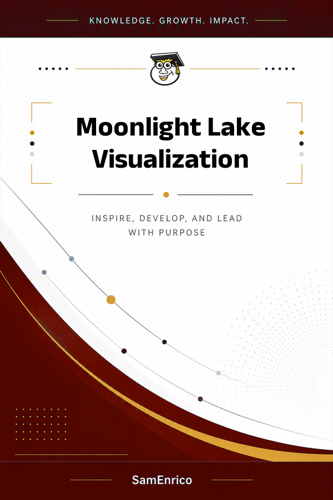
Non-FictionSelf-HelpNight Relaxation
Moonlight Lake Visualization eBook
Float on a still lake under moonlight for deep noc
by Lusk Devon
Float on a still lake under moonlight for deep nocturnal peace.
Formats
Free sample
Chapter 1: The Ancient Alarm System...--You are exhausted. The kind of exhaustion that sits deep in your bones, that makes your eyelids heavy and your limbs feel filled with sand. You have been moving all day—thinking, deciding, responding, worrying, planning, remembering, anticipating. Your body is crying out for rest. Your mind, however, has other plans.The moment your head touches the pillow, something shifts.
The darkness that should signal safety instead triggers a quiet alertness. Your heart beats a little faster. Your thoughts, which were sluggish just moments ago, suddenly sharpen. You find yourself replaying a conversation from three years ago. You remember an email you forgot to send.
You calculate how many hours of sleep you will get if you fall asleep right now—which you won't, because you are thinking about falling asleep, which is the surest way to remain awake.This is the ritual. Night after night. Week after week. You are tired. You are wired.
And you have no idea why your own brain seems to be working against you.Let me tell you a secret: your brain is not broken. It is not defective. It is not secretly trying to torture you.Your brain is doing exactly what evolution designed it to do. And once you understand why, the entire experience of lying awake at night begins to change. Not because the thoughts disappear, but because you stop interpreting them as emergencies.
You start seeing them for what they really are: echoes of an ancient alarm system that has not yet realized you are safe.The Paradox of the Tired Mind Let us begin with the simple fact that confuses so many people: exhaustion and alertness are not opposites. They can coexist. In fact, they often do.Consider what happens when a parent hears their child cry in the middle of the night. They were deeply asleep just seconds ago. Now they are fully alert, heart pounding, moving toward the sound.
The body accomplished something remarkable in that moment: it overrode the need for rest because it detected something that required attention. The exhaustion was still there, somewhere beneath the surface. But the alarm system took precedence.Now consider what happens when you lie down after a stressful day. Your body is exhausted. But your brain, still scanning for threats, has not received the all-clear signal.
The silence of the bedroom, which should be soothing, is interpreted through this ancient lens. And what does silence mean to a brain that evolved on the savanna? It means danger. It means predators are nearby. It means stay alert.You are not a bad sleeper.
You are a good survivor. The problem is that your brain cannot tell the difference between a lion in the grass and an email you regret sending. Both register as threats. Both trigger the same alert system. And both will keep you awake until the system receives the signal it is waiting for: safety.This is the paradox of the tired mind.
You are exhausted because you have been alert all day. You are alert because your brain still thinks it needs to protect you. And the more you try to force yourself to sleep, the more your brain interprets your effort as evidence that something must be wrong. After all, if everything were fine, why would you be trying so hard?The Evolutionary Roots of Nighttime Wakefulness To understand why your brain behaves this way, we have to go back. Way back.
Not to your childhood, but to the childhood of the human species.Imagine a night on the African savanna, fifty thousand years ago. A small group of people has gathered around a fire. The sun has set. The darkness is almost total. The sounds of the night—crickets, the distant call of a hyena, the rustle of grass in the wind—are the only signals available.
In this environment, the people who slept too deeply were at risk. The people who remained slightly alert, who woke at the slightest unusual sound, were more likely to survive. Their brains passed down this tendency to their children, and to their children's children, all the way to you.Your brain is not designed for a world with electric lights, smartphones, and 24-hour news cycles. It is designed for a world where darkness meant danger and stillness meant vigilance. The wiring has not changed.
The environment has changed dramatically. This mismatch is the source of so much nighttime suffering.Here is what this means for you: when you lie awake at night, your brain is not malfunctioning. It is doing exactly what it was built to do. It is scanning for threats. It is keeping you alive.
The problem is not that your brain is broken. The problem is that it is using outdated criteria to determine what counts as a threat.An email from your boss is not a lion. A mistake you made five years ago is not a predator. A worry about tomorrow is not a physical danger. But your brain, operating with ancient software, cannot tell the difference.
It treats every stressor as a survival threat. And it will keep you awake until it receives the signal that the threat has passed.This is where the reframe begins. You are not broken. You are not a bad sleeper. You have an ancient alarm system that is doing its job a little too well.
And the goal is not to dismantle the alarm system. The goal is to teach it something new: that the quiet of night is not danger. It is sanctuary.The Difference Between Threat and Discomfort One of the most important distinctions you will learn in this book is the difference between a genuine threat and simple discomfort. Your brain does not make this distinction naturally. It has to be taught.A genuine threat is something that can actually harm you.
A fire in your home. A person who means you harm. A physical danger that requires immediate action. Your brain is right to sound the alarm for these things. You want that alarm system to work.Discomfort, on the other hand, is not dangerous.
It is unpleasant. It is unwanted. But it will not hurt you. Lying awake at night is uncomfortable. Feeling anxious is uncomfortable.
Worrying about tomorrow is uncomfortable. None of these things will kill you. None of them require the full activation of your alarm system. But your brain has not learned this distinction yet. It treats discomfort the same way it treats danger.This is why traditional advice like "just relax" or "don't think about it" rarely works.
Your brain does not respond to commands. It responds to evidence. And right now, the evidence it has collected over a lifetime suggests that nighttime alertness is necessary for survival. You cannot simply tell it to stop. You have to show it, through repeated experience, that the quiet of night is safe.That is what this book is for.
The Moonlight Lake Visualization is not a trick. It is not a quick fix. It is a systematic way to provide your brain with the evidence it needs to recalibrate its alarm system. You will…
This is the end of the free sample. Get the eBook to keep going. Buy now
About this book
Details
- Author
- Lusk Devon
- Publisher
- SamEnrico
- Language
- English
- Genre
- Non-Fiction, Self-Help, Night Relaxation
- Released
- 2026-06-06
- Pages (approx.)
- 139
- Available as
- eBook, Audiobook

Read better in the ZLOADR app
Your eBooks on your phone or tablet. Sign in with your SamEnrico account and start reading.
More by Lusk Devon
 Indian Seller Amazon USALusk Devon$11.99
 Hand Levitation InductionLusk Devon$11.99
 The Metta for Test AnxietyLusk Devon$11.99
 Babe Ruth’s British Blitz: The Home Run King’s Secret UK Tour and ScandalLusk Devon$11.99
 Information Systems Security ManagerLusk Devon$11.99
 How to Start a Narrow Gauge Railway (recreational) Business (Beginners Guide)Lusk Devon$11.99
 Pharmacy Shopping GuideLusk Devon$12.99
 Amazon FBA vs Jumia ExpressLusk Devon$12.99
 Understanding Refsum Disease, Infantile FormLusk Devon$17.99
You may also like
 Hong Kong Handover 1997Dunn Johnnie$11.99
 Zumba For Postnatal Recovery CourseNeal Christian$11.99
 Zumba for BeginnersLadner Nikia$11.99
 YouTube Comment Mining GuideHumes Pandora$12.99
 Worry Box MeditationCarlin Rudy$11.99
 Workplace Stress MeditationNguyen Lynn$11.99
 Workplace Stress and Sleep RepairHawley Ivory$11.99
 Workplace Perfectionism CureDelaney Jeffry$11.99
 Workplace Injustice Anger GuideWallen Isabelle$11.99
 Work Addiction and Burnout LinkGreenwood Ester$11.99
 Women in Yoga and WellnessBeattie Galina$11.99
 Women in Stand Up ComedyChun Evangeline$11.99