
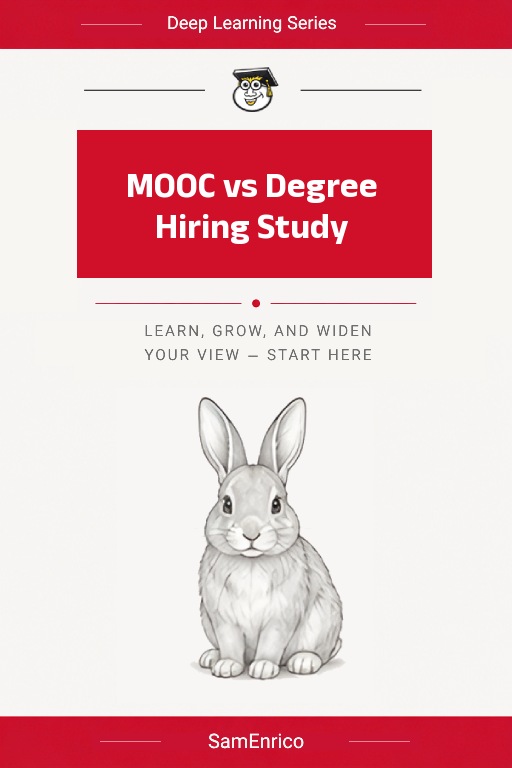
MOOC vs Degree Hiring Study eBook
Compare hiring outcomes for MOOC certificates vers
by Gifford Mary
Compare hiring outcomes for MOOC certificates versus traditional degrees across tech, business, and creative fields.
Formats
Free sample
Chapter 1: The $1.7 Trillion Question--For the past four decades, a single question has shaped the lives of over 200 million people worldwide. It has dictated career trajectories, determined household wealth, influenced marriage decisions, and even affected life expectancy. That question is not "What do you want to do with your life?" It is something far more specific, far more consequential, and far more expensive: Where did you go to college?The answer to that question has historically functioned as a social and economic sorting mechanism more powerful than almost any other variable outside of race and class. A degree from Harvard, Stanford, or MIT opened doors that remained welded shut for graduates of community colleges. A bachelor's degree in any field, from any accredited institution, provided a statistical earnings premium of approximately 84% over a high school diploma—a gap that widened from 40% in 1980 to nearly 100% by 2020.
The degree was not merely a credential; it was a passport. And like any passport, it determined which borders you could cross, which opportunities you could access, and which zip codes you could afford to call home.But something strange began happening around 2012, the year that Stanford professors Andrew Ng and Daphne Koller launched Coursera and Sebastian Thrun launched Udacity. Strange is perhaps the wrong word. Disruptive is better. A fundamental shift began to ripple through the labor market—quietly at first, then with increasing velocity.
Employers who had demanded degrees for decades started dropping those requirements. Google, Apple, IBM, Bank of America, and Accenture all announced that they would no longer require four-year degrees for thousands of positions. At the same time, millions of learners began accumulating alternative credentials: MOOC certificates, nanodegrees, specializations, and micro-credentials that cost a fraction of a traditional degree and could be completed in months rather than years.The result is a labor market caught between two competing realities. The first reality is that a bachelor's degree remains the single most reliable pathway to middle-class stability. The second reality is that the degree's monopoly on signaling job readiness has been fractured—perhaps irreversibly—by the rise of digital credentials that are cheaper, faster, and more directly tied to specific job skills.This book is about the collision of these two realities.
It is not a polemic against higher education, nor is it a cheerleading manifesto for online learning. It is a data-driven investigation into a question that millions of people are asking themselves right now, often late at night, while staring at student loan balances or scrolling through job listings: Did I make the right choice? Should I have gone to college? Should I go now? Or should I spend 400onacertificateinsteadof400 on a certificate instead of 400onacertificateinsteadof40,000 on a degree?The answer, as with most important questions, is not simple.
It depends on who you are, where you live, what field you want to enter, how much experience you already have, and—perhaps most critically—which employer you hope to convince to hire you. This chapter introduces the landscape of that decision, the stakes involved, and the framework that will guide the rest of the book.The Cost of Certainty Let us begin with numbers, because numbers have a way of cutting through ideology. The total outstanding student loan debt in the United States currently stands at approximately 1.7trillion.Thatfigureexceedstotalcreditcarddebtandautoloandebtcombined.Itisdistributedamongroughly43millionborrowers,withanaveragebalanceof1.7 trillion. That figure exceeds total credit card debt and auto loan debt combined. It is distributed among roughly 43 million borrowers, with an average balance of 1.7trillion.Thatfigureexceedstotalcreditcarddebtandautoloandebtcombined.Itisdistributedamongroughly43millionborrowers,withanaveragebalanceof37,000 per borrower.
But averages conceal extremes: approximately 7 million borrowers owe more than 100,000,andapproximately2millionowemorethan100,000, and approximately 2 million owe more than 100,000,andapproximately2millionowemorethan200,000.These numbers represent more than financial statistics. They represent years of delayed homeownership, postponed marriage, reduced retirement savings, and chronic financial anxiety. A 2023 study by the Education Data Initiative found that 63% of student loan borrowers have delayed major life events due to their debt, and 54% report that their mental health has been negatively affected. The degree, once a guaranteed ticket to the middle class, has become for many a financial anchor.But here is the uncomfortable truth that seldom appears in the headlines: despite the debt crisis, the degree still pays off—on average. The Georgetown University Center on Education and the Workforce has documented that bachelor's degree holders earn approximately 2.8millionovertheirlifetimes,comparedto2.8 million over their lifetimes, compared to 2.8millionovertheirlifetimes,comparedto1.6 million for high school graduates.
That million-dollar gap remains substantial enough to justify the investment for the average student, particularly those who graduate from public universities with manageable debt loads.The problem is that averages lie. The million-dollar premium is not distributed evenly across majors, institutions, or graduates. An English major from a private liberal arts college with 150,000indebtmayhaveanegativereturnoninvestment,whileacomputersciencegraduatefromastateuniversitywith150,000 in debt may have a negative return on investment, while a computer science graduate from a state university with 150,000indebtmayhaveanegativereturnoninvestment,whileacomputersciencegraduatefromastateuniversitywith30,000 in debt may have an extraordinarily positive one. The same credential produces vastly different outcomes depending on context.Enter the MOOC certificate. In 2011, the first Massive Open Online Courses emerged as free or low-cost alternatives to traditional education.
By 2024, platforms like Coursera, ed X, and Udacity had enrolled over 200 million learners worldwide and issued tens of millions of certificates. The cost of a typical specialization or professional certificate ranges from 39to39 to 39to99 per month, with most programs requiring three to six months of part-time study. A complete career-focused certificate—such as Google's Data Analytics Professional Certificate or IBM's Full Stack Cloud Developer Certificate—can be completed for under $400.From a purely financial perspective, the comparison seems laughable. A 400certificatethatleadstoajobpaysforitselfindays.A400 certificate that leads to a job pays for itself in days. A 400certificatethatleadstoajobpaysforitselfindays.A120,000 degree that leads to a job takes years to recoup.
But this comparison assumes that the certificate and the degree are competing for the same jobs, with the same employers, under the same conditions. They are not. And understanding the conditions under which each credential thrives is the central project of this book.The Paradox at the Heart of the Debate Before we proceed, we must acknowledge a contradiction that will recur throughout these pages. On one hand, the survey data from learners is overwhelmingly positive. A landmark study by Zhenghao and colleagues (2015) surveyed 52,000 MOOC completers and found that 87% reported career benefits from their coursework.
Of those, 62% reported improved skills for their current job, 26% reported finding a new job, and 9% reported starting a new business. These are not trivial numbers. They represent real people whose lives were changed by a few hundred dollars and a few months of disciplined study.On the other hand, the experimental data from employers tells a more complicated story. In a randomized control trial conducted by Rivas, Baker, and Evans (2020)—a study we will examine in detail in Chapter 3—employers consistently preferred candidates with traditional degrees over candidates with equivalent MOOC certificates. When presented with identical resumes differing only by credential, employers chose the degree holder every time.How can both findings be true?
How can 87% of learners report career benefits while employers simultaneously prefer degree holders? The answer lies in a distinction that is rarely made in public debates about education and hiring: the difference between career benefit and hiring advantage.A career…
This is the end of the free sample. Get the eBook to keep going. Buy now
About this book
Details
- Author
- Gifford Mary
- Publisher
- SamEnrico
- Language
- English
- Genre
- Non-Fiction, Student's Shortcut
- Released
- 2026-05-30
- Pages (approx.)
- 156
- Available as
- eBook, Audiobook

Read better in the ZLOADR app
Your eBooks on your phone or tablet. Sign in with your SamEnrico account and start reading.
More by Gifford Mary
 Mindfulness for College StudentsGifford Mary$11.99
 Customer Service Text AnalyticsGifford Mary$11.99Customer Service Text AnalyticsGifford Mary$11.99
 Teresa's Concept of MortificationGifford Mary$11.99
 Neurodivergent Social ConnectionGifford Mary$11.99
 The Hypnosis Audio File ManagementGifford Mary$11.99
 Operation: Secret Dossier – The 1994 USA World Cup HeistGifford Mary$11.99
 Ambassador Program Pre LaunchGifford Mary$12.99
 Learn to Play the Air HornGifford Mary$11.99
 Artificial Intelligence Systems DevelopmentGifford Mary$11.99
 How to Start a Phosphatic Straight Fertiliser Business (Beginners Guide)Gifford Mary$11.99
You may also like
 Hong Kong Handover 1997Dunn Johnnie$11.99
 Zumba For Postnatal Recovery CourseNeal Christian$11.99
 Zumba for BeginnersLadner Nikia$11.99
 YouTube Comment Mining GuideHumes Pandora$12.99
 Worry Box MeditationCarlin Rudy$11.99
 Workplace Stress MeditationNguyen Lynn$11.99
 Workplace Stress and Sleep RepairHawley Ivory$11.99
 Workplace Perfectionism CureDelaney Jeffry$11.99
 Workplace Injustice Anger GuideWallen Isabelle$11.99
 Work Addiction and Burnout LinkGreenwood Ester$11.99
 Women in Yoga and WellnessBeattie Galina$11.99
 Women in Stand Up ComedyChun Evangeline$11.99