
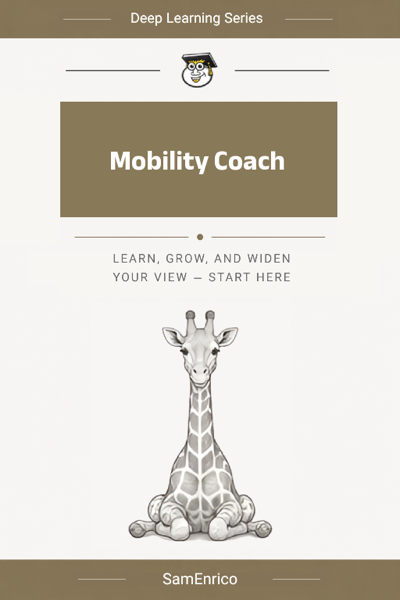
Non-FictionInformativeEducational
Mobility Coach eBook
A Coursebook on Mobility Coach
A Coursebook on Mobility Coach
Formats
Free sample
Chapter 1: The $30 Billion Mistake...--–- You have been lied to about stretching. Not by malicious villains, but by an entire industry built on a misunderstanding of how your body actually works. Every year, people across the world spend more than $30 billion on stretching classes, yoga memberships, foam rollers, massage guns, and flexibility apps. And yet, according to every major long-term study on the subject, chronic back pain rates have not improved in three decades. Knee pain is rising.
Hip replacements are happening earlier. The average office worker still cannot squat to pick up a pencil without grunting.The problem is not your effort. The problem is not your genetics. The problem is not that you are "getting old."The problem is that you have been trying to solve a neurological problem with a mechanical solution.This chapter will dismantle everything you thought you knew about tightness, flexibility, and mobility. By the time you finish reading, you will understand why static stretching has failed you, what your body actually needs to change, and why the next eleven chapters of this book will give you results that years of "just stretch more" never could.The Warm-Up That Changed Everything Let me tell you about a client named Marcus.
Marcus is forty-seven years old, runs a contracting business, and has spent fifteen years believing his lower back was simply "bad." His doctor told him to stretch his hamstrings. His chiropractor told him to do cat-cow stretches. His personal trainer gave him a list of ten static stretches to hold for thirty seconds each.Marcus did all of it. Religiously. Every morning, he spent fifteen minutes on his living room floor, pulling his knees to his chest, twisting his spine, and reaching for his toes.
And every afternoon, around two o'clock, his lower back would seize up again. He accepted this as his fate. Some people just have bad backs, he told himself.When Marcus came to see me, I did not add more stretches to his routine. I did not give him a new foam roller or a fancy mobility app. Instead, I asked him to lie on his back and breathe.
That is it. Just breathe.Within two minutes, his lower back relaxed in a way fifteen years of stretching had never achieved. Within one week, he stopped taking ibuprofen before bed. Within one month, he squatted down to pick up his grandson without thinking about it first.Marcus did not have tight hamstrings. Marcus did not have a weak core.
Marcus had a nervous system that had locked his muscles into a protective splint because it believed his spine was unstable.Stretching those hamstrings was like trying to open a locked door by polishing the hinges. The lock was the nervous system. And no amount of polishing was going to turn that key.The Myth of the "Tight Muscle"Here is the first and most important concept you must understand: muscles do not decide to be tight. They do not have a mind of their own. A muscle cannot wake up one morning and think, "You know what?
I think I will shorten myself permanently for no reason."Muscles respond to commands from your central nervous system—your brain and spinal cord. When you feel "tightness," you are not feeling a muscle that has physically shortened like a dried-up rubber band. You are feeling a muscle that has been instructed by your nervous system to guard, to brace, and to limit motion.Think about what happens when you touch a hot stove. You do not consciously decide to pull your hand away. Your spinal cord processes the danger signal and pulls your hand back before your brain even registers the pain.
That is your nervous system protecting you from injury.Now think about what happens when you have a previous back injury. Your nervous system remembers that injury. It does not forget. And every time you approach the position that once caused pain—even if the tissue has healed completely—your nervous system tightens the muscles around that area to prevent you from going there again.That "tightness" you feel in your lower back? That is your nervous system saying, "I do not trust this position.
I am locking it down."This is called neuromuscular inhibition. It is your body's default safety mechanism. And static stretching does almost nothing to change it.The Science of Why Static Stretching Fails Let us look at the research. A landmark meta-analysis published in the Scandinavian Journal of Medicine & Science in Sports reviewed more than two dozen studies on static stretching and injury prevention. The conclusion?
Static stretching performed before exercise did not reduce injury risk. In some cases, it increased it by temporarily weakening the muscle—a phenomenon called "stretch-induced strength loss."Another study from the Journal of Strength and Conditioning Research found that holding a static stretch for longer than sixty seconds reduced maximal strength output by up to 7.5 percent for up to an hour after stretching. That means if you stretch your hamstrings before a squat workout, you are literally making yourself weaker for the very activity that requires strength to protect your joints.But the deeper problem is this: static stretching does not address the nervous system's protective reflexes. When you hold a stretch for thirty seconds, you are pulling on a muscle that your nervous system is actively trying to shorten. It is a tug-of-war.
And your nervous system always wins.The two primary reflexes at play are the muscle spindle reflex and the Golgi tendon reflex.The muscle spindle is a sensory receptor inside your muscle that detects stretch. When it senses that you are pulling too hard or too fast, it fires a signal back to the muscle saying, "Contract! Resist the stretch!" This is why you feel that intense, burning sensation when you push a stretch too far. That is not "good pain." That is your nervous system actively fighting you.The Golgi tendon organ is a sensory receptor in your tendon that detects tension. If you hold a stretch long enough—usually forty-five to sixty seconds—the Golgi tendon organ will eventually override the muscle spindle and tell the muscle to relax.
This is called autogenic inhibition. It is the physiological basis for why static stretching "works" in the moment.But here is the catch: autogenic inhibition is temporary. Within minutes of releasing the stretch, the muscle spindle resets and the tightness returns. You have not changed the underlying neurological pattern. You have simply bribed the nervous system to take a brief coffee break.A Brief History of How We Got It Wrong To understand why we are so stuck on stretching, we need to look at the history of exercise science.
In the 1970s and 1980s, researchers studying athletes noticed that gymnasts and dancers had exceptional range of motion. These athletes stretched extensively. The conclusion seemed obvious: stretching causes flexibility.But correlation is not causation. Gymnasts and dancers also started training at age five, when their nervous systems were still developing. They performed thousands of repetitions of movement patterns under load.
They engaged in plyometrics, strength training, and proprioceptive drills. Stretching was only one variable among many.Nevertheless, the fitness industry ran…
This is the end of the free sample. Get the eBook to keep going. Buy now
About this book
Details
- Author
- Pullman Herbert
- Publisher
- SamEnrico
- Language
- English
- Genre
- Non-Fiction, Informative, Educational
- Released
- 2026-06-02
- Pages (approx.)
- 144
- Available as
- eBook, Audiobook

Read better in the ZLOADR app
Your eBooks on your phone or tablet. Sign in with your SamEnrico account and start reading.
More by Pullman Herbert
 Hindsight Bias Market GuidePullman Herbert$11.99
 Disability Resentment GuidePullman Herbert$11.99
 Caregiver Stress and TechnologyPullman Herbert$11.99
 Huldra’s Hollow: The Enchantress of the Forbidden ForestPullman Herbert$11.99
 Ultimate Handbook Guide to Chennai : (India) Travel GuidePullman Herbert$11.99
 UNICEF Child Protection CareersPullman Herbert$12.99
 How to Produce AzaleasPullman Herbert$11.99
You may also like
 Hong Kong Handover 1997Dunn Johnnie$11.99
 Zumba For Postnatal Recovery CourseNeal Christian$11.99
 Zumba for BeginnersLadner Nikia$11.99
 YouTube Comment Mining GuideHumes Pandora$12.99
 Worry Box MeditationCarlin Rudy$11.99
 Workplace Stress MeditationNguyen Lynn$11.99
 Workplace Stress and Sleep RepairHawley Ivory$11.99
 Workplace Perfectionism CureDelaney Jeffry$11.99
 Workplace Injustice Anger GuideWallen Isabelle$11.99
 Work Addiction and Burnout LinkGreenwood Ester$11.99
 Women in Yoga and WellnessBeattie Galina$11.99
 Women in Stand Up ComedyChun Evangeline$11.99