
Non-FictionSelf-HelpStrategy Selection
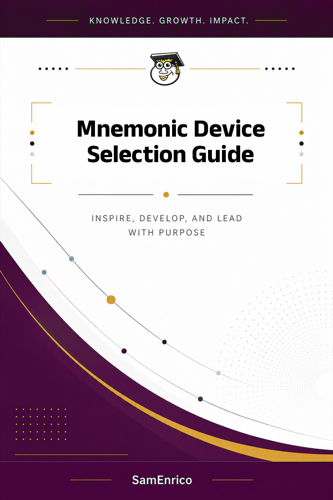
Mnemonic Device Selection Guide eBook
Choose the right method for lists, numbers, speech
Choose the right method for lists, numbers, speeches, or names.
Formats
Free sample
Chapter 1: The $10,000 Name...--I forgot my wife’s name.Not her first name. Not her last name. Her maiden name. The name she had for twenty-six years before she met me. The name her father still calls her.
The name printed on her birth certificate.We were at a dinner party. Someone asked, "So what was your maiden name?" She looked at me. I looked at her. Seven seconds of silence stretched into an eternity. I opened my mouth and said, "It starts with a B?" She smiled the smile that says we will discuss this later.
The table laughed awkwardly. I wanted to disappear.That night, I did what any humiliated husband would do. I went online and searched for "how to remember names." I found dozens of articles, hundreds of tips, and at least fifteen books promising to give me a "perfect memory." I bought three of them. I read them cover to cover. I learned about Memory Palaces, Peg Systems, the Major System, the Dominic System, the Story Method, Chunking, Acronyms, Acrostics, the Keyword Method, Loci, the Journey Method, Roman Rooms, and something called PAO that seemed to require memorizing a hundred characters before it would work for anything.I had never felt so stupid in my life.Not because the techniques were hard.
Most of them were surprisingly simple. The problem was something else entirely. I now knew sixteen different ways to remember things. But standing at a networking event, staring at a new client whose name was already slipping away, I had no idea which of the sixteen to use. Should I build a Memory Palace?
That seemed like overkill for one name. Should I use the Peg System? That required me to remember that 1 = bun, which had nothing to do with the person in front of me. Should I just repeat their name three times and hope for the best? That had never worked before.I had fallen into what I now call the Selection Paradox: the more memory techniques you know, the harder it becomes to choose the right one under real-world pressure.This book is the solution I wish I had found that night.
It is not another collection of memory tricks. The world does not need more tricks. The world needs a decision engine—a simple, repeatable system that tells you, in ten seconds or less, exactly which technique to use for the task in front of you. Grocery list? Here is your method.
Credit card number? Here is a different method. Client's name? A third method. Twenty-minute speech?
A fourth method.By the time you finish this chapter, you will understand why most memory books fail. You will take a three-minute diagnostic that reveals your personal "memory fingerprint"—whether you learn best by seeing, hearing, or doing. And you will learn about the Forgetting Curve, the scientific discovery that explains why almost everything you try to remember vanishes within twenty-four hours unless you use the right tool.Let us begin with a story that explains why you are not broken, why your memory is actually working exactly as evolution designed it, and why the solution is not to try harder but to choose smarter.The Most Expensive Forgetting You Have Ever Done Before we talk about solutions, let us talk about the cost of forgetting.I want you to think about the last time you forgot something that actually mattered. Not the milk. Not the umbrella.
Something that cost you money, embarrassment, or opportunity.Maybe you forgot a prospect's name during a sales call and lost the deal. Research from the Name Memory Institute suggests that forgetting a client's name reduces trust by approximately 40% in the first two minutes of a conversation. That is not a small number. That is the difference between "I feel good about this person" and "I do not trust them."Maybe you forgot a key point during a presentation and lost your train of thought in front of fifty people. According to a 2019 survey of 1,500 professionals, the single greatest fear associated with public speaking is not stage fright—it is forgetting what comes next.
Notecards become a crutch. Teleprompters become a cage. And the moment you look down at your notes, you lose eye contact, you lose rapport, and you look unprepared.Maybe you forgot a password, a PIN, or a credit card number at the worst possible moment. You stood at the checkout counter, phone dead, trying to remember the four digits that would unlock your ability to pay. The line grew behind you.
Your face grew red. You eventually called your spouse, who sighed and said, "It's the same as the garage code," which you had also forgotten.Maybe you forgot something from a conversation with your partner—a birthday, an anniversary, a preference, a promise—and watched their face fall as they realized you had not been paying attention.Forgetting is not a neutral event. Forgetting carries a cost. Sometimes the cost is measured in dollars. Sometimes it is measured in trust.
Sometimes it is measured in the slow erosion of a relationship.Here is the good news: you are not uniquely bad at remembering. Your memory is not "broken." You do not have a "bad memory" any more than you have "bad eyesight" because you cannot see in the dark. Your memory is a tool, and like any tool, it has specific strengths and specific weaknesses. The problem is that most of us have been taught to use a screwdriver when we need a hammer, a hammer when we need a wrench, and a wrench when we need a saw.The solution is not to try harder. The solution is to choose smarter.The Selection Paradox: Why More Techniques Make You Worse Let me introduce you to a concept that will appear throughout this book: the Selection Paradox.The Selection Paradox states that as the number of available techniques increases, the difficulty of selecting the correct technique increases faster than the benefit of having more techniques.In plain English: knowing fifty memory tricks is actually worse than knowing five, unless you also know exactly when to use each one.This is counterintuitive.
We assume that more knowledge is always better. If ten techniques are good, then fifty techniques must be great. But cognitive science tells us otherwise. When you stand in a grocery aisle with thirty seconds to remember your shopping list, your brain does not have time to evaluate sixteen different mnemonic systems. Your brain freezes.
You default to whatever you used last, regardless of whether it was appropriate. Or you give up entirely and pull out your phone.The Selection Paradox explains why traditional memory books have such a poor track record with real-world readers. These books are often excellent dictionaries of techniques. They explain the Major System beautifully. They walk you through building a Memory Palace step by step.
They give you peg lists and rhyming schemes and acronyms for everything from the Great Lakes to the cranial nerves.But they never answer the question that matters most: What do I do right now, in this specific situation?Consider these two scenarios:Scenario A: You are standing in your kitchen. You…
This is the end of the free sample. Get the eBook to keep going. Buy now
About this book
Details
- Author
- Ayala Kanisha
- Publisher
- SamEnrico
- Language
- English
- Genre
- Non-Fiction, Self-Help, Strategy Selection
- Released
- 2026-06-10
- Pages (approx.)
- 148
- Available as
- eBook, Audiobook

Read better in the ZLOADR app
Your eBooks on your phone or tablet. Sign in with your SamEnrico account and start reading.
More by Ayala Kanisha
 Military Morning DisciplineAyala Kanisha$11.99
 Vacation Disconnect GuideAyala Kanisha$11.99
 Burnout and Workload TriageAyala Kanisha$11.99
 ACT Emotional FlexibilityAyala Kanisha$11.99
 HIIT Progress Tracker LogAyala Kanisha$11.99
 Jumia Payment Settlement GuideAyala Kanisha$12.99
 Silver Sulfadiazine GuideAyala Kanisha$11.99
 Persuasion For Real Estate AgentsAyala Kanisha$11.99
 Red Tails Over Berlin: The Tuskegee Airmen's Secret Mission in World War IIAyala Kanisha$11.99
 The Siege of Amida: Rome's Forgotten Last StandAyala Kanisha$11.99
 How to Produce Sauté PansAyala Kanisha$11.99
 Cocker Spaniel: Sweet & SoftAyala Kanisha$11.99
You may also like
 Hong Kong Handover 1997Dunn Johnnie$11.99
 Zumba For Postnatal Recovery CourseNeal Christian$11.99
 Zumba for BeginnersLadner Nikia$11.99
 YouTube Comment Mining GuideHumes Pandora$12.99
 Worry Box MeditationCarlin Rudy$11.99
 Workplace Stress MeditationNguyen Lynn$11.99
 Workplace Stress and Sleep RepairHawley Ivory$11.99
 Workplace Perfectionism CureDelaney Jeffry$11.99
 Workplace Injustice Anger GuideWallen Isabelle$11.99
 Work Addiction and Burnout LinkGreenwood Ester$11.99
 Women in Yoga and WellnessBeattie Galina$11.99
 Women in Stand Up ComedyChun Evangeline$11.99